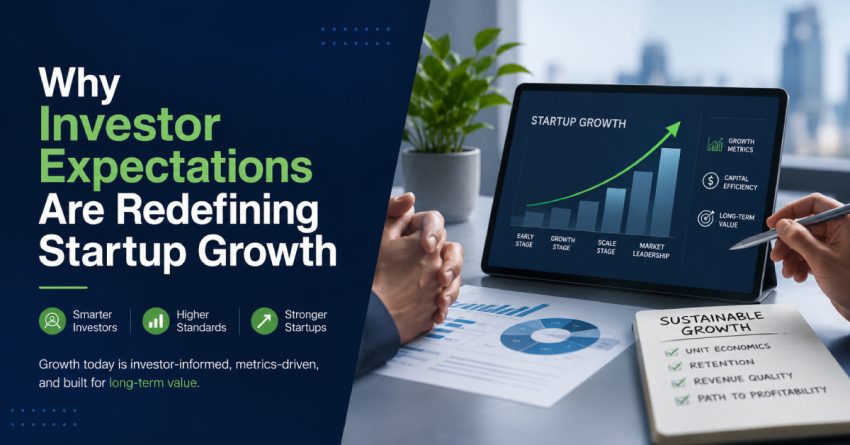
Over the last 10 years, the startup scene has undergone a dramatic transformation. Earlier, investors primarily focused on innovative ideas and rapid growth, and the willingness to offer capital to new companies. These days, however, the expectations of investors have changed dramatically. However, modern investors seek more than just growth; they seek growth in a sustainable, stable, and valuable business. This has given rise to a significant change in the overall landscape of support for startups as well.
Today’s startup environment is far more competitive and uncertain. The economic climate, shifting buyer behavior, technological and market saturation, have made investors more hesitant in their decision-making process. With this change, support for startups is now not only looking for investment, but also for developing better foundations for their long-term success.
Investors Now Prioritize Sustainable Growth
One of the biggest changes in the startup ecosystem is the growing preference for sustainable business models. In years gone by, start-ups were frequently urged to focus on rapid growth – at least in the short term – even if profitability was postponed. Nowadays, investors are focused on financial discipline, real growth plans and operational efficiency.
This change has truly transformed how support is being provided to entrepreneurs. The focus is not just on speedy scaling but also on guiding businesses towards optimizing costs, creating revenue-generating strategies, and focusing on the long-term planning aspect. Initial scale-ups are increasingly required to show stability, customer retention, and good financial stewardship before receiving significant funding support.
The Rise of Strategic Mentorship
Modern investors are increasingly getting involved in the operations of the business rather than simply providing capital. The investors show enthusiasm as partners and even go ahead with sharing their industry expertise, business networks, and market insights.
Essentially, there has been a shift in approach over time and investors look to shape up the entire business with not just funding but mentorship. New startups can be mentored in skills like building leadership, growing business, operational management, branding, and technology. Investors acknowledge the fact that early-stage companies seek assistance and effective decision making to thrive in competitive market.
Hence, mentorship-based framework gives founders a valuable opportunity to gain insights from seasoned experts who have gained hold on the intricacies of a certain industry, its market and growth strategies.
Greater Focus on Governance and Transparency
Investor expectations on the governance of businesses have also tightened. These days, transparency, accountability, and ethical business conduct are a must for the growth of startups. Investors now expect that startups have appropriate accounting, reporting, and compliance practices and processes from the outset.
Therefore, provisions for startups extend to more attention to legal advisory, compliance management, financial audits and risk assessment practices. Confidence of investors in businesses can be gained if they are professional and have structured business operations.
This shift has made startups more inclined to take the time to develop internal systems instead of just growing quickly enough to catch up.
Technology and Data Are Driving Investor Decisions
Data is essential to investors before they invest these days. Metrics that help assess the potential of a startup include those focusing on customer acquisition, retention, operational efficiency, and market trends.
This has been an impactful factor on the type of support provided to startups in various industries. The startup segment now has a upbeat enthusiasm for investors to invest in startups that use cutting-edge technology, digital monitoring systems, automation, and analytics tools to enhance the visibility of operations and decision-making. Businesses that make the maximum use of the data to get a better handle on customer behavior and business performance tend to have a competitive edge.
The need for a long-term vision
The preference for founders who are visionary and flexible is growing, as well. Investors have come to the realization that markets and support for startups can shift dramatically, and companies need to be able to adapt.
It has fortified the relationship between investors and startups to stronger strategic partnership for a long-term approach. Investors are looking for companies that are growing responsibly, adapting to the evolving industries and gaining long-term customer trust. Rather than hype, there is more focus on resilience, innovation and business strategies.
Conclusion
The startup ecosystem is changing in many aspects driven by investor expectations. Today’s investors don’t just consider fast growth and market expansion. They have now become looking for sustainable business models, transparency in operation, solid leadership and value creation over the long term. Consequently, the types of support for start-ups have shifted from a narrow focus on funding to a more complex approach, incorporating the support in the form of mentoring, governance advisory, technology adoption, and strategic planning. In today’s business landscape, it is more critical than ever that startups establish a solid and responsible foundation to achieve success.
FAQs
Q1: Why do investors now focus on sustainable growth instead of fast scaling?
Economic uncertainty, shifting buyer behavior, and market saturation have made investors more cautious. They now expect startups to demonstrate customer retention, cost optimization, and financial stability before receiving significant funding.
Q2: How does investor mentorship help startups grow?
Strategic mentorship is when investors go beyond providing capital and actively share their industry expertise, business networks, and market insights. This helps startup founders develop leadership skills, operational management, branding strategies, and technology adoption — giving them a stronger foundation for growth.
Q3: How are technology and data influencing investor decisions for startups?
Investors rely on data metrics like customer acquisition, retention rates, and operational efficiency to assess a startup’s potential. Startups that use digital monitoring systems, automation, and analytics tools to drive decision-making have a clear competitive advantage in attracting investment.
Q4: What kind of support do startups need beyond just funding?
Today’s startups need a comprehensive support system that includes mentorship, governance advisory, compliance management, technology adoption guidance, and strategic planning — not just capital injection.
Q5: What qualities do modern investors look for in startup founders?
Investors prefer founders who are visionary, adaptable, and focused on long-term resilience. They value leaders who can navigate changing markets, build customer trust over time, and grow their business responsibly rather than chasing short-term hype.
Also Read: How Incubators and Accelerators Support Startup Growth