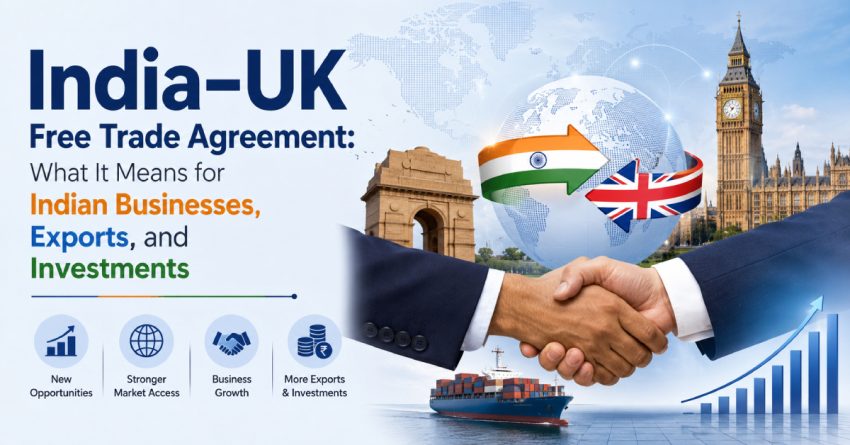
A New Chapter in India–UK Economic Relations
The India–UK Free Trade Agreement (FTA) marks a significant milestone in strengthening economic ties between India and the United Kingdom. By reducing trade barriers, improving market access, and encouraging greater investment and business collaboration, the agreement is expected to create new opportunities for businesses, exporters, investors, and service providers. For Indian businesses, it presents an opportunity to expand into the UK market, diversify export opportunities, attract investment, and enhance global competitiveness.
Advantages for Indian Exporters Under the Agreement
One of the major advantages of the India–UK Free Trade Agreement is better access to the UK market. A large number of Indian goods will get reduced or zero tariffs, thus becoming cheaper for their British consumers.
Exporting industries that will be most affected positively include the following:
Textiles and Clothing
Indian textile producers will be able to compete against foreign producers owing to reduced import tariffs.
Engineering Goods
India’s engineering products have been known to be one of its strong exporting products, and easier market access will help in the increase of their consumption.
Gems, Jewelry, and Leather
Labour-intensive industries like gems and jewelry and leather will experience an upsurge in exports thanks to reduced tariffs.
More Investment Opportunities
Moreover, the deal is likely to foster higher foreign direct investments (FDIs) for India and the UK, since investors favor economies with sound trade policy and a stable business environment.
With better economic relations, Britain’s firms can increase their manufacturing, technological, financial, renewable, and infrastructural investments in India. Conversely, India-based firms seeking to enter the UK market can find a conducive environment.
stimulate innovations, and build lasting business relationships.
A Major Boost for India’s Services Sector
India’s internationally renowned services industry is set to reap huge benefits. Information Technology firms, consulting firms, financial service providers, lawyers, and engineers can take advantage of better market access and greater business mobility.
While the agreement does not create any new immigration channels, it makes it easier for various professionals to conduct short-term business visits abroad.
MSME and Startup Opportunities
It is often very difficult for MSMEs to enter international markets owing to high costs and stringent regulations. However, the India-UK Free Trade Agreement will provide a better setting since the trade restrictions would be reduced along with greater access to international markets.
Start-ups in India can also take advantage of the agreement to forge collaborations in the fields of technology, research, digital, health, education, and innovative business areas. With the changing dynamics of global supply chains, small companies could find completely new avenues for exports.
Preparing for the Future
Although the agreement opens up new opportunities, there is need for strategic preparation for businesses. The business needs to assess product quality, international standards, UK regulation, and improve their supply chain to take advantage of the agreement.
Digital transformation, sustainability, product certification, and market research will be critical for Indian companies to compete effectively.
Conclusion
The India–UK Free Trade Agreement marks a turning point in the trading and investing scenario of India. The lowering of tariffs, better market access, promotion of bilateral investments, and cooperation in the services sector makes way for many new opportunities for businesses big and small. Those companies that are capable of adapting themselves to the market changes and global benchmarks will find the most scope in this historical economic alliance.
Frequently Asked Question
Q: What is the India–UK Free Trade Agreement?
The India–UK Free Trade Agreement is a bilateral trade arrangement designed to improve market access, reduce trade barriers, and encourage stronger business, investment, and services ties between India and the United Kingdom.
Q: Can MSMEs benefit from the India–UK FTA?
Yes. MSMEs may gain better access to an international market, new distribution opportunities, and potential collaborations with UK businesses. However, they must meet product-quality, certification, and compliance requirements.
Q: How can the FTA support Indian startups?
Startups may explore partnerships, technology collaborations, research opportunities, and market expansion in areas such as digital services, healthcare, education, clean technology, and innovation-led businesses.
Q: What should Indian businesses check before exporting to the UK?
Businesses should assess product eligibility, rules of origin, UK import regulations, quality standards, certifications, labelling, pricing, logistics, tax implications, and market demand.
Q: Can CAC help MSMEs assess their readiness for the UK market?
Yes. CAC can help MSMEs review their business model, product readiness, documentation processes, operational capabilities, and key compliance considerations before exploring UK expansion.