As businesses continue to expand into new markets, they need strategies that balance speed, operational control, and risk management. The Build-Operate-Transfer (BOT) model has emerged as a preferred approach for global companies seeking to establish operations efficiently while retaining long-term ownership. By enabling businesses to build, operate, and eventually take full control of their operations, the BOT model supports sustainable expansion with reduced execution risk.
What Is the Build Operate Transfer Concept?
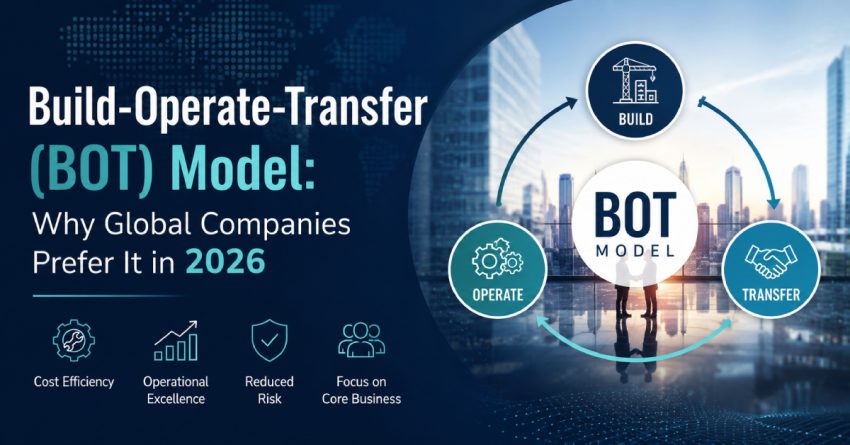
The build operate transfer concept is a business model under which a special service provider operates a specific operation for a client organization. The ownership rights of the operation are transferred to the client when specific requirements for performance and stability are met.
The Three Stages
Build Stage
At this stage, the partner:
- Constructs the needed infrastructure.
- Hires competent personnel.
- Introduces technology and process improvements.
- Adheres to local rules.
Operate Stage
The partner runs the operation by:
- Supervising the operation.
- Tutoring workers.
- Evaluating performance indicators.
- Increasing productivity.
Transfer Stage
After operating successfully, the client takes full ownership of:
- The manpower.
- The infrastructure.
- The operation processes.
- The management functions.
Reasons Why Global Companies Favor BOT in 2026
Quick Market Entry
Entering an unfamiliar market independently takes some time. The BOT framework enables fast market access because the partners have prior knowledge about the hiring process, legal requirements, and operations.
Reduced Risks
Any company looking to expand internationally will face uncertainties regarding compliance, recruitment, and operational efficiency. Through build operate transfer model, organizations will be able to reduce these risks and gain confidence.
Easy Access to Talents
Organizations will be able to assemble a skilled team fast, without having to spend months exploring the talent pool. The approach works well in tech, engineering, finance, healthcare, and customer service industries.
Optimized Costs
By using build operate transfer model, organizations can save on all the startup costs involved in expanding to a new geographical region.
Strategic Advantages beyond Cost Reduction
Increased Control of Operations
Unlike regular outsourcing, the BOT model ultimately allows organizations to gain full ownership of their operations, ensuring higher alignment with organizational goals and growth strategies.
Better Knowledge Transfer
During the operation stage, the organization’s leadership will learn more about how business is conducted locally, including management and operations, before gaining full ownership.
Business Continuity
With an organized transfer process, there is no risk of business disruptions during the transfer of ownership.
Industries Driving BOT Adoption
Many industries have come to realize that adopting the build operate transfer model makes sense for their operations because of such factors as:
- IT
- SW development
- Business process services
- Engineering and manufacturing
- Healthcare support services
- Financial operations
- R&D
Conclusion
With firms continuously expanding worldwide in 2026, flexibility, rapidity, and sustainability have become very important business priorities. One way through which these objectives can be achieved is through the implementation of the Build-Operate-Transfer method. With the combination of effective operational management and a phased process of taking ownership, firms can effectively enter into international markets and develop highly efficient teams. For firms that are interested in sustainable growth across the globe but do not want to compromise their independence in the future, this business strategy is among the most practical.
Frequently Asked Question
Q: What is the Build-Operate-Transfer (BOT) model?
The BOT model is a business expansion approach in which a specialist partner builds an operation, manages it for an agreed period, and then transfers ownership, people, processes, and infrastructure to the client.
Q: How does the BOT model work?
It works in three phases: build the required team and infrastructure, operate the function while stabilising performance, and transfer the established operation to the company when it is ready.
Q: How can CAC support a Build-Operate-Transfer strategy?
CAC can help organisations assess BOT feasibility, define the operating model, support process and governance design, identify risks, and create a structured roadmap for a smooth transition to ownership.
Q: Which industries can benefit from the BOT model?
BOT is commonly used in IT and software development, business process services, engineering, manufacturing, finance, healthcare support, research and development, and customer-service operations.
Q: What is included in the build phase of a BOT model?
The build phase may include setting up infrastructure, recruiting employees, establishing technology systems, designing processes, and addressing local legal and compliance requirements.
Also Read: Build-Operate-Transfer (BOT) Model: How It Works & Why It Matters