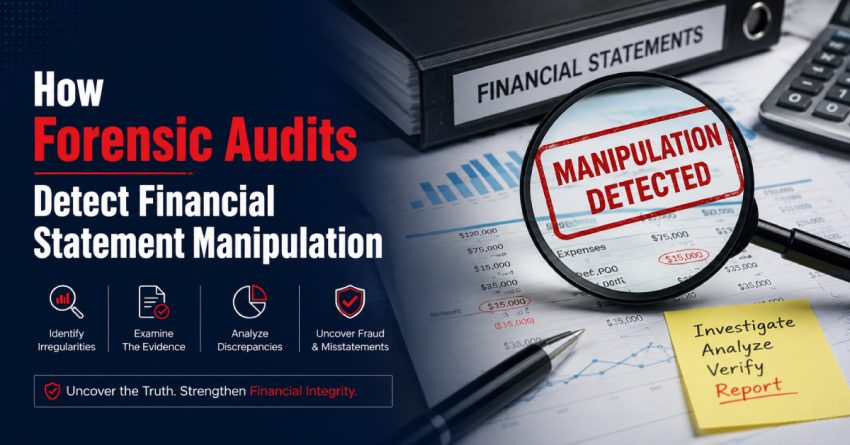
Financial statements are an essential tool for investors, lenders, regulators, and others to analyze financial situation of a company. They provide an overall insight into an organization’s financial well-being and performance. It allows better decision making by the stakeholders. Sometimes these financial statements are intentionally falsified, and the complexities can be serious. Because of this manipulation, investors can make assumptions and it can harm company’s reputation. This is where Forensic Audit comes in play to investigate these irregularities.
What is Financial Statement Manipulation?
A financial statement manipulation is a type of fraud in which the financial statements are intentionally misrepresented to create a positive financial image for the organization. This could include an overstatement of revenues, understatement of expenses, disguised liabilities, or inflated asset values.
They can be for a variety of reasons. The objective of the companies could be to please the investors or to obtain funding, to maintain stock prices, or to earn performance-based incentives. Whatever the cause, when there is poor financial reporting, trust is lost and this can have a long-term impact on the organization.
Role of Forensic Audit
Forensic Audit is a particular investigation of finance records to determine fraud or misbehavior or financial irregularities. A forensic audit is not just a financial statement examination; it delves deeper into finding evidence of intentional deception and collecting that can be utilized in any legal action.
Forensic auditors use investigative techniques and financial analysis and data examinations to uncover signs of manipulation and how fraudulent activities may have taken place.
Recognizing Unusual Financial Patterns
Analysis of unusual financial patterns and trends is one of the keyways to detect financial statement manipulation by forensic audit. Financial information is carefully examined over several periods to look for discrepancies which could be due to fraudulent reporting.
For instance, if a company suddenly sees a sharp increase in revenue without any corresponding growth in business, or has unexplained decreases in expenses, or huge changes in important financial ratios, it can indicate that the financial data is being manipulated. Anomalies can be used to draw the auditor’s attention to the areas of concern when they are investigating the account.
Examining Supporting Documentation
Any figures in financial statements must be backed by documentation. In a Forensic Audit, the auditors look at the invoices, contracts, bank statements, purchase orders and the other records to determine if reported transactions are legitimate.
This in-depth review can reveal fictitious sales, unauthorized transactions, double bookings or hidden liabilities.
Leveraging Technology and Data Analytics
Forensic audits are also conducted with technology and data analysis tools. These help auditors to review large amounts of financial information.
Data analytics are used to detect unusual transactions, duplicate payments, and suspicious journal entries to prove manipulation. Auditors also use technology to spot trends that are not apparent in traditional auditing. It makes the investigation more effective.
Strengthening Corporate Transparency
Corporate governance, transparency, and fraud identification can be enhanced by Forensic Audit. It is used to pinpoint deficiencies in internal control and plan to stop future manipulation.
Businesses can lower fraud risks and give more confidence to stakeholders by filling the gaps and enhancing reporting procedures.
Conclusion
Manipulation of financial statements is a major risk to business and investors. A Forensic Audit is a critical document that can identify any hidden irregularities, confirm financial data and provide evidence of any fraudulent activities. A Forensic Audit offers complete analysis and documentation, data analytics, and more to uncover manipulation, enhance transparency, and ensure integrity of financial reporting. As the financial frauds are rising, the demand for forensic auditing increased for businesses.
Frequently Asked Questions
Also Read: Benefits of Using Forensic Accounting Software Tools for Internal Audits