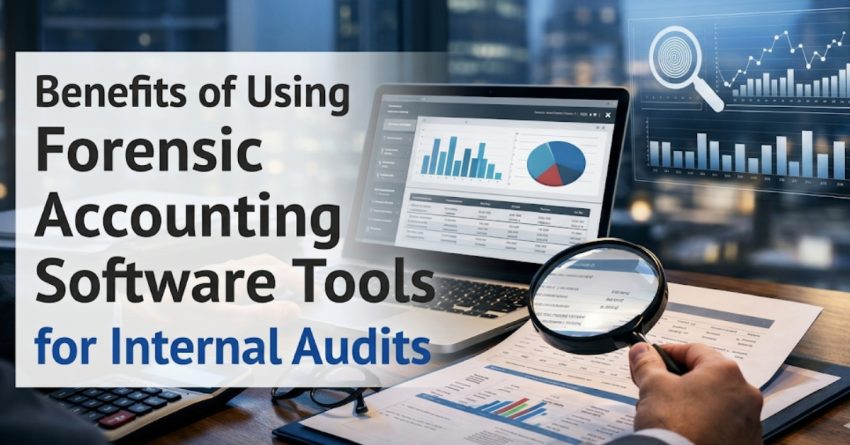
In today’s complex financial environment, organizations face increasing risks of fraud, data manipulation, and regulatory non-compliance. Internal audits play a critical role in identifying these risks and ensuring financial transparency. With the rise of advanced technology, forensic accounting software tools have become essential for enhancing the efficiency and accuracy of internal audit processes.
Improved Fraud Detection Capabilities
One of the primary benefits of using forensic accounting software tools is their ability to detect fraud more effectively. These tools use advanced algorithms and data analytics to identify unusual patterns, suspicious transactions, and inconsistencies in financial records. Unlike manual auditing, which can be time-consuming and prone to human error, these tools can quickly scan large volumes of data and flag potential issues for further investigation.
This proactive approach helps organizations prevent financial losses and maintain stronger internal controls.
Enhanced Data Analysis and Accuracy
Internal audits usually entail processing huge volumes of data, and this may be hectic without the appropriate tools. This is made easier with the use of forensic accounting software which automates data collection, organization and analysis. They also present clear understanding of dashboards, visualization and reports to auditors.
These tools also eliminate errors thus giving more accurate findings in the audit because of a reduced number of manual interventions. It results in decision-making and better financial reporting.
Time and Cost Efficiency
Conventional auditing procedures consume a lot of time and resources particularly when there are complicated financial systems. Forensic accounting computer programs make the audit procedure to be faster and easier because they automate repetitive procedures like data matching, reconciliation, and report generation.
Consequently, the audit teams can finish their work at a quicker pace and concentrate on activities that are of high value such as risk assessment and strategic planning. This does not only minimize the cost of operation but also enhances productivity.
Strengthened Compliance and Risk Management
Organizational compliance with regulations is a significant issue in all businesses. The consequences of not being able to adhere to the financial regulations might be penalties and legal action as well as damage to the reputation. FAS software programs assist in ensuring compliance through keeping elaborate audit trails and records.
Such tools will also help in curbing future risks before they become serious and therefore organizations can take appropriate corrective action. This improves the general risk management system and improves organizational strength.
Better Transparency and Reporting
One of the objectives of internal audits is transparency. Auditors can use forensic accounting software tools to create detailed and simple to understand reports. These reports present the stakeholders with clear information on financial activities, risks and measures control.
Increased transparency is known to establish trust in the organization but also create credibility among the external stakeholders such as investors and regulators.
Conclusion
With the increase in the complexity of financial systems, the need to have more advanced auditing solutions is associated, forensic accounting software tools are becoming an effective means of optimizing internal audits, through the enhancement of fraud detection, accuracy, efficiency, and compliance.
The adoption of such tools in organizations is more likely to help them to protect their financial integrity, mitigate risks, and make sound decisions. Finding appropriate technology can be the difference between excellent audit qualities in an age where information-driven decisions are essential.