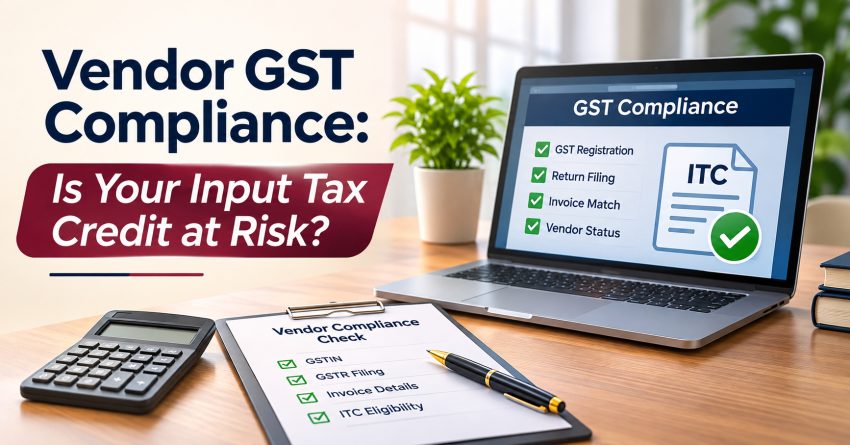
Input Tax Credit (ITC) plays an important role in managing a business’s GST liability. It allows eligible businesses to claim credit for GST paid on purchases and use it against their output tax liability, subject to prescribed conditions. However, claiming ITC involves more than receiving an invoice and recording a transaction. Vendor reporting and compliance can affect the availability and eligibility of the credit claimed by the buyer.
This makes vendor compliance an important part of GST risk management. Without proper monitoring, businesses may face ITC mismatches, reversals, additional tax liabilities and compliance complications. A structured GST compliance review can help identify potential gaps and support timely corrective action.
How Can Vendor Non-Compliance Affect Your Input Tax Credit?
Even when a business has received goods or services and paid the applicable GST to its supplier, claiming ITC requires compliance with prescribed GST conditions. The supplier must report the relevant invoice details in their GST returns, and the recipient must ensure that the credit is eligible under applicable provisions.
Some common vendor-related issues that can put ITC at risk include:
- Delayed or Incorrect GST Return Filing: If vendors delay filing GSTR-1 or report invoice details incorrectly, the relevant invoices may not appear correctly in the recipient’s GSTR-2B, affecting ITC reconciliation and eligibility.
- Incorrect Invoice Details: Errors in GSTIN, invoice numbers, taxable values or tax amounts can create mismatches in GST records.
- Supplier’s Failure to Pay Tax: Where a supplier collects GST but fails to pay it to the government, the recipient may face ITC-related risks under the applicable GST provisions. Such cases should be examined based on the transaction details and relevant legal requirements.
- Inactive or Cancelled GST Registration: Transactions with vendors whose GST registrations have been cancelled or are otherwise invalid can require closer examination.
- Ineligible ITC Claims: Credits claimed without meeting the applicable conditions may need to be reversed, along with interest wherever applicable.
Why Regular Vendor GST Compliance Monitoring Matters
Businesses often work with multiple suppliers across different locations and product categories. Tracking the GST compliance status of every vendor can become difficult without a systematic process.
Regular reconciliation of purchase registers with GSTR-2B is an important step in identifying discrepancies. It helps businesses understand which invoices have been reported, where differences exist and which vendors require follow-up.
Maintaining proper documentation is equally important. Purchase invoices, payment records, delivery documents and communication with vendors can support the verification of transactions during an assessment or GST audit.
Businesses should also consider reviewing vendor GST registration details periodically rather than relying entirely on information collected when a supplier was initially onboarded.
How Can a GST Audit Help Identify ITC Risks?
A GST audit provides an opportunity to examine whether the organisation’s tax records, transactions and compliance processes are aligned with applicable GST requirements. It can help identify gaps that routine accounting reviews may overlook.
A structured GST audit may include:
- Reviewing purchase registers and reconciling them with GSTR-2B.
- Identifying discrepancies in vendor-reported invoices.
- Checking the eligibility of ITC claims under GST provisions.
- Examining credit reversals and related documentation.
- Reviewing vendor compliance and transaction records.
- Assessing whether corrective actions are required.
These checks can help businesses identify potential exposure, improve internal controls and establish a more reliable vendor verification process.
Make Vendor Compliance Part of Your GST Strategy
Input Tax Credit management should not begin only when a GST notice or audit requirement arises. Businesses need a continuous approach that combines vendor verification, invoice reconciliation, proper documentation and periodic compliance reviews.
Regular monitoring can help organisations identify potential ITC risks early, address discrepancies and reduce avoidable compliance issues. Vendor GST compliance is therefore not just the supplier’s responsibility; it is also an important part of protecting your business’s tax position.
Concerned About Your Vendor GST Compliance?
CAC can help your business review vendor compliance, identify ITC discrepancies and strengthen GST processes. Contact our team to discuss your requirements.
Contact CAC for professional assistance with GST compliance.
FAQs
Q: How does vendor GST compliance affect Input Tax Credit?
Vendor reporting and tax compliance can affect a buyer’s ITC eligibility. Missing invoices, incorrect GST details and non-payment of tax can create credit-related risks.
Q: Is a GST invoice alone sufficient to claim Input Tax Credit?
No. A valid invoice is one requirement; receipt of goods or services, supplier reporting and other applicable GST conditions must also be satisfied.
Q: How often should businesses review vendor GST compliance?
A monthly review aligned with return preparation helps identify missing invoices and discrepancies early. High-risk vendors may need additional monitoring.
Q: What should businesses in Delhi include in a vendor GST compliance review?
Businesses in Delhi should review vendor registration, invoice accuracy, purchase-to-GSTR-2B reconciliation, ITC eligibility and supporting transaction records.
Q: How can I request a vendor GST compliance review in Delhi NCR?
Contact CAC with your GST registrations, purchase volume and reconciliation concerns to discuss the scope of a vendor compliance and ITC review.