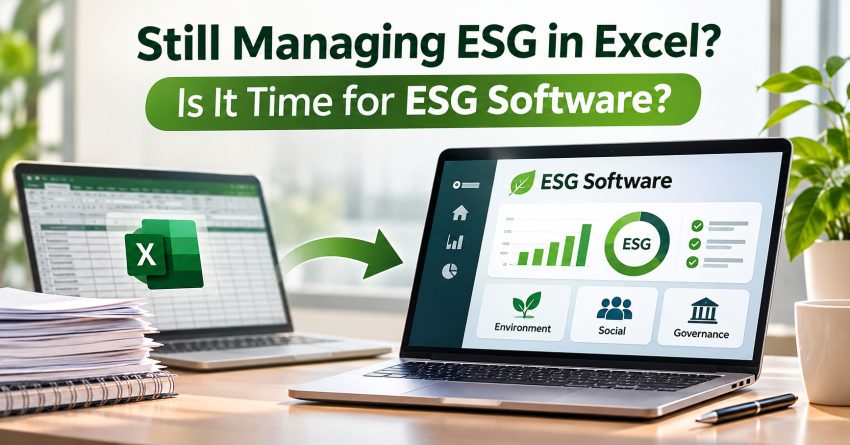
Environmental, Social and Governance (ESG) reporting involves collecting, verifying, and presenting data from across an organisation. This may include energy consumption, carbon emissions, employee well-being, and governance practices. While Excel can be useful for basic ESG data management, reporting becomes more challenging as data volumes grow and multiple departments or locations are involved. ESG reporting software offers a more structured way to manage sustainability data, monitor performance, and prepare reports.
Where Does Excel Go Wrong in ESG Reporting?
Spreadsheets can serve a good purpose for calculations and information management. Nevertheless, as the scope of ESG reporting becomes wider and includes many departments, locations and suppliers, it becomes more difficult to maintain accuracy and consistency.
The most common challenges of spreadsheet-based ESG reporting include:
- Scattered information, as ESG data may be distributed in different files in different departments.
- Human errors due to manual data entry and changes in formulas.
- Poor traceability of the process, which makes it difficult to track who entered, reviewed and edited data.
- Time-consuming reporting: Teams spend considerable time validating figures, consolidating data, and preparing reports.
These limitations do not make Excel unsuitable for every business. However, they can indicate when a more structured reporting system is needed.
How Can ESG Reporting Software Help?
ESG reporting software is a unified tool that allows gathering, organizing and analyzing sustainability-related data. In accordance with its features, it could have several advantages that facilitate the process of reporting.
Centralised ESG Data Collection
It becomes possible to collect data from all departments in one place, thus, companies can keep consistent data regarding the use of energy, water consumption, waste management, staff diversity and other factors.
Automated data collection and system integrations can also reduce manual work and save time.
Enhanced Data Quality and Responsibility
Such software solutions usually offer features like validation rules, approvals, audit trails that enable teams to find missing data, analyze inconsistencies and monitor changes to the data provided.
Additionally, enhanced visibility of the ownership of data will allow establishing responsibility within departments.
Easier ESG Reporting
Sustainability reporting may be performed based on various frameworks and internal requirements. Reporting tools could contain reporting templates, dashboards and data mapping.
Businesses must still verify the accuracy of their reports and ensure that the software supports their applicable reporting frameworks and disclosure requirements.
Improved ESG Performance Tracking
Beyond reporting, software solutions could also help businesses in tracking the progress in achieving their ESG objectives. Any changes in the company’s emissions, resource consumption, and staff-related figures could be highlighted on dashboards, thereby helping the management realize where improvements need to be made.
This helps management use ESG data to identify improvement opportunities and monitor progress towards sustainability targets.
When Should a Firm Think about Changing its Reporting Approach?
Switching from the use of spreadsheets may be considered in case reporting is done by several departments, updates occur frequently, there are multiple locations, or increased disclosure is required.
Before adopting a certain platform, the firm should evaluate its capabilities regarding reporting, integrations, security, scalability and cost. Moreover, it should check if a solution will be compatible with current processes without complicating them.
A phased implementation could be adopted during the process of implementing the tool.
Conclusion
Excel can be useful for managing ESG data, but it may become difficult to maintain consistency and traceability as reporting requirements grow. ESG reporting software can help businesses centralise data, improve oversight, and monitor sustainability performance. The right solution depends on the organisation’s reporting needs, available resources, and future plans. By choosing a suitable platform, businesses can spend less time consolidating information and more time using ESG insights to guide decisions.
FAQs
Q: What are the main disadvantages of using Excel for ESG data management?
Common limitations include manual errors, scattered data, inconsistent reporting, poor traceability, and time-consuming data validation.
Q: How does ESG software help companies track carbon emissions and sustainability goals?
ESG software can track emissions, resource consumption, and sustainability metrics through dashboards, helping companies monitor progress against targets.
Q: Is ESG reporting software suitable for small and medium-sized businesses?
Yes, businesses of different sizes can use ESG software when reporting complexity, data volumes, and costs justify adoption.