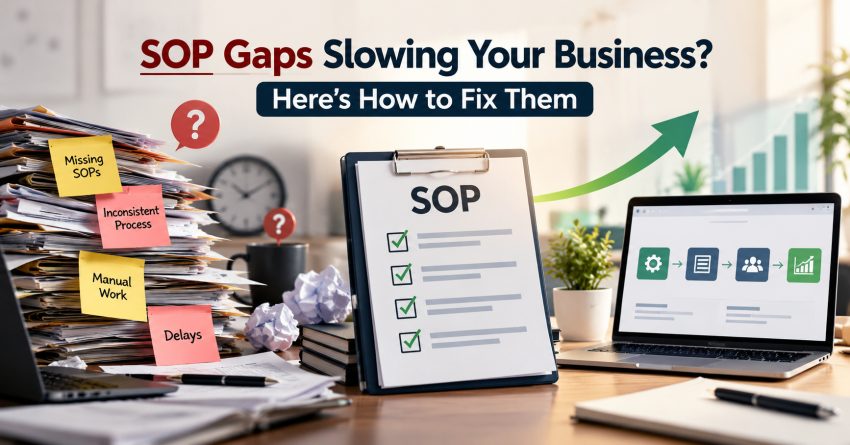
Standard Operating Procedures (SOPs) help businesses maintain smooth operations, ensure consistency, and provide clear guidance to employees. However, inaccurate instructions, unclear responsibilities, and missing process information can lead to delays and confusion. Effective SOP management helps organisations identify these gaps, clarify procedures, and provide employees with practical guidance to complete their work efficiently.
Identify Areas Where SOP Gaps Exist
SOP gaps can grow over time due to changes in responsibilities, new systems, or growth. A process that was successful in the past might not be relevant to how work is now accomplished.
The first step for businesses is to look at:
- Tasks that frequently require clarification from employees
- Work that depends heavily on individual experience or knowledge
- Activities where errors or recurring mistakes occur
- Processes that have not been reviewed for a long time
- Differences in how various teams perform the same task
This review helps businesses identify and prioritise the SOPs that need immediate attention.
Remove Unnecessary Complexity
An SOP should simplify a process, not complicate it. Employees are less likely to use them effectively when they are long documents, instructions are not clear, or there are unnecessary approval steps.
By streamlining processes, eliminating redundant steps, and organizing information in a logical flow, SOP management can help businesses simplify their operations. Complex processes can be easier to understand when provided with checklists, flowcharts and clearly defined decision points.
Ensure SOPs Match Actual Procedures
A major challenge in the business is the difference between what is documented and what the employees do. The reason why an SOP does not accurately describe the current workflow is that the technology and staff and business requirements have changed.
Periodic contact with process owners and employees can be used to identify these differences.
The goal is to ensure that documented procedures reflect current, approved workflows rather than outdated practices.
Assign Clear Ownership
All significant SOPs should clearly designate an owner. When documents are not owned, changes can be made without affecting the document.
SOP owners can be held accountable for:
- Adjusting processes every so often
- Ensuring relevant teams are coordinated for updates
- Ensuring that instructions are still relevant and useful
- Recording the dates of changes and approvals
- Providing staff with information on key changes
Clarity of ownership provides a more structured approach to managing a procedure and less chance of a procedure becoming redundant.
Introduce Technology where it can be of Service
Technology can streamline SOP access, updates, and monitoring. Rather than having to keep multiple versions of the document, email or paper, businesses can keep a centralised system in place to keep track of the approved versions and what others can access.
Digital SOP systems may also support version control, review reminders, approval workflows, and employee access., reminders to review, approval procedures and access by staff. Technology must facilitate a good process, not cover up bad processes or unneeded process.
Continue to Review and Improve Continually
SOP development should not be treated as a one-time documentation exercise. As any organisation expands, embraces new technology, new markets, new responsibilities, business processes change.
Businesses can conduct regular reviews to determine if an SOP is still relevant and if employees can follow the SOP effectively. Users’ feedback can also identify real-world challenges that might not be apparent in the initial documentation.
Addressing SOP gaps can improve consistency, reduce avoidable errors, and clarify responsibilities across an organisation. With structured SOP management, businesses can keep procedures aligned with actual operations and establish a more reliable foundation for continuous improvement.
Efficient operations depend on clear instructions, consistent practices, and well-defined responsibilities. With CAC’s SOP management services, businesses can streamline procedures, eliminate redundant steps, improve process accountability, and establish a structured approach to reviewing and updating SOPs.
FAQs
Q: What are SOP gaps, and how do they affect business operations?
SOP gaps are missing, outdated, or unclear procedures that can cause operational delays, repeated errors, inconsistent work practices, and employee confusion.
Q: How does CAC help businesses identify and resolve SOP gaps?
CAC supports organisations by reviewing existing procedures, identifying operational gaps, simplifying workflows, and improving process accountability through structured SOP management.
Q: What are the common mistakes businesses make when developing SOPs?
Common mistakes include overly complex instructions, unnecessary approval steps, unclear ownership, outdated documentation, and procedures that do not reflect actual workflows.