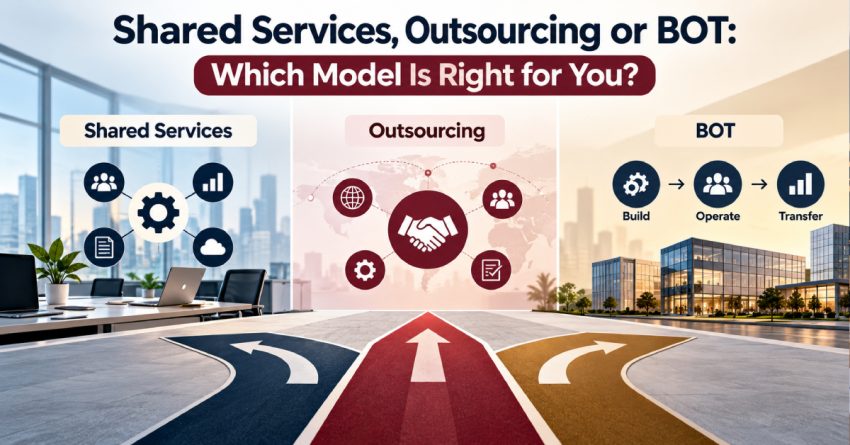
Support functions are vital to business growth, especially as organisations expand into new markets. However, managing finance, human resources, IT and procurement separately across locations can lead to duplicated effort and higher operating costs. Organisations may therefore consider global shared services, outsourcing or a Build-Operate-Transfer (BOT) model. The right choice depends on the level of control, investment and long-term operating structure the business requires.
Understanding the Three Models
Shared services involves consolidating similar services into a centralised team that helps several business units or locations. Outsourcing means hiring the necessary services from an outside organisation to perform selected activities, whereas a BOT model is a situation in which an external partner constructs and operates a function, after which the function is passed on to the organisation.
For organisations with operations in different countries, the benefits of global shared services can be of particular value in providing consistency in centralised functions, while helping to support geographically distributed operations.
When Shared Services Make Sense
When organisations are looking to achieve more control over important support services and reduce duplication of work across locations, shared services is a good fit. A central team can establish common processes, systems and performance standards.
The model may be suitable for companies that desire to:
- Ensure consistency of practices throughout sites
- Enhance visibility of support functions
- Reduce duplicated resources
- Set up shared technology bases
- Retain greater internal control
Global shared services can also enable organisations to build up specialist teams to serve multiple business units rather than have separate teams in each location.
When Outsourcing May Be Better
Outsourcing can be a good choice where a company desires an outside team to take care of a particular function or process. This enables the internal teams to concentrate on the core business activities and the service provider to manage agreed operational tasks.
When considering outsourcing, it is important to consider the following:
- The organisation lacks specific in-house expertise.
- Managing a function internally requires significant resources.
- Flexible capacity is important.
- The company wants to reduce administrative workload.
- Suitable external service providers are available.
Before outsourcing critical operations, businesses should also assess service quality, data security, contractual obligations and long-term costs.
When to Consider a BOT Model
A BOT model may be useful if a company is interested in creating a new operation but lacks the resources and knowledge to construct the operation on their own. A team can be set up by an external partner, processes and infrastructure put in place, the function operated over an agreed period and then transferred to the organisation.
This could be a way to ease into the process of internalization over time and to still be able to benefit from the outside expertise during the beginning of the process.
Compare the Models before Deciding
The decision should reflect the organisation’s goals, resources and long-term plans. Key factors to consider when comparing the three models include:
- Desired level of operational control
- Initial investment requirements
- Availability of internal talent
- Scalability requirements
- Data security and compliance requirements
- Long-term operating costs
- Time required to establish the function
For organisations looking for centralisation and standardisation, global shared services might be the right choice, while for those focussed on flexibility and external knowledge, outsourcing could be more suitable. Consider a BOT model if the intended long-term outcome is to develop internal capacity with assistance during the transition.
Select Based on the Long-Term Strategy
The best model is the one that can back the organisation in other capacities beyond cost reduction. The structure chosen will impact the business on a number of levels – including talent, technology, governance, scalability and operational control – over the coming years.
Organisations may find that global shared services can serve as an excellent basis for consistent processes across a number of markets whilst outsourcing or BOT arrangements are other ways of getting the expertise and capability. By carefully comparing the models, companies can choose one that aligns with their needs and future expansion.
Planning to Restructure Your Support Functions Across Markets?
Consider CAC’s global shared services to help you assess centralisation, outsourcing and BOT models, compare their operational and financial implications, and select an approach that supports scalability, control and long-term business growth.
FAQs
Q: Why are companies adopting global shared services?
Companies adopt global shared services to standardise processes, reduce duplicated activities, improve operational visibility, and support multiple business locations.
Q: What is the difference between shared services, outsourcing, and the BOT model?
Shared services centralise internal functions, outsourcing delegates tasks to external providers, while the BOT model establishes operations that eventually transfer to the business.
Q: How Can CAC Help Businesses Choose the Right Operating Model?
CAC supports organisations in assessing shared services, outsourcing and BOT models, comparing their financial and operational implications, and selecting an approach aligned with their long-term business objectives.
Q: What are the main benefits of global shared services for multinational companies?
Global shared services help multinational companies maintain consistent processes, improve coordination, reduce duplication, and strengthen control across geographically distributed operations.
Q: How does CAC support long-term operational transformation?
CAC helps businesses evaluate shared services, outsourcing, and BOT structures to improve scalability, operational coordination, and long-term efficiency.