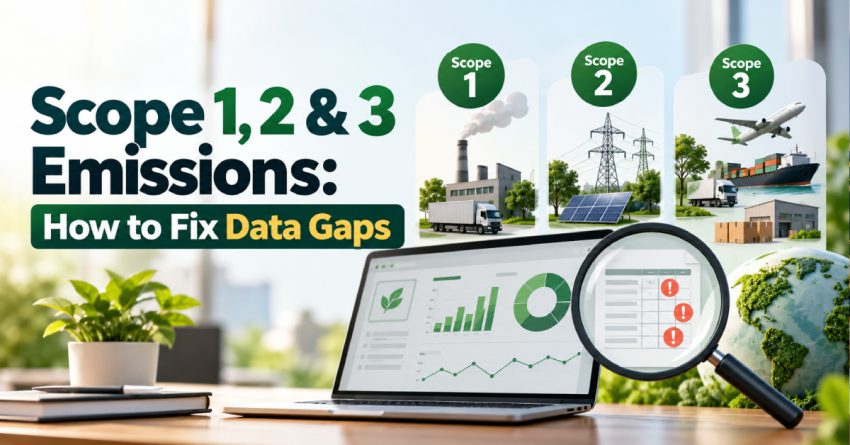
Emissions data is increasingly important for corporate sustainability reporting and climate-related decision-making. However, many organisations struggle to collect complete and accurate information across facilities, suppliers, logistics partners and other business activities. Understanding Scope 1, 2 and 3 emissions and identifying gaps in the underlying data can help businesses improve reporting quality and identify opportunities to reduce emissions.
Start with Clear Data Ownership
A common finding in terms of missing emissions data is that there’s no individual or team to collect and validate the needed information. Information can be distributed among finance, procurement, facilities and operations and supply chain teams.
Businesses should assign clear responsibility for each emissions category and define:
- What data needs to be collected
- Who is responsible for providing it
- How frequently the data should be updated
- Who reviews and approves the information
Clarity of responsibility can minimise duplication and make the information more visible if it is missing.
Improve Scope 1 Data Collection
Scope 1 emissions are typically those that an organisation owns or controls. This can include fuel for company owned vehicles, boilers, furnaces or any other equipment.
Data gaps may arise when facilities record fuel consumption differently or maintain incomplete equipment records. Businesses can improve data quality by maintaining accurate asset registers, standardising fuel consumption records and requiring all facilities to follow consistent reporting procedures.
Strengthen Scope 2 Information
Scope 2 emissions are linked to the purchased energy used by an organisation, such as electricity, steam, hot or cold water. It can be difficult to obtain accurate electricity consumption data if companies have multiple offices, plants or leased facilities.
Organisations can improve Scope 2 data collection by tracking:
- Electricity consumption by building or facility
- Utility bills and meter readings
- Relevant renewable energy purchase records and contracts
- Locations where estimated energy consumption is used
Also, Scope 1, 2 and 3 emissions data should also be reviewed for consistency in activity data, calculation methods and emission factors.
Tackle Scope 3 Data Challenges
Scope 3 emissions are indirect emissions across an organisation’s value chain that are not included in Scope 2. They can arise from purchased goods and services, transportation, business travel, employee commuting and other relevant activities. Collecting this data can be challenging because it often depends on information from suppliers and other external parties.
First, companies can start by determining which of the Scope 3 categories is the most important to report on, rather than striving to gather complete data in all areas at once. Supplier questionnaires, procurement records, logistics data and spend-based estimates can be used to set up an initial baseline.
Over time, replace Assumptions with Better Data.
It is not always possible for every organisation to have primary data at their fingertips. If information does not exist, reasonable estimates or secondary emission factors may be needed. The assumptions used should be documented, along with areas where data quality can be improved in the next reporting cycle.
For Scope 1, 2 and 3 emissions, the ability to keep a record of data sources, calculation methods and assumptions can facilitate year-on-year improvements.
Create a Repeatable Data Process
Emissions data management should not be treated as a one-time reporting exercise. Organisations should have a process that they can repeat that makes data collection more effective every year. Consistently reviewing can help expose gaps in the records, inconsistencies in measurements and categories that need to be addressed through increased supplier involvement.
A structured approach to Scope 1, 2 and 3 emissions reporting can improve data reliability and support better climate-related decision-making. By assigning clear data ownership, standardising collection methods, engaging suppliers and progressively replacing estimates with more accurate data, businesses can strengthen sustainability reporting over time.
Looking to improve emissions data accuracy and strengthen sustainability reporting?
Consider CAC’s sustainability advisory services to help you identify data gaps, establish reliable reporting processes, improve emissions tracking, and build a stronger foundation for informed climate-related decisions.
FAQs
Q: How can companies improve the accuracy of Scope 1, 2 & 3 emissions reporting?
Companies can improve accuracy by assigning data ownership, standardising collection methods, maintaining supporting records, and regularly validating emissions information.
Q: How does CAC help businesses address emissions reporting challenges?
CAC supports organisations in identifying emissions data gaps, improving tracking processes, establishing reporting practices, and strengthening sustainability-related decision-making.
Q: Why is assigning data ownership important for emissions reporting?
Clear data ownership ensures responsible teams collect, validate, update, and approve emissions information, reducing missing records and reporting inconsistencies.