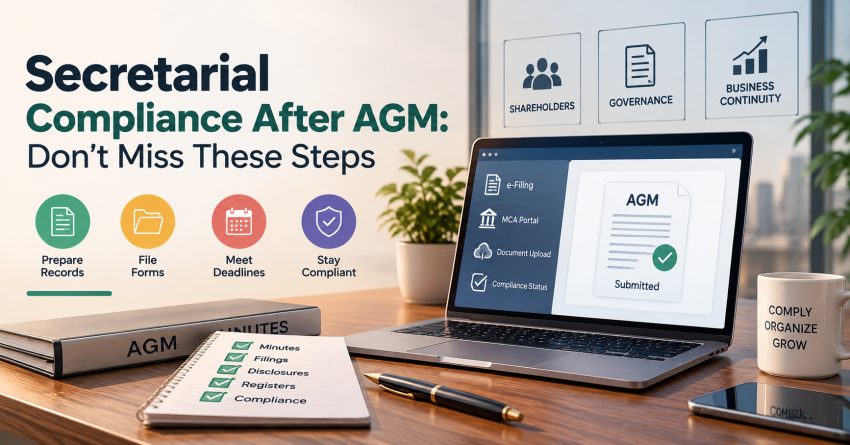
Completing an Annual General Meeting does not conclude a company’s compliance responsibilities. Decisions taken by members must be properly documented, implemented and reported to the relevant authorities.
Post-AGM compliance can include preparing minutes, filing financial statements and annual returns, reporting resolutions, updating statutory registers, processing appointments and completing dividend requirements. A structured checklist ensures that each approved decision becomes a valid and properly recorded corporate action.
Why Post AGM Compliance Matters
The AGM creates a formal record of shareholder decisions, but many decisions require subsequent documentation, filings and record updates. Post-meeting compliance preserves evidence, implements approvals, maintains accurate corporate records, supports audits and due diligence, and demonstrates effective governance.
Collect and Secure Meeting Records
Organize the signed attendance register, proxies, corporate authorizations, notice, dispatch proof, annual report, explanatory statement, shorter-notice consents, chairman’s notes, ballots, e-voting data, scrutinizer’s report, member questions, inspection documents and any authorized audio-visual records. Protect physical and electronic records against loss or alteration.
Prepare a Resolution Wise Action List
For every resolution, record its number, subject, type, result, effective date, responsible department, supporting documents, ROC form, deadline, implementation date and completion status. This prevents approved decisions from remaining unimplemented.
Verify the Voting Results
Reconcile votes in favour and against, invalid votes, abstentions, remote e-voting, meeting votes, polls, scrutinizer observations, related-party voting restrictions and the required approval threshold. Results should match the scrutinizer’s report and the chairperson’s declaration.
Publish Voting Results Where Applicable
Where required, publish results on the company website, stock exchange platform, e-voting service or another prescribed channel. State the meeting date, resolution, voting mode, voting counts, percentages, result and scrutinizer’s report, and retain submission evidence.
Prepare the AGM Minutes
Record the company and meeting details, date, venue or participation mode, chairperson, officials present, quorum, members, proxies, documents tabled, auditor qualifications, summary of discussion, resolutions, voting process, results, dissent and adjournment. Minutes should fairly summaries proceedings rather than reproduce a verbatim transcript.
Review and Sign the Minutes
Check the draft against the notice, agenda, chairman’s notes, attendance, voting results, scrutinizer report, recordings, resolutions and applicable secretarial standards. Enter and sign the minutes within the prescribed period. Corrections after signature should follow the permitted procedure.
Preserve the Minutes Book
Maintain consecutive page numbering, dates, signatures, controlled blank spaces, authorized storage, protected electronic records, restricted access and lawful inspection procedures. Treat the minutes book as a statutory record rather than an ordinary file.
File Financial Statements with the ROC
File the approved balance sheet, profit and loss statement, cash flow statement, notes, auditor’s report, Board’s Report, consolidated accounts, subsidiary statement, CSR disclosures and other required attachments. Confirm that attachments are final, signed and identical to those approved and placed before members.
File the Annual Return
Report the required information on the registered office, activities, group relationships, capital, shareholding, members, directors, key managerial personnel and other prescribed matters using the form applicable to the company’s class.
Reconcile the Annual Return
Compare the return with member and share transfer registers, depository records, director registers, meeting minutes, financial statements, charge records, related-party registers, earlier ROC filings and beneficial ownership records. Do not copy the previous return without verifying changes.
File Applicable Resolutions
Determine whether resolutions concerning constitutional documents, specified contracts, borrowing, undertakings, managerial appointments, capital, related parties or other prescribed matters require filing. Attach the certified resolution, explanatory statement, notice, altered documents and approvals, ensuring exact wording consistency.
Complete Director-Related Filings
For an appointment, reappointment, retirement or cessation, verify consent, disclosure of interest, eligibility, identification details, approvals, ROC filings, statutory register, website and authorized signatory records. Keep the effective date consistent everywhere.
Complete Auditor-Related Compliance
Review consent, eligibility certificate, appointment term, remuneration, shareholder resolution, intimation, ROC filing, engagement letter and any handover. Auditor resignation or removal may trigger additional procedures.
Implement Dividend Decisions
Confirm the declared amount, eligible members, record date, designated bank account, deposit of funds, tax deduction, payment instructions, failed payments, unpaid dividend account, investor communication, register and unclaimed dividend tracking. Dividend funds should not be diverted for unrelated use.
Update the Register of Members
Update share transfers, transmissions, issues, buybacks, address and nominee changes, beneficial ownership, dematerialization and dividend entitlement. Reconcile the register with depository and transfer-agent records.
Update the Register of Directors and KMP
Record each director’s name, identification number, address, nationality, appointment or cessation date, shareholding, committee position and applicable key managerial personnel details. Match these entries with ROC filings and public disclosures.
Update the Register of Contracts
For covered related-party or other arrangements, record the contract date, parties, relationship, terms, value, approval date, interested directors, resolutions and agreement. Reconcile entries with the financial statements and ledgers.
Update Other Statutory Registers
Review registers of loans and investments, charges, securities, transfers, duplicate certificates, deposits, auditors, dividends and beneficial ownership. Use a master checklist so connected updates are not overlooked.
Update Internal and External Records
Corporate changes may require updates to bank mandates, digital signatures, portal access, websites, organization charts, vendor and customer records, employment files, insurance, licences, contracts and group records. ROC filing alone may not update these systems.
Track Filing Status and Acknowledgements
Monitor service request numbers, payment, challans, form status, resubmission, approval or rejection, master data and acknowledgements. Respond to resubmission requests within the permitted period using corrected documents.
Reconcile ROC Master Data
After filing, verify company status, registered office, directors, capital, charges, last AGM date, balance sheet date, filing status, auditor details and other public information. Investigate and correct differences.
Common Post AGM Compliance Errors
Avoid delayed minutes, differences between minutes and voting results, incorrect resolution wording, unsigned attachments, the wrong annual return form, inconsistent director dates, missed auditor filings, outdated registers, delayed dividend work, ignored resubmissions, unverified master data, weak record preservation and incomplete implementation.
Conclusion
Post-AGM compliance connects shareholder decisions with official legal and operating records. A resolution-wise tracker aligns minutes, filings, registers and stakeholder communications. After filing, verify status, reconcile master data and complete a closing report to reduce penalties, inconsistencies and disputes.
Frequently Asked Questions
Q: What is post-AGM secretarial compliance?
It covers documentation, filings, register updates and implementation activities required after an Annual General Meeting.
Q: What should a company do immediately after an AGM?
Secure attendance and voting records, verify results and prepare a resolution-wise action and filing checklist.
Q: Why are AGM minutes important?
They provide the official record of proceedings, shareholder decisions and voting results.
Q: Who signs the AGM minutes?
The chairperson of the meeting signs the minutes in accordance with the applicable provisions and secretarial standards.
Q: Can signed minutes be changed?
They should not be altered informally. Any correction must follow the legally permitted procedure.
Also Read: Secretarial Compliance for Companies in India: A Complete Guide