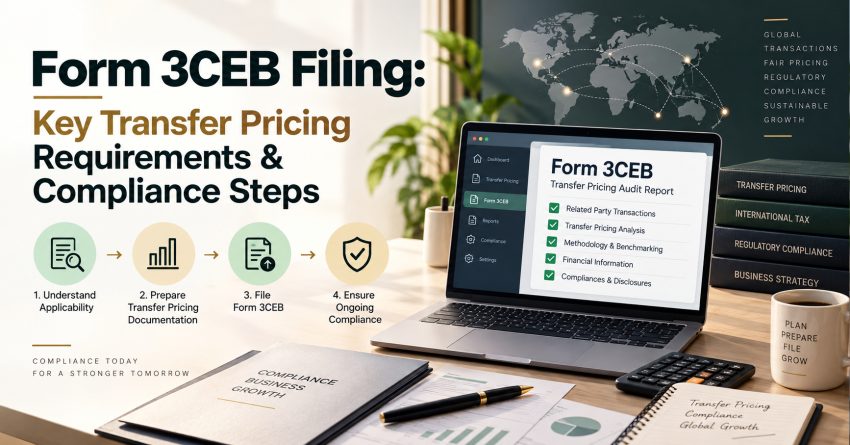
Cross-border transactions between related entities are closely examined under transfer pricing regulations. Businesses must demonstrate that their pricing follows the arm’s length principle – the price or conditions that independent enterprises would have agreed upon under comparable circumstances.
Where applicable, a taxpayer must maintain prescribed documentation and obtain an accountant’s report in Form 3CEB. The report should be reconciled with related-party ledgers, agreements, invoices, remittances, tax records and the transfer pricing study. Incomplete or inconsistent reporting can lead to adjustments, tax demands, interest and penalties.
Understanding the Purpose of Form 3CEB
Form 3CEB is an accountant’s report for covering international transactions and specified domestic transactions. It is prepared and digitally signed by a chartered accountant and filed electronically. It reports associated enterprises, transaction nature and value, the selected method, arm’s length result, taxpayer adjustments, financial arrangements, cost allocations, tangible and intangible property dealings and other prescribed categories. Filing the form does not replace the obligation to maintain supporting documentation.
Determine Whether Transfer Pricing Provisions Apply
Identify transactions with foreign related parties, overseas subsidiaries or parent entities, permanent establishments, entities under common control and transactions treated as deemed international transactions. Review specified domestic transactions and business restructurings as well. Do not rely only on accounting labels because the tax definition of an associated enterprise can capture less obvious relationships.
Identify Associated Enterprises
Map direct and indirect ownership, common management, business control, intellectual-property dependence, loans and guarantees, raw-material or sales dependence, director appointments and other prescribed participation or control conditions. Maintain an updated group structure and record changes during the financial period.
Create a Complete Transaction Inventory
List purchases and sales, services, management fees, royalties, software charges, research services, intercompany loans, interest, guarantees, cost-sharing, reimbursements, commissions, leases, intangible transfers, restructuring, outstanding receivables and capital arrangements. Record the counterparty, country, relationship, value, currency, agreement and ledger reference for every item.
Review Intercompany Agreements
Verify parties, scope, pricing, payment and credit terms, currency, responsibilities, intellectual-property ownership, risk allocation, termination and governing law. Actual conduct must agree with the contract; documentation cannot support a position that differs from how the parties operated.
Conduct a Functional Asset and Risk Analysis
A FAR analysis identifies the functions performed, assets used and risks assumed by each party. Examine manufacturing, distribution, marketing, procurement, research, quality control, support, management and finance functions; tangible and intangible assets; and market, inventory, credit, product, currency, capacity, research, regulatory and warranty risks. This analysis supports characterization of the tested entity and method selection.
Select the Most Appropriate Method
Available approaches commonly include the Comparable Uncontrolled Price Method, Resale Price Method, Cost Plus Method, Profit Split Method, Transactional Net Margin Method and another prescribed method. Select the method based on the transaction, available information, industry conditions and FAR analysis, and document why it is reliable.
Perform a Benchmarking Analysis
Choose the tested party and profit-level indicator, identify a suitable database and search criteria, select and reject comparables with reasons, examine financial information, make permitted adjustments and calculate the arm’s length result or range. Retain the complete search trail and update the study when the business model, market or available comparables change.
Reconcile Form 3CEB with Financial Records
Reconcile reported values with the trial balance, ledgers, audited accounts, related-party notes, tax audit report, GST returns, TDS statements, remittance records, import and export documents, transfer pricing study and intercompany confirmations. Explain differences caused by taxes, exchange conversion, credit notes, provisions, reimbursements or classifications.
Review Management and Shared Service Fees
Support service fees with agreements, service descriptions, emails, reports, employee time records, allocation workings, allocation keys, invoices, payment records and evidence of business benefit. Demonstrate that services were received, were not duplicated and were not merely shareholder activities. An invoice alone may not prove that a service was rendered.
Examine Intercompany Loans and Interest
Document the loan agreement, principal, currency, rate, repayment term, security, borrower’s credit profile, benchmark rate, interest workings, accrual or payment, withholding tax and foreign-exchange compliance. Benchmark a foreign-currency loan with commercially relevant data rather than applying a domestic rate without analysis.
Review Corporate Guarantees
Assess the guaranteed type, amount, term, borrower’s credit profile, benefit obtained, comparable rates, actual exposure, lender terms and regulatory reporting. Determine whether a covered transaction exists and whether an arm’s length guarantee fee is required.
Analyse Outstanding Receivables
Review contractual and actual credit periods, industry practice, reasons for delay, independent-customer terms, working-capital adjustments, currency effects, interest implications and subsequent recovery. Long-outstanding receivables may require separate financing analysis depending on the facts and law.
Review Royalty and Intangible Transactions
Retain licence agreements, descriptions and ownership details of intangibles, territory and term, royalty calculations, comparable arrangements, proof of use, economic benefit, tax deduction records and regulatory approvals. Distinguish ownership from a right to use the intangible.
Examine Cost Reimbursements
Determine who incurred the cost, who benefited, whether third-party invoices exist, whether allocation is reasonable, whether a service element or mark-up applies, and whether withholding tax is relevant. Clearly distinguish pure pass-through expenditure from value-adding services.
Evaluate Specified Domestic Transactions
Confirm the domestic relationship, relevant provision, transaction value, pricing policy, agreements, benchmarking and tax impact. Check the current scope and threshold before deciding whether Form 3CEB reporting applies.
Consider Safe Harbour and APA Options
Eligible taxpayers may compare safe harbour provisions with an Advance Pricing Agreement. The appropriate route depends on transaction type, value, compliance cost, required certainty and the group’s longer-term cross-border structure.
Prepare and Review Form 3CEB
Verify taxpayer details, associated enterprises, relationship type, transaction descriptions and values, methods, arm’s length results, adjustments, specified domestic transactions, agreement references and consistency with the study, audited accounts and tax audit report. The taxpayer should assign the form to the chartered accountant and review and accept it after uploading it.
Reflect Adjustments in the ITR
Where an adjustment is identified, review the increase in taxable income, amounts already booked, primary and secondary adjustment implications, effects on losses and MAT, relevant ITR schedules, tax and interest, and consistency with Form 3CEB. The return and the accountant’s report should not contradict each other.
Common Form 3CEB Filing Errors
Avoid omitting an associated enterprise or low-value transaction, reporting ledger-inconsistent figures, reusing an outdated study, selecting a method without reasoning, missing deemed transactions, treating all reimbursements as pass-through costs, ignoring receivables, loans or guarantees, reporting inconsistent related-party information, leaving the form unaccepted, or failing to reflect an adjustment in the return.
Conclusion
Form 3CEB filing requires coordination across finance, tax, legal and operating teams. A complete transaction inventory, current agreements, reliable FAR analysis, appropriate benchmarking and reconciliation with audited accounts create a defensible transfer pricing position. Starting early allows time to resolve missing evidence, ledger differences and possible adjustments before filing.
Frequently Asked Questions
Q: What is Form 3CEB?
It is an accountant’s report used to disclose covered international transactions and specified domestic transactions under transfer pricing provisions.
Q: Who prepares Form 3CEB?
An eligible chartered accountant examines, certifies and electronically files Form 3CEB after it is assigned by the taxpayer.
Q: Is Form 3CEB applicable only to companies?
No. Applicability follows the nature of the transaction, so companies, firms and other eligible taxpayers may be covered.
Q: Is transfer pricing study compulsory?
Documentation requirements depend on the transaction and applicable thresholds, but the taxpayer must maintain sufficient documentation to support the arm’s length nature of covered transactions.
Q: Which transfer pricing methods may be used?
Common methods include the Comparable Uncontrolled Price Method, Resale Price Method, Cost Plus Method, Profit Split Method, Transactional Net Margin Method and the Other Method.