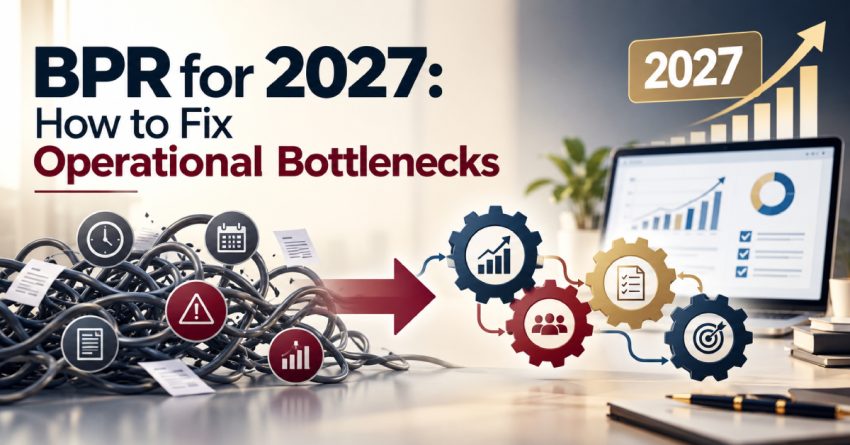
Operational efficiency is becoming a key priority for businesses preparing for 2027. Even well-established organisations can face delays, repetitive tasks, unclear responsibilities and disconnected systems that slow down performance. Business Process Reengineering (BPR) helps businesses identify these issues and redesign workflows to improve efficiency, coordination and measurable business outcomes.
Identify Where Processes Are Breaking Down
The first step of Business Process Reengineering is to understand the point of the bottlenecks in the business process. A process may seem efficient at a high level, but some steps in the process are not needed and lead to unnecessary delays. For instance, approvals can go through several people, employees can type in the same data to several systems, or crucial tasks may require manual follow-ups.
The first step in business is to identify the current processes and review:
- Whether tasks are frequently delayed
- Which approvals create unnecessary waiting time
- If duplicate work has to be done by employees
- Which processes are critically dependent on spreadsheets or manual data entry?
- Where communication gaps affect handovers
This evaluation provides a better understanding of the requirements for change prior to designing new processes.
Removing Unnecessary Processes
Not all the tasks in an existing workflow are value-adding. Certain procedures might have been established years ago because of issues no longer present. Others might have been simply added on as the organisation grew.
Business Process Reengineering helps companies rethink each step in a workflow instead of continuing outdated practices. Any step that is not adding value in terms of quality, compliance, customer satisfaction or business results should be examined.
Reducing process friction can be achieved by simplifying approval chains, eliminating redundant documentation, and clarifying decision-making responsibilities.
Use Technology Where It Solves a Real Problem
Technology can help address operational challenges; however, introducing new software alone will not fix inefficient processes. Before the adoption of automation or digital tools, it is crucial for business to make sure they understand the problem first and only then look into the solution.
Potential applications include:
- Eliminating duplicate data entry
- Introducing electronic approval processes
- Monitoring processes through real-time dashboards
- Integrating systems to avoid duplicate information
- Automating task alerts and reminders
The goal should be to speed up and make processes more reliable, not to simply add more technology to an already complex workflow.
Redesign Processes Around Business Outcomes
Business re-engineering that works looks at results instead of departments. A process that works well for one team may create challenges for another. So, business needs to look at the transfer of information, decision and responsibility through the process.
Organisations can focus on 2027 outcomes including quicker turnaround times, fewer errors, improved customer experience and transparency of accountability. Process owners should also be able to set metrics for each process, which will allow them to see the impact and improvement on each process after it has been implemented.
Train Employees on Process Changes
If employees are not aware of the process’s purpose and how it works, then it will be unsuccessful, regardless of how it is designed. Persons that are involved in the process day-to-day can also offer a lot of good information on real-life issues that may not be captured in the formal process map.
Accordingly, training, communication and feedback should be part of the redesign process. Employees should understand their responsibilities, how the new process works and how to report problems after implementation.
Develop a Continuous Improvement Approach
Business process re-engineering should not be viewed as a single shot. Business needs, expectations and technology evolve. Key processes within organisations need to be reviewed periodically to see if they are achieving expected outcomes.
Business Process Reengineering (BPR) helps businesses address inefficiencies, simplify workflows and improve accountability. By eliminating unnecessary activities, using technology effectively and involving employees in change, organisations can build more efficient, future-ready operations for 2027 and beyond.
Looking to eliminate operational bottlenecks and improve process efficiency? Consider CAC’s business process re-engineering services to help you assess existing workflows, identify inefficiencies, simplify processes, strengthen accountability, and create streamlined operations that support your business goals.
FAQs
Q: How can businesses identify bottlenecks in their daily operations?
Businesses can identify bottlenecks by reviewing workflow delays, repetitive tasks, approval processes, and communication gaps that affect productivity.
Q: How does CAC help organisations overcome operational challenges?
CAC supports organisations by assessing existing workflows, identifying bottlenecks, simplifying processes, and recommending improvements aligned with business objectives.
Q: When should a company consider redesigning its business processes?
A company should consider process redesigning when frequent delays, repeated errors, manual dependencies, or unclear responsibilities begin affecting performance.
Q: How can business consulting services in Delhi support process improvement?
Business consulting services in Delhi can help organisations evaluate operational gaps, streamline workflows, strengthen internal controls, and improve decision-making.
Q: How Can CAC Help Make Business Operations Easier?
CAC helps businesses streamline workflows, reduce repetitive tasks and improve productivity for smoother, more efficient day-to-day operations.