Introduction
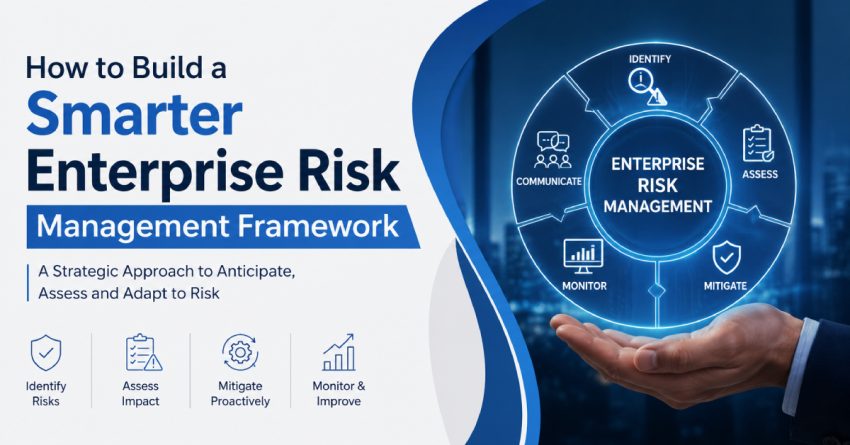
With increasing complexities in today’s dynamic business environment, there are numerous uncertainties that a business might encounter. Some of these uncertainties include cyber-attacks, legislative changes, supply chain disruptions, and economic turbulence. It is not enough to only manage these uncertainties; it is important that organizations put in place a systematic process that will enable identification of the risk and equip the firm with strategies for dealing with them. Enterprise risk management can help organizations foresee risks, make prudent decisions, and develop resilience.
Risk management should no longer be perceived as exercise done simply to comply with requirements but rather as an integral part of strategy and operation in modern organizations.
Understanding the Purpose of an Enterprise Risk Management Framework
Going Past Individual Risks
Conventional risk management usually concentrates on departments or individual risks. An effective framework analyzes risks on a company-wide level, making sure each business function is involved in the strategy.
Such an approach enables executive managers to see how different risks interact with each other and how various business units can cooperate to minimize their risks.
Risk Management for Organizational Goals
A good framework should facilitate business processes and not hamper them. Integrating risks into business objectives allows businesses to safely innovate, expand and digitize.
Key Elements of a Smarter Framework
Risk Identification
Create a Complete Risk Profile
Organizations need to start with identification of the possible risks associated with operations. These can be of operational nature, security-related risks, financial risks, regulatory risks, environmental risks, and many others.
Collection of ideas from several departments helps to uncover all hidden risks.
Risk Assessment
Assess the Impact and Probability of Risks
After the risk assessment, the next step is to assess the likelihood of such risks and their business impact. Prioritization of high impact risks will allow allocation appropriately and focusing mitigation efforts.
Continuous assessments will allow businesses to be always ready for new risks.
Risk Response Planning
Creating Effective Response Plans
Each important risk needs to have an appropriate response plan which could be risk reduction, transfer, acceptance, or avoidance.
Clear responsibilities and communication procedures will help to coordinate actions under unexpected conditions.
Leveraging Technology for Better Decision-Making
Use of Data and Analytics
Data analysis, artificial intelligence, and automation have completely changed how organizations handle risks. With real-time monitoring, companies can spot anomalies and weaknesses and respond immediately to changes in circumstances.
With the help of technology, reporting is improved using dashboards for better and faster decisions among the organization’s leadership team.
Continuous Monitoring
Contemporary enterprise risk management does not remain the same. Risks are always changing depending on changes in the markets, technology, and regulations. Through continuous monitoring, companies can adjust their controls and mitigation strategies.
Building a Risk-Aware Organizational Culture
Commitment to Leadership
Organizations need strong leadership to build a culture of risk awareness among all staff. Those leaders who foster transparency and accountability will provide an environment in which employees feel free to report issues before it is too late.
Employees Involvement
With training sessions and workshops, as well as teamwork and collaboration among different departments, staff members realize how important it is for them to be part of the risk management process.
Conclusion
Development of a smart approach to enterprise risk management is not just about policy formulation and documentation. It involves strategy, constant monitoring, the use of technology, and involvement of all organizational levels. Enterprises that can effectively identify risks, assess their impacts, and adjust to emerging conditions will be in a position to manage uncertainties with more confidence. Through the adoption of risk management as a strategic competency and not just an operational one, enterprises can enhance their resilience and decision-making abilities.
Frequently Asked Question
Q: What is an enterprise risk management (ERM) framework?
An enterprise risk management (ERM) framework is a structured approach that helps organizations identify, assess, manage, and monitor risks across all business functions to support strategic objectives and improve resilience.
Q: Why is enterprise risk management important for businesses?
Enterprise risk management helps businesses anticipate potential risks, improve decision-making, strengthen regulatory compliance, protect business assets, and ensure long-term operational stability.
Q: What are the key components of an enterprise risk management framework?
A comprehensive ERM framework typically includes:
- Risk identification
- Risk assessment
- Risk response planning
- Continuous monitoring
- Risk reporting
- Governance and accountability
- Technology and data analytics
Q: How can organizations build a strong risk-aware culture?
Organizations can build a risk-aware culture by encouraging leadership involvement, providing employee training, promoting transparent communication, defining clear responsibilities, and integrating risk management into everyday business decisions.
Q: How do businesses identify enterprise risks?
Businesses identify risks by evaluating operational processes, financial activities, cybersecurity threats, regulatory requirements, supply chain vulnerabilities, and market conditions while gathering input from multiple departments.
Also Read: Key Objectives of Internal Control and Their Role in Risk Management