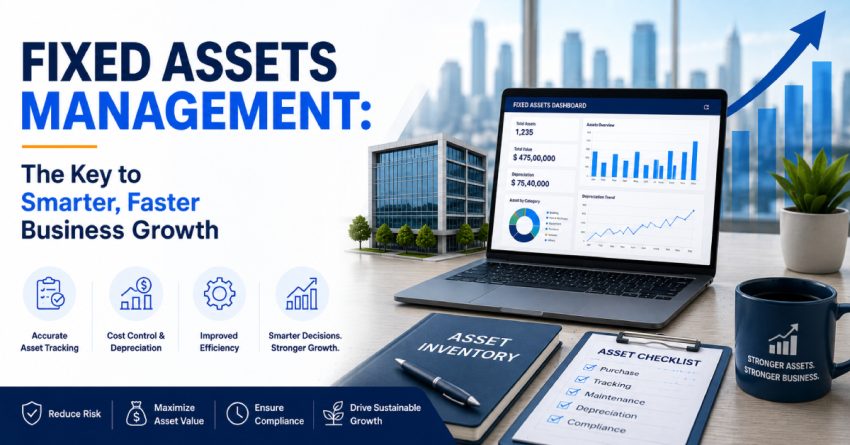
Effective management of fixed assets is vital in ensuring that any enterprise maintains financial and operational discipline. From plant machinery to office infrastructure, managing the various assets that an organization utilizes may be challenging in the long run. The process of fixed assets management becomes necessary in such circumstances. Streamlining the process leads to enhanced accuracy and efficient decision-making.
Below are some of the best practices in Fixed Asset Management that organizations can adopt for their own benefit.
Maintain a Centralized Asset Register
It is imperative that a business maintains a central asset register that contains all pertinent information regarding the fixed assets in question. Information such as the asset description, date of purchase, purchase cost, location, and depreciation are all essential in ensuring that an asset is managed effectively.
Use Technology for Better Tracking
Relying on manual asset tracking techniques is problematic since it leads to errors. Organizations should consider leveraging software tools to automate the various aspects of Fixed Asset Management. Barcoding or radio frequency identification (RFID) can also be used.
Conduct Regular Asset Audits
Audits on a regular basis are instrumental in confirming the accuracy of asset records with physical assets. Such audits can be extremely effective in detecting any missing, faulty, or unused assets.
Incorporating audit processes in the fixed assets management can scale down errors and inconsistencies immensely and increase accountability. Additionally, it can also help the organizations in planning for asset maintenance and replacement effectively.
Policy Standardization
Consistency in practice while managing your assets is most crucial. Having set policies for acquiring, using, maintaining, and disposing of assets will improve your asset management processes.
Having consistency will make it easier for you and your staff to handle Fixed Assets Management efficiently. Asset management processes will also become streamlined with standardized procedures.
Track Depreciation Accurately
Another factor that is important in asset management is depreciation. Using the proper processes and techniques will ensure that depreciation is recorded accurately.
Fixed Assets Management entails making periodic adjustments to the value of your assets according to their use and lifespan.
Plan Preventive Maintenance
Proper maintenance of assets is the key to longevity and performance. The likelihood of asset failure and expensive repairs is minimized with proper preventive maintenance.
Maintenance can be incorporated into Fixed Assets Management for the optimal tracking of your assets.
Dispose of Assets Efficiently
With time, some assets may become obsolete. Such assets must be disposed of properly since keeping them on record may lead to confusion.
Effective disposal of fixed assets is one of the essential aspects of Fixed Asset Management. Disposal of obsolete assets makes it possible to maintain accurate asset registers.
Train Employees and Build Awareness
The involvement of employees is essential for proper management of fixed assets. Training employees on the need for fixed asset management makes it easier for them to adhere to the set procedures.
If staff members have knowledge of Fixed Asset Management, they help keep the business organized and well-run.
Conclusion
Efficient management of fixed assets does not only improve the flow of business activities. Proper asset management also ensures that there is efficiency in the entire operations of a business entity.
Proper management of fixed assets through implementation of efficient Fixed Asset Management practices helps improve business performance.
Frequently Asked Questions
Also Read: Net Fixed Assets: The Hidden Indicator of Financial Health