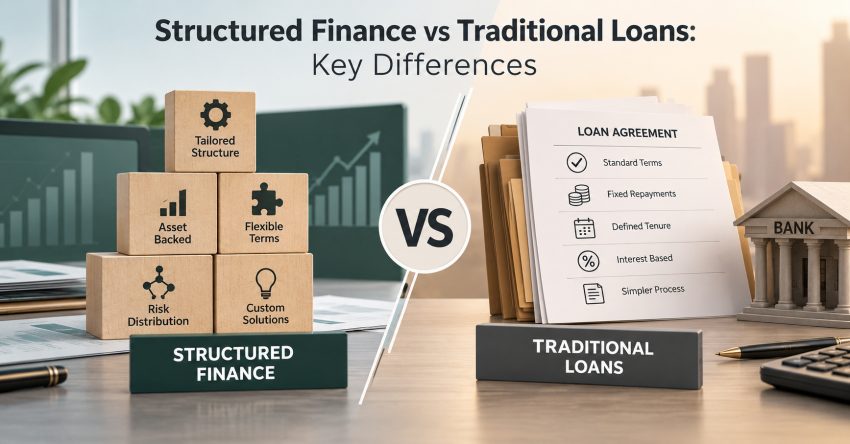
Firms might need external finance to expand operations, buy assets, undertake large projects or fund working capital requirements. Loans are one of the most preferred ways to source finance for business, but they may not be appropriate for firms having more complicated financing requirements. This is where the role of structured finance comes in and customizes the financing according to the requirements of the firm’s assets and cash flow.
Understanding the difference between the two financing options will allow businesses to make a more informed decision about the choice of financing option according to their financial situation.
What is a traditional loan?
Traditional loans are one of the most common forms of business financing. In a lending arrangement, the lender lends a certain amount of money to the borrower, and the borrower repays that amount over some time.
Traditional loans are generally assessed based on factors such as:
- Creditworthiness of the borrower.
- Existing financial performance
- Collateral or guarantees
- Repayment capacity
- The length of time of a loan and its interest rate.
They are appropriate at times when a company has regular cash flows and is in need of a specific volume of cash.
Structured Finance: What is it?
Structured finance can be used when a business’ needs cannot be met through traditional financing methods. The financing arrangement can be based on a particular asset, a collection of receivables, a project or future cash flow, rather than simply the borrower’s overall credit profile.
Structured finance may involve customised funding structures that incorporate different financial instruments or repayment mechanisms. Such deals are typically part of high-dollar deals, acquisitions, infrastructure projects, asset-backed financing and other complicated needs.
The financing structure is developed based on risk analysis, asset assessment, and anticipated cash flows.
| Factor | Structured Finance | Traditional Loan |
| Structure | Customised to the transaction or business requirement | Usually follows a standard lending structure |
| Funding Basis | May be based on assets, receivables, projects or specific cash flows | Primarily based on borrower creditworthiness and repayment capacity |
| Flexibility | Highly flexible | Some flexibility
|
|
Complexity |
More complex and customised | Relatively simple and standardised |
| Collateral | May involve specific assets or cash flows | May require conventional collateral or guarantees |
| Suitable For | Large, complex or specialised financing needs | Routine business funding requirements |
| Repayment | Repayments can be based on cash flows or transaction structures | Typically made in fixed amounts over an agreed period
|
Who Can Consider Structured Finance?
Structured finance may be considered when a business has funding needs that cannot be fully met through a traditional loan.
It could be used for:
- Infrastructure or development on a large scale
- Raising funds through acquisition or expansion financing.
- Asset-backed funding
- Receivables-based financing
- Complex corporate transactions
This includes businesses that have unique or non-standard cash-flow cycles.
The viability of the structure will be determined by the financial condition of the company, its goals, risk profile and the type of transaction.
Selecting the proper financing approach
It is not enough to just consider the amount of money needed to choose between structured finance and a traditional loan. Some other factors that should be taken into account are the cost of funding, flexibility in repayment, collateral needs, risk exposure and long-term financial goals.
Businesses can work with a structured finance advisor to evaluate available financing options and develop a structure aligned with their needs. This can help clarify the situation when traditional loans cannot satisfy a more complicated financing need.
Conclusion
Structured finance can be useful for complex or specialized financing needs, while traditional loans can be suitable for simpler funding requirements. Ultimately, it will depend on the financial needs, risk aversion, cash-flow and expansion goals of the business.
Considering these aspects will help companies choose a financing model that meets their current needs and can help ensure long-term financial success.
Need the Right Financing Structure for Your Business?
Explore tailored structured finance solutions aligned with your funding needs, assets, cash flows, and growth objectives. Speak with our experts today to discuss your financing requirements.
Frequently Asked Questions
Q: What is the difference between structured finance and a traditional loan?
Traditional loans generally follow standard lending terms based on creditworthiness and repayment capacity. Structured finance can be customised around specific assets, receivables, projects, or cash flows.
Q: When is structured finance suitable for a business?
Structured finance may be suitable for complex funding needs such as acquisitions, infrastructure projects, asset-backed financing, receivables financing, or businesses with non-standard cash flows.
Q: How can a structured finance advisor help a business?
A structured finance advisor helps businesses evaluate financing options and develop funding structures aligned with their assets, cash flows, transaction needs, and financial objectives.
Q: Can businesses in Delhi and across India get structured finance support from CAC?
Yes, CAC supports businesses across Delhi and India with structured finance solutions tailored to their funding requirements and transaction needs.
Also Read: The Role of Structured Finance Companies in Infrastructure Financing