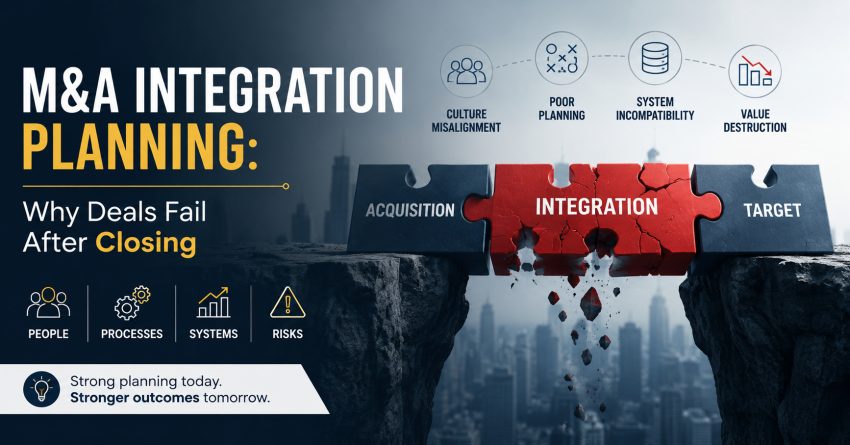
Mergers and acquisitions can provide companies with an opportunity to grow their operations and capabilities. Nevertheless, the success of M&A does not depend on the deal itself but rather on the way companies plan and manage the process of integration afterwards. The lack of an integration plan can be a cause for many problems and even failures. Integration planning has therefore gained significant importance within the merger and acquisitions advisory industry.
Understanding M&A Integration Planning
Mergers and acquisitions integration planning is the process that allows bringing together two companies and creating a single efficient company after the deal is made. The planning includes the alignment of people, processes, technologies, operations, and business goals.
Importance of Integration
Beyond Signing the Deal
Even though negotiations and due diligence are important, the true value of the acquisition is achieved only when the two firms start to collaborate properly.
Common Reasons M&A Deals Fail After Closing
Some problems can stop companies from reaching their strategic goals after merging.
Differing Work Cultures
Unmatched Corporate Cultures
All businesses have their own work culture, management, and employee expectations. Ignoring these factors will result in poor morale among employees, lack of communication, and increased employee turnover.
Absence of an Integration Strategy
Unclear Roles and Responsibilities
If there is no clear strategy for the integration process, the employees will not know who should do what and how to make decisions. It usually leads to the slowdown of business processes.
Professional mergers and acquisitions advisors can help companies to prepare detailed integration strategies.
IT and Processes Issues
Incompatible Systems
ERP, financial software, and other business processes might be more difficult to integrate than planned. Poorly integrated systems lead to inefficient processes and inaccurate data.
Best Practices for Successful Integration
An effective integration plan improves the probability of attaining desired business results.
Leadership for Integration
Form an Integration Team
The experienced team will handle all phases of the transition, communicate effectively, track progress, and address problems before they negatively impact business performance.
Communication is Key
Communicate Effectively With the Employees
Communication aids employees in comprehending the changes in the business, thereby decreasing uncertainties and enhancing collaboration during the integration process.
Standardize Business Processes
Standardize Business Activities
Businesses need to assess their processes, get rid of duplications, and set standard operating procedures.
Businesses frequently involve mergers and acquisitions consulting experts in order to recognize risks of integration and follow best practices for enhancing deal value.
Measuring Integration Success
Integration success should be measured by utilizing performance indicators.
Monitor Critical Performance Indicators
Measure Business Impact
Businesses should continuously measure their financial performance, employee retention, customer satisfaction, operational efficiency, and synergy. Continuous monitoring allows the management to tackle any obstacles that might arise while moving towards their goals.
Conclusion
A good merger or acquisition doesn’t happen after the deal is signed, but rather it starts then. Organizations which place emphasis on post-merger integration will be able to tackle any difficulties that arise, retain key personnel, and realize all the advantages which served as motivation for such business dealings. Through proper alignment of culture, processes, technologies and communications, businesses can get the most out of their acquisitions.
Maximize deal value with CAC’s M&A advisory services, helping businesses plan and manage post-merger integration, align operations, and reduce integration risks.
Frequently Asked Question
Q: What is M&A integration planning?
M&A integration planning is the process of bringing two companies together into a single, efficient organization following a deal. It involves aligning people, processes, technologies, operations, and business goals to realize the actual value of the acquisition.
Q: Why do M&A deals fail after closing?
M&A deals primarily fail after closing due to three main reasons:
- Differing Work Cultures: Ignoring unmatched corporate cultures leads to poor employee morale, lack of communication, and increased turnover.
- Absence of an Integration Strategy: Unclear roles and responsibilities slow down business processes and decision-making.
- IT and System Incompatibilities: Difficulties in integrating ERP, financial software, and business systems cause operational inefficiencies and inaccurate data.
Q: How is the success of an M&A integration measured?
Integration success is tracked using key performance indicators (KPIs) to continuously assess financial performance, employee retention, customer satisfaction, operational efficiency, and achieved synergies.
Q: What is the role of an M&A advisor in post-deal integration?
M&A advisors help companies prepare detailed integration strategies, identify potential post-closing risks, and apply industry best practices to maximize overall deal value.
Q: Why is cultural alignment critical in post-merger integration?
Work culture encompasses management style and employee expectations. Failing to address cultural differences results in low employee morale, poor communication, and higher turnover among key personnel.
Also Read: Deal Structuring in M&A: The Key to Successful Transactions