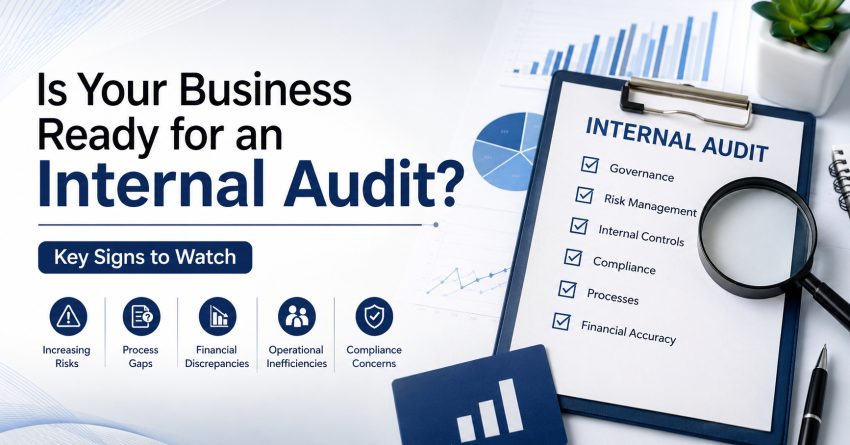
The world today has become highly complicated for businesses, in which it becomes imperative for organizations to have financial acumen, regulatory compliance, and efficiency to grow sustainably. While organizations grow, their associated risks become more prominent in terms of their processes, controls, and governance. This is where the internal audit comes into play as it becomes a useful mechanism.
The Importance of Conducting Internal Audits
Conducting an internal audit is not only a regulatory requirement but a process by which business activities and risk management policies can be independently reviewed. Early detection of inefficiencies will allow businesses to make sound decisions and develop robust operating structures.
Companies conducting regular audits tend to have better risk management skills.
Important Indicators That Show Your Business Could Benefit from an Audit
Rapid Business Expansion
Business Growth
If your company has seen some recent expansion, either by opening new branches, adding new departments, or launching a new line of products, the current internal controls could be insufficient. Growth brings about operational difficulties that need constant monitoring to be resolved properly.
Consistent Operational Errors
Frequent Problems
The presence of constant mistakes in such fields as inventory control, payroll processing, purchasing, and accounting suggests there are some flaws in internal controls. Internal audit will help identify the problem’s source and suggest how to improve the processes.
Legal Changes
Staying Up to Date
Every industry is characterized by frequent updates in the legislation and accounting requirements. If your firm faces difficulty in keeping up with these changes, an audit will help analyze the level of compliance.
Financial Warnings Signs
Unusual Discrepancies
Financial Mismatch
Any unexpected budget or financial differences should never be overlooked because such discrepancies can arise due to some process failure or even fraud. Early detection of such things will help to avoid any further losses.
Higher Operating Expenses
Lower Efficiency
When there is an increase in the costs of operations but no growth of the business at all, it suggests that the company is not using its resources efficiently.
Indicators of Governance and Risk
Lack of Proper Internal Controls
Varying Procedures
If several departments have different procedures for performing the same activity, there is higher risk involved in running your organization. Consistency in procedures and proper monitoring are important.
Change in Personnel Holding Key Positions
Control Issues and Skill Shortfalls
Frequent change in personnel of finance, procurement, or management departments creates weakness in business processes. Auditing helps in proper handling of these departments.
Preparing Your Business for Success
Create a Culture of Responsibility
Promote Continuous Improvement
The first step in the preparation of the company for the internal audit is the record keeping, process documentation, and openness within all organizational units. The management should motivate its staff members to follow the standards and speak up in case of any problems.
Periodic evaluations will allow companies to stay proactive in their operations. Instead of responding to external inspections or financial problems, businesses can improve their governance by means of regular evaluations and monitoring.
Internal audit should be treated as a strategic tool for business that will provide the company with stability, quality, and effective decisions. Companies that regularly evaluate themselves are ready to change their business environment.
The internal audit service provided by CAC will aid businesses in risk management, internal control enhancement, and operational effectiveness. Work with us and benefit from sustainable business growth.
Frequently Asked Question
Q: What is an internal audit and why is it important for businesses?
An internal audit is an independent review of a company’s business activities, risk management policies, and operational structures. It is important because it enables early detection of operational inefficiencies, strengthens governance, enhances regulatory compliance, and ensures sustainable growth.
Q: How does an internal audit help with regulatory compliance and risk management?
An internal audit analyzes a company’s current level of compliance against evolving legal and accounting standards, allowing management to correct non-compliance issues proactively rather than reactively.
Q: What is the difference between an internal audit and an external audit?
An internal audit is a continuous, internal process aimed at proactively identifying inefficiencies, improving internal controls, and strengthening overall governance. An external audit primarily focuses on statutory compliance and validating financial statements for external stakeholders, whereas internal audits serve as a strategic management tool for operational efficiency.
Q: How does employee turnover impact internal controls?
Frequent personnel changes in key departments like finance, accounting, and procurement create skill shortfalls and control issues. Internal audits help evaluate these critical areas to ensure consistent standard operating procedures regardless of staff turnover.
Q: What are the long-term benefits of regular internal evaluations?
- Proactive Risk Management: Addresses operational weaknesses before external inspections or financial crises occur.
- Resource Optimization: Eliminates process duplications and controls rising operational expenses.
- Enhanced Decision-Making: Provides leadership with accurate data and insights to support sustainable growth.
Also Read: AI vs Traditional Internal Audits: Which Delivers Better Results?