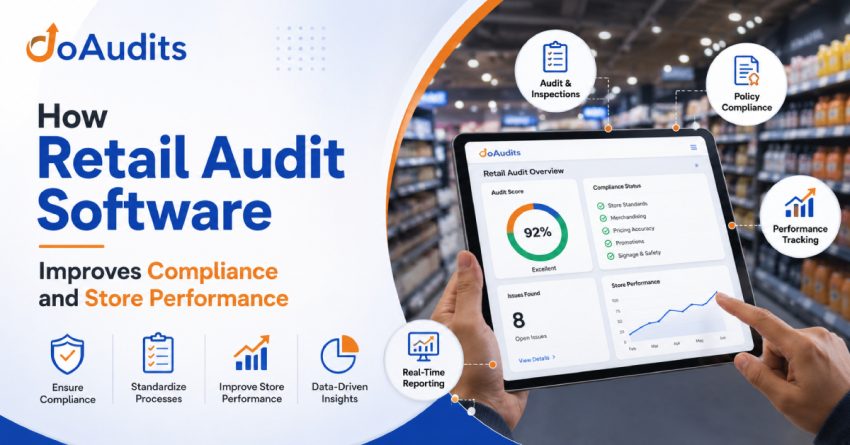
The retail business sector exists in a dynamic environment that demands consistency in service delivery within different outlets. Store managers have several tasks to undertake, including stock monitoring, merchandising, checking employee productivity, among others. Manual audits using checklists are associated with inefficiencies and delays in delivering results due to inconsistencies and lack of proper record keeping. It is therefore not surprising why retail audit software is revolutionizing the retail industry.
Modern retail audit software enables businesses to monitor store performance in real time, streamline compliance processes, and take corrective actions quickly. As a result, retailers can improve operational consistency, enhance customer experience, and make more informed business decisions.
Simplifying Store Audits
Conventional store audits may sometimes be inefficient and susceptible to human errors. Management tends to use a significant amount of time to fill out forms, generate reports, and share audit information with various departments. Digital auditing systems make the entire process easier for auditors by enabling them to perform audits using portable gadgets such as smartphones and tablets.
This allows auditors to document their observations, take photos, create actions for correction, and produce reports immediately. Consequently, this eliminates documentation and ensures audit information gets into the hands of the right personnel immediately.
Compliance Management at Different Locations
There are various requirements that retailers need to comply with in connection with their activities, ranging from product safety, hygiene standards, labor relations, and operational requirements. It is hard to ensure that all stores adhere to the same standards, particularly in case of multi-location businesses.
By adopting retail auditing software such as Doaudits, powered by CAC, companies can ensure that checklist templates are consistent, maintain regular compliance tracking, and send automatic notifications about necessary measures to be undertaken by managers. Electronic records will make it easy to prove compliance during any review process.
Reminders will ensure that stores conduct regular audits in accordance with a predefined schedule.
Improving Stores’ Performance
In addition to ensuring compliance, store audits also help to improve the performance and efficiency of the stores. Through digital auditing systems, information is provided concerning how products are arranged, stock control, customer services, and how clean the stores are.
Store managers can easily identify trends in performance, compare stores based on their performance, and learn from best practices that can be replicated across the board. Dashboards on performance ensure that there is data-driven decision-making by leadership teams since trends and key performance indicators are clearly highlighted.
Faster Corrective Actions
The biggest advantage of implementing digital audit software includes the quick resolution of the problem. Instead of waiting for reports to go through the manual system of approval, the store manager gets an alert the moment a problem is detected.
Problems can be delegated to the relevant employees right away along with deadlines. This leads to efficient and rapid resolution of the problem with minimum probability of future occurrence.
This allows businesses to achieve high levels of efficiency and productivity.
Helping to Make More Informed Decisions
Information gathered via retail audit software offers many opportunities for improvement other than routine auditing itself. For instance, reviewing audit reports can help retailers find problems within their organization and fix them via better training, inventory management, etc.
Moreover, the ability to make advanced reports will be useful for making proper evaluations of the performance of retail stores on regional levels and making proper business decisions. Such information will be helpful for making business decisions and achieving more efficient operational control and development of the business.
Conclusion
Retail audit software has become an essential tool for businesses seeking to improve compliance, operational consistency, and overall store performance. By digitizing audits and providing real-time visibility into operations, retailers can identify issues faster, strengthen accountability, and make data-driven decisions. Solutions like Doaudits, powered by CAC, help organizations streamline audit management while supporting sustainable operational excellence across all store locations.
Frequently Asked Question
Q: What is retail audit software?
Retail audit software is a digital tool that helps businesses inspect store operations, track compliance, record observations, assign corrective actions, and analyze performance across one or multiple locations.
Q: Can Doaudits help track audit actions and closures?
Yes. Doaudits enables teams to assign audit findings to responsible users, set deadlines, monitor progress, and maintain a clear record of corrective-action closures.
Q: How does Doaudits support retail audit management?
Doaudits helps retailers digitize audit checklists, track compliance in real time, assign corrective tasks, maintain audit records, and gain actionable visibility into store operations.
Q: What types of retail checks can be completed using audit software?
Retail teams can assess stock availability, product displays, store cleanliness, employee processes, safety requirements, customer service quality, pricing accuracy, and other operational standards.
Q: Can retail audit software be used for multi-location retail businesses?
Yes. It is particularly useful for multi-store retailers because management can monitor audit status, compliance gaps, and performance trends across locations from one central dashboard.
Also Read: Why Omnichannel Retail Fails Without Strong Retail Audits