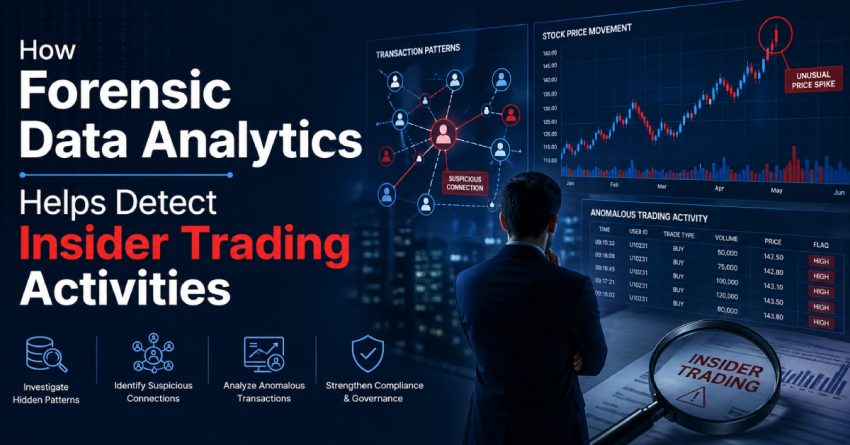
Trust and transparency are the foundation of financial markets. The effects of insider trading are that it is a distortion of fair market practices and an unequal playing field to investors. Insider trading is an activity in which something that is not public and price sensitive information is used to have an unfair advantage in the trade of stocks. The number of digital transactions and communication channels has made it more difficult to detect such activities. And here the forensic data analysis tools are very important in detecting suspicious patterns and regulatory compliance.
Learning about Insider Trading Risks
Insider trading may take a lot of different forms: corporate executives trading prior to earnings announcements, employees leaking confidential information, or third parties trading based on privileged knowledge. Such operations usually leave behind unobvious traces of data, instead of blatant offenses. The conventional audit technique might not identify such patterns due to manual checks or small datasets.
Forensics data analysis tools can be resourceful in relation to analyzing large amounts of financial data, communication logs, and transactional records. Moreover, they facilitate the investigators in spotting uncharacteristic trading conduct.
The operation of Forensic Data Analysis Tools
Fundamentally, forensic data analysis tools are meant to collect, process, and analyze structured and unstructured information. When it comes to insider trading, they are interested in the connection of trading activity with access to confidential information.
These tools analyze:
- Volume and timing of trading.
- Pricing prior to significant announcements.
- Access and communication logs of employees.
- Past trading patterns of people.
Using the combination of these datasets, forensic data analysis tools can emphasize the correlation between access to information and trading decisions. As an example, in case of a surge in trading just prior to a merger announcement, the system raises a red flag, and it is investigated further.
Determining Patterns and Red Flags
Among the largest benefits of data analysis tools in forensics, one can distinguish the possibility to identify patterns. Insider trading is hardly a single occurrence. It can be a repetition of behavior or synchronized actions between many accounts.
These tools have detected some red flags that are common such as:
- Sudden increase in trading activity before key corporate events
- The trades are done by people who have access to confidential data either directly or indirectly.
- Awkward profit margins of trades that are in the short term.
- Connections among employees and foreign trading accounts.
Forensic data analysis tools help to zero in on the connections among individuals, transactions, and timelines to demonstrate an accurate view possible misconduct.
Role Regulatory Compliance
There are strict compliance rules and regulations within the regulatory bodies like the Securities and Exchange Board of India (SEBI) and the U.S. Securities and Exchange Commission (SEC) against insiders trading. To keep penalties at bay, organizations must keep tabs on questionable activities and report them.
Forensic data analysis tools assist companies to remain compliant because they:
- Surveillance of trading activities as an automation process.
- Production of alerts on abnormal behavior.
- Having elaborate audit trails.
- Being in charge of the internal investigations with data that is evidence-based.
Such proactive strategy helps cut down the risks of regulatory breaches and betters the fundamentals for corporate governance.
Financial Institutions Benefits
The use of forensic data analysis tools is of great benefit to banks, investment firms and listed companies. These tools are not only useful in the detection of insider trading but also in the overall risk management.
Key benefits include:
- Instant identification of suspicious transactions.
- Less dependence on manual auditing.
- Improved effectiveness in detecting fraud.
- Higher financial transparency
Challenges and Considerations
Forensic data analysis tools are effective, yet they have their own challenges Big data needs robust data infrastructure and expertise to manage large volumes of data. One also needs to strike a balance between surveillance and regulations on data privacy.
It is the responsibility of organizations to make sure that these tools are utilized in a responsible manner and that the data is secured. Proper training and clear policies are essential for maximizing their effectiveness.
Future of Insider Trading Detection
With the inclusion of artificial intelligence and machine learning, forensic data analysis tools are becoming sleek and cutting-edge. They are now able to anticipate the possible risks based on the previous behavior and interrogate the anomalies in the real-time.
The use of forensic data analysis tools will only increase as the financial markets are continually changing. They will continue to play a major role in ensuring integrity of the market and discouraging unethical acts.
Also Read: Benefits of Using Forensic Accounting Software Tools for Internal Audits