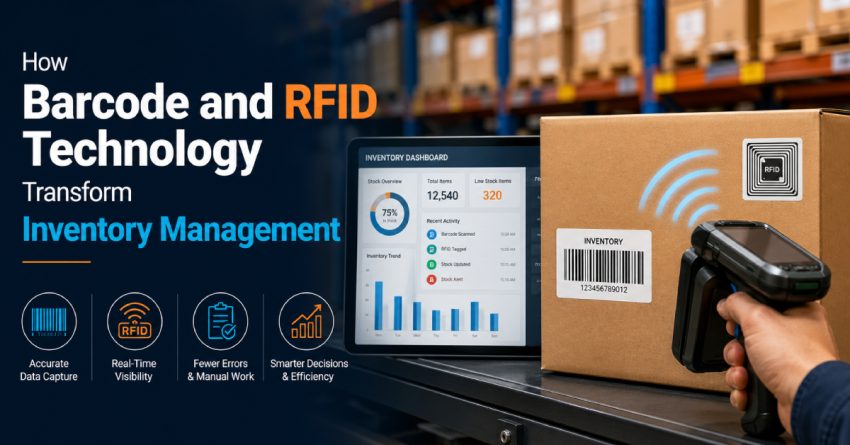
Efficient tracking and control of stock are essential for any business dealing with physical goods. As operations grow more complex, traditional manual methods become less reliable and prone to errors. This is where barcode and RFID (Radio Frequency Identification) technologies play a transformative role in Inventory Management, helping businesses streamline processes, reduce inaccuracies, and improve overall efficiency.
Understanding Barcode Technology
One of the most popular tools applied in Inventory Management is barcode technology. It is an act of giving a special code to each and every product and the scanning of the products can be done with the help of a barcode reader. These codes contain critical data like product identification, price and quantity.
The benefit of barcodes is that they are simple and cost-effective. Through scanning of the items at the time of receiving, storing and selling them, business can keep the records of their inventory accurately and up to date. This minimizes the chances of human error compared to manual data entry and accelerates the operations greatly. Barcode systems can be the initial step in automation of the Inventory Management processes by small and medium-sized businesses.
Exploring RFID Technology
RFID technology takes inventory tracking to the next level. RFID tags do not necessarily need to be scanned directly in a line of sight as with barcodes. They transmit data to a reader rather than using radio waves and so multiple items can be scanned at a time even at a distance.
RFID is especially applicable in large warehouses and complex supply chains because of this ability. Under RFID, businesses can keep track of inventory movement in real time, track goods in various points and find stock that has been misplaced easily. Consequently, Inventory Management is quicker, more precise and less work intensive.
Key Benefits of Barcode and RFID Integration
The combination of barcode and RFID technologies has a number of benefits. First, it has a great deal of enhancement of accuracy, as it reduces the manual intervention. Mistakes in the stock levels, misplaced goods, and mis recorded data are highly minimized.
Second, technologies increase efficiency in operations. The workers can handle inventory tasks like receiving, picking and shipping at a significantly quicker rate. This translates to enhanced productivity and faster delivery of orders.
Third, one of the significant advantages is real-time visibility. Companies can have a better understanding of inventory levels, trends, and demand. This villanelle makes smarter decisions and avoid such problems as overstocking or stockouts. Ultimately, the Inventory Management strategies are enhanced using these technologies.
Choosing the Right Technology
Although both barcode and RFID systems are useful, it depends on the size and requirement of the business. Barcodes are simply inexpensive to apply for and are suitable for smaller operations. RFID, however, is more expensive to start with but has more advanced features that can be applied to large businesses.
Other organizations even combine the two technologies in order to maximize efficiency. When the technology is aligned with the business objectives, businesses have an opportunity to streamline their Inventory Management systems and produce improved outcomes.
Conclusion
The RFID and barcode technologies have transformed the inventory processing of businesses. These tools have become fundamental parts of the modern Inventory Management by enhancing the accuracy, speed, and offering real-time information. As businesses keep on developing and keeping up with the demands of the market, the introduction of appropriate technology will help keep things in control, lowering expenses and staying competitive.
Also Read: How Inventory Management Prevents Overstocking and Stockouts