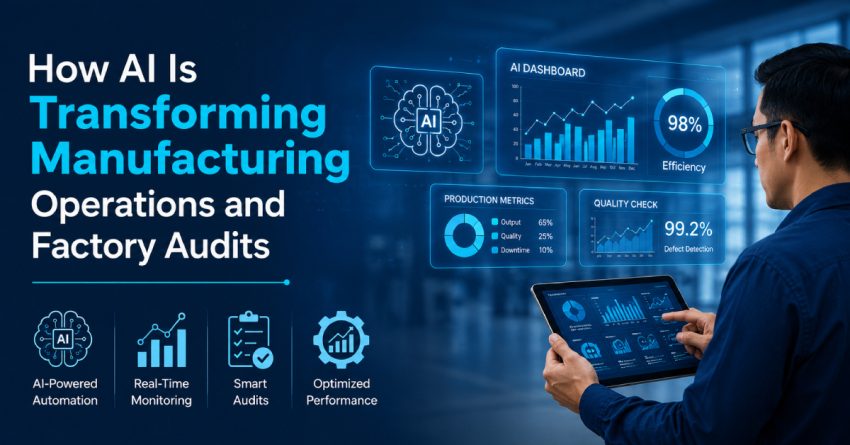
Artificial intelligence (AI) is transforming manufacturing by improving production efficiency, enhancing quality control, and enabling smarter factory audits through data-driven automation. Predictive maintenance, automatic quality inspection, and intelligent plant audit are some of the advantages which artificial intelligence is providing to manufacturers in terms of making their operations more efficient. In a highly competitive environment, companies are using technology tools like artificial intelligence in order to become more efficient and comply with regulatory demands. Along with business process re-engineering, artificial intelligence makes organizations think out of the box regarding how to conduct their operations.
AI Enhances Production Efficiency
There is a huge volume of data generated during operations in manufacturing plants. The data is processed through the application of artificial intelligence for the identification of trends and inefficiencies, among other things. Although production managers used to manually check the operations prior to the implementation of AI solutions, that is not an issue anymore.
AI systems help in predicting equipment failure as well, which allows manufacturers to perform maintenance before any unexpected breakdowns and disruptions happen. This helps in maintaining the lifecycle of critical machines and increases manufacturing productivity.
Smart Quality Control Through Automation
Product quality consistency is important in any manufacturing setting. Computer vision software with AI capabilities can do the inspection process extremely fast and accurate enough to find defects which may not be noticeable through naked eyes.
Automated inspection systems keep learning from the data coming from the production process. This enables them to see even slightest variations in quality of the products manufactured. Through AI integration into quality control, manufacturers save on wastage and cost of rework and increase client satisfaction. This will also help in business process re-engineering.
Factory Audit Is Made Simpler with AI
It is essential to conduct factory audits because they help comply with safety regulations and quality control measures. The traditional method of performing factory audits entails extensive document handling, inspection, and other paperwork.
AI technology is simplifying this task by gathering operational data in real-time through sensors and other sources of digital documentation. AI tools make audits simpler because they sort the gathered information and highlight non-compliance issues while creating a report that takes little effort from the auditor.
Additionally, real-time monitoring allows the manufacturer to avoid compliance problems during formal auditing.
Decision-Making Enhanced by AI
AI helps the company to use manufacturing data in making business intelligence. Using the interactive dashboards, managers get access to real-time information about how the manufacturing process is performing, the level of stock held in the storage facility, the condition of the machines, and the efficiency of the process being applied.
This will help make timely and informed decisions even when it comes to reorganizing the manufacturing process, addressing challenges in the supply chain, or distributing work. By combining BPR with AI, it becomes possible to redesign the entire manufacturing process.
Preparing for the Future of Manufacturing
As Industry 4.0 advances, more AI will be incorporated in manufacturing processes. New technologies like digital twins, cooperative robots, and intelligent automation will increase productivity while also ensuring sustainable manufacturing and resilience.
By investing in artificial intelligence technology now, manufacturers are creating solid foundations for the future. Combining modern technology and continual process improvement will help manufacturers stay competitive in the changing market.
Conclusion
Artificial Intelligence transforms manufacturing processes through increased efficiency, improved quality control, simplified factory auditing, and better decision-making. Rather than replacing human expertise, AI provides data-driven insights that help manufacturers make faster and more informed decisions.
With the help of BPR, AI enables manufacturers to reinvent their inefficient workflows and increase operational excellence as well as compliance with regulations. This combination will help to create more resilient and innovative manufacturers in the future.
Frequently Asked Questions
Q: How is AI transforming manufacturing operations?
AI is improving manufacturing by automating production processes, predicting equipment failures, enhancing quality control, optimizing resource utilization, and enabling faster, data-driven decision-making.
Q: How does AI improve factory audits?
AI simplifies factory audits by automatically collecting operational data, monitoring compliance in real time, identifying potential risks, and generating audit reports with minimal manual effort.
Q: What technologies are used alongside AI in modern manufacturing?
Manufacturers commonly combine AI with IoT sensors, computer vision, robotics, digital twins, cloud computing, machine learning, and industrial automation to build smart factories.
Q: What is Industry 4.0, and how does AI contribute to it?
Industry 4.0 is the integration of digital technologies into manufacturing. AI plays a key role by enabling intelligent automation, predictive analytics, smart maintenance, and connected manufacturing systems.
Q: What are the long-term benefits of adopting AI in manufacturing?
Implementing AI helps manufacturers increase productivity, improve product quality, reduce operational costs, strengthen regulatory compliance, enhance sustainability, and remain competitive in an evolving industrial landscape.
Also Read:Business Process Re-Engineering: 5 Steps to Improve Performance