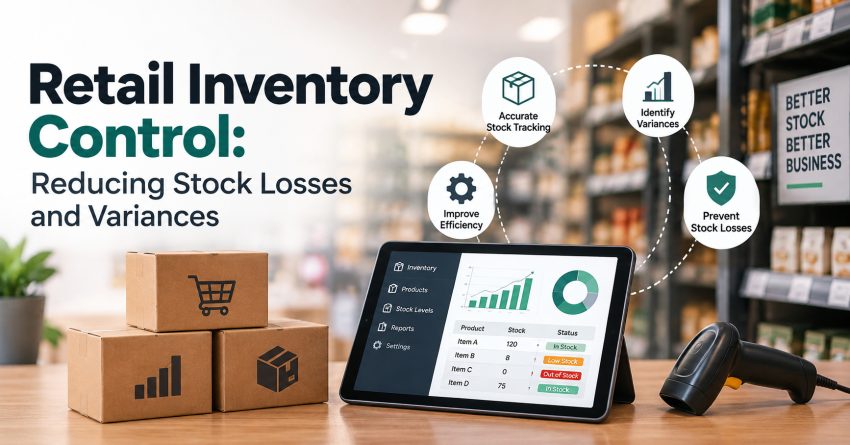
For retailers, every item on the shelf represents invested capital. Minor issues, such as items missing, damaged, wrongly entered or not accounted for, can have a large impact on profits. Good inventory management can assist retailers in keeping an accurate record of the goods, identify losses, and keep inventory available to the customer when needed.
What Factors Make Retail Stock Loss?
There are many reasons for inventory discrepancies. Such discrepancies can take place at any stage of the transaction process, from receiving goods to selling them.
The following are some of the common reasons for such:
- Thefts: Customers and even employees may steal items.
- Incorrect quantity received: The purchase document will not tally with the actual quantity received.
- Mislabeling item codes or quantities can result in incorrect data entry.
- Damaged items may remain listed as available inventory even though they are not saleable.
- Discrepancies between the quantity received and that listed on the invoice are supplier discrepancies..
Keep an accurate Stock Record.
Accurate records are the foundation of effective retail inventory control. All goods movements (e.g., purchases, transfers, sales, returns, write-offs) should be accounted for.
If you have a centralised system, it can help to minimise the need for manual spreadsheets and ensure that everyone in your organisation has the same access to stock information.
The bottom line: The best inventory control systems will have limited success if stock isn’t moved properly.
Do periodic stock counts.
Physically counting stock can assist retailers in comparing actual inventory with the numbers that appear in their inventory system. Some annual stocktake might be required, but a yearly-only stocktake can mean there can be discrepancies for too long.
Consider Cycle Counting
Retailers can choose to count specific products at periodic intervals, rather than all products at one time. More frequent checks can be made on high value or rapid moving goods or products, and longer cycles for lower risk goods or products.
This can help businesses to more easily manage stock verification and to identify discrepancies sooner when they’re recurring.
Enhance Receiving and Storage Controls
The starting point of inventory accuracy is when products enter the business. Employees are encouraged to check the items being delivered against purchase orders and supplier documentation for delivered quantity, product code and condition.
How things are stored is also important. Product labelling, stockrooms, access restrictions, and specific storage areas can minimise product misplacement and make physical product counts easier.
Collect data through the use of Technology to detect variability.
Contemporary inventory management systems can offer significant visibility into inventory flow. Retailers can use barcode scanners, point-of-sale integration, automated alerts and reports to detect unusual patterns.
In this instance, differences in the recorded and actual stock may be repetitive and suggest a process issue that needs to be investigated.
Technology must be used as a tool, and not a substitute for, human oversight. Staff should continue to check reports and make follow-up investigations on any unusual discrepancies.
Set up Accountability Across Teams.
But warehouse or store manager is not the only person responsible for inventory control. Various departments within a business, including sales, purchasing, warehouse, finances and management, affect stock accuracy.
To enhance accountability, businesses can do the following:
The responsibilities for stock handling have been clearly established.
- Providing staff with training on stock control measures.
- The stock should not be accessed by anyone except for the authorized person.
- Making entry of damaged and missing goods to the logbook
- Reviewing variance reports regularly
Use Inventory Data to Reduce Stock Losses
It is not all about counting products more frequently to reduce stock losses. Retailers should take the time to understand the reasons for the discrepancies and take corrective action to overcome them.
Using accurate records, the regular stock counts, controlled processes, the technology, and the accountability of employees, a business can build its inventory management stronger. More efficient use of stock will eliminate unnecessary losses, increase stock availability, aid purchasing and even benefit the retailer’s profitability.
The objective is straightforward – knowing what you have, where it is, and how it moves through the business
Frequently Asked Questions
Q: What is retail inventory control?
Retail inventory control is the process of accurately tracking goods as they move through a retail business. It includes recording purchases, transfers, sales, returns and write-offs so retailers can understand what stock they have, where it is and how it is moving.
Q: What causes inventory losses in retail businesses?
Common causes of retail inventory losses and discrepancies include theft, incorrect quantities received, incorrect data entry, damaged goods and differences between supplier invoices and the stock actually received.
Q: What is cycle counting in retail inventory management?
Cycle counting is a method of physically counting selected inventory items at scheduled intervals instead of counting all stock at once. High-value or fast-moving products can be checked more frequently, while lower-risk products can be counted less often.
Q: What is the difference between cycle counting and annual stocktaking?
Annual stocktaking involves physically checking the entire inventory, typically once a year, often once a year, whereas cycle counting checks selected products more frequently throughout the year. More frequent checks can help identify recurring discrepancies sooner.
Q: How can better inventory control improve retail profitability?
Stronger inventory control can help reduce unnecessary stock losses, improve product availability and support better purchasing decisions. Together, these improvements can contribute to more efficient stock use and retailer profitability.
Also Read: The Warehouse Productivity Secret: Smarter Inventory Management