Introduction
In today’s world of business, companies work in a more complicated environment of regulations, and hence, risk identification, compliance management, and operational efficiency become very crucial factors. In such cases, internal audit services play a pivotal role in meeting these goals. With the rise of artificial intelligence (AI), there has been a change in the process of conducting internal audits. Although conventional methods of auditing use mostly manual processes, with the introduction of AI, there has been a paradigm shift in this process.
Understanding Traditional Internal Audits
What Are Traditional Audits?
Traditional audits are carried out by experts who assess financial documents, procedures, and controls through manual inspections and interviews. Such audits employ set procedures to detect risks and make recommendations for improvement.
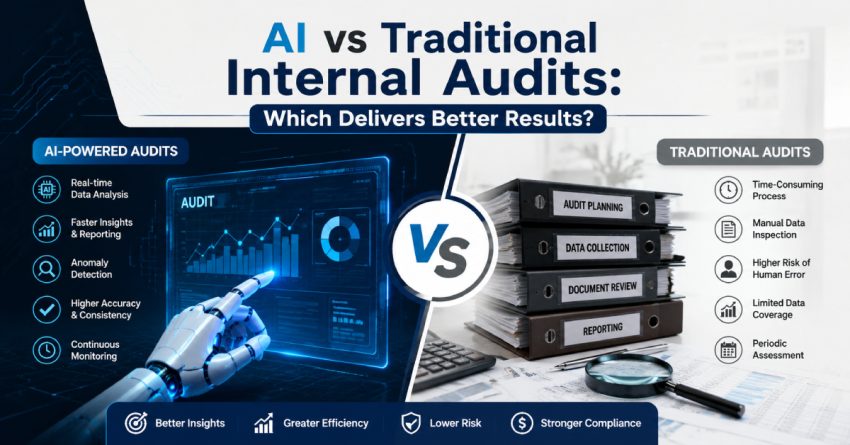
Characteristics of Traditional Audits
- Manual inspection of documents and transaction records
- Test of records on sampling basis
- Relying on judgment of the auditor
- Set schedule of periodic audits
Traditional audits are extremely useful in situations where professional judgment, ethics, and business background are important factors in decision-making.
How AI is Transforming Internal Audits
Artificial intelligence in audits
AI adds value to the auditing process by processing huge data sets in a matter of minutes, spotting trends, and flagging up any risks which could easily be missed when performing an audit manually. The algorithms learn from past audits, therefore becoming better at future audits as well.
Benefits of artificial intelligence
- Fast data processing
- Constant monitoring rather than periodic audits
- Better fraud detection
- Ability to analyze risks
- Documentation and reporting automation
More and more organizations are beginning to apply artificial intelligence in internal audit services.
AI vs Traditional Audits: A Comparison
Speed and Efficiency
The application of artificial intelligence allows for faster analysis of data compared to conventional auditing methods. While conventional auditing may take days, an AI audit can be done in a few hours.
Accuracy and Risk Identification
AI can detect subtle trends and anomalies throughout the entire dataset rather than just samples of data. On the other hand, conventional auditors can bring their professional skepticism into the process.
Decision Making and Adaptability
Conventional auditors have the ability to consider qualitative elements when analyzing situations such as culture and decision-making of the organization. AI is particularly effective when dealing with structured data.
Which Approach Delivers Better Results?
The Optimal Strategy Is a Blend of Both
Instead of considering AI and classical auditing as rivals, companies should treat them as two different yet interconnected approaches to auditing processes. While AI performs tedious routine actions, professional auditors check results, analyze them, and provide recommendations for improvement.
Here are some benefits of such an integrated approach:
- Higher auditing accuracy;
- Timely completion of auditing cycles;
- Better compliance with regulations;
- Better risk management;
- Making better decisions for the company;
- Savings in the long run.
Modern services of internal auditing provide their customers with both highly efficient AI technologies and experienced personnel.
Preparing for the Future of Auditing
Improving the Audit Function Smartly
Companies that wish to advance their audit processes should concentrate on:
Technology
- Use artificial intelligence-based analytics tools.
- Automate the process of auditing.
- Eliminate data barriers between different business systems.
Human Factors
- Prepare auditors for the data analysis process.
- Grow the ability to use artificial intelligence among auditors.
- Foster cooperation between technology and auditing specialists.
It allows companies to utilize both technology and humans to the fullest extent possible.
Conclusion
The discussion concerning the difference between AI and the regular audit process does not lie in the need to replace one with the other. The former offers unparalleled speed and analysis, while the latter provides expert knowledge and experience. Both contribute to making a more effective audit process that can detect risk factors and improve compliance and continuous improvement within an organization. As companies transform themselves through the use of technology, integrating internal audit services can yield better results.
Frequently Asked Question
Q: What is the difference between AI and traditional internal audits?
Traditional internal audits rely on manual document reviews, sampling, and auditor expertise, while AI-powered audits use automation, data analytics, and machine learning to analyze large datasets, identify risks, and improve audit efficiency.
Q: Are AI-powered audits more accurate than traditional audits?
AI can analyze entire datasets and identify hidden patterns that manual audits may overlook. However, traditional auditors provide professional judgment, business context, and ethical evaluation, making a combination of both approaches the most effective.
Q: What are the benefits of using AI in internal audits?
AI-powered internal audits offer several benefits, including:
- Faster audit execution
- Continuous risk monitoring
- Improved fraud detection
- Higher data accuracy
- Automated reporting
- Better compliance management
Q: What is the best approach for modern internal audits?
The most effective approach combines AI technology with experienced internal auditors. AI improves speed and data analysis, while auditors provide critical thinking, regulatory expertise, and business insights.
Q: How can businesses prepare for AI-enabled internal auditing?
Businesses can prepare by implementing AI-powered audit tools, integrating data across business systems, training audit teams in analytics and AI technologies, automating routine audit processes, and combining technology with experienced internal auditors for better governance and compliance.
Also Read: How Internal Audit Strengthens Third-Party Risk Management