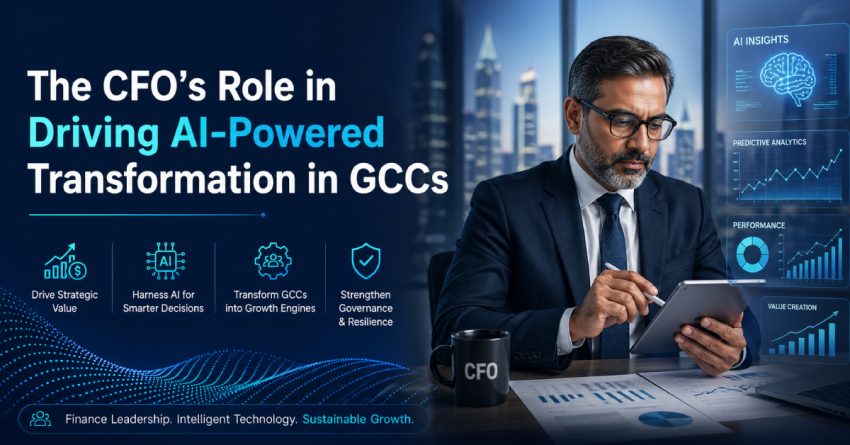
Global Capability Centres (GCCs) are increasingly becoming useful in finance, analytics, risk management and enterprise decision support. With the onset of artificial intelligence being integrated into the fundamental business operations, the Chief Financial Officer (CFO) has become one of the primary sponsors of AI-driven change in GCCs. The presence of the CFO will make AI investments consistent with the business value, financial discipline, and governance standards.
Moving from Automation Spend to Strategic Investment
Early AI implementation in GCCs that had a financial orientation usually revolved around the processing of routine activities like reconciliations, reporting and processing of transactions. Nowadays, the role of the CFO is to consider AI as a strategic investment. It involves specifying specific business results, authorizing utilisation cases with quantifiable returns and giving preference to projects that enhance forecasting, risk management and decision support as opposed to merely cost reduction.
Defining Value Metrics and ROI Frameworks
The CFO has the role of making sure that AI projects provide value. This involves establishing financial and operational measures including productivity improvement, reduction of cycle time, reduction of errors and increased visibility of cash flow. Defined ROI models can assist GCC executives to monitor progress and support the increment in successful AI implementations throughout the business.
Strengthening Data Foundations and Quality
AI systems rely on valid and stable data. CFOs ensure data integrity on a financial basis and have a lot of responsibility on enterprise reporting accuracy. In GCCs, the CFO assists in investing in data standardisation, governance and integration among systems. Well-built data bases mitigate the risk of models and enhance the credibility of AI-based insights.
Enabling Advanced Financial Planning and Analysis
Financial planning and analysis (FP&A) in GCCs are being revamped by AI-driven tools. Predictive forecast, scenario modelling, and variance analysis helps the team in the finance area to predict instead of responding to the results. The CFO leads the way in adoption by making sure that these tools facilitate strategic planning cycles, and they are aligned with the processes of decision-making within the enterprise.
Balancing Speed with Control and Compliance
Although AI is faster in making insights and executing them, it also paves the way to new risks. The CFO is important in balancing innovation and money management, audit requirement, and regulation. The governance structures establish the process of approval, documentation, and audit of AI-based outputs and hold accountability intact.
Supporting Talent Transformation in Finance GCCs
The adoption of AI alters the skills needs in GCCs. CFOs contribute to workforce change by making investment in upskilling initiatives aimed at analytics, data interpretation, and business partnering. Instead of decreasing the number of people required by the business, the AI will allow the finance professionals to transition to more valuable analysis and advice, as opposed to manual processing.
Partnering with CIOs and Business Leaders
GCCs need to closely integrate finance, technology and business functions in order to bring about AI-powered transformation. The CFO collaborates with CIOs and functional leaders to prioritize use cases, budget allocation and manage implementation risks. Through this alliance, AI programs facilitate budgetary rigor and efficiency.
Improving Risk Management and Fraud Detection
The use of AI tools add to risk monitoring in GCCs by detecting abnormalities, trends, and possible control violations. These capabilities have helped the CFO to enhance internal controls, identify fraud earlier and enhance compliance reporting. Human control is needed to interpret the results and to provide a corrective action.
Scaling AI through Standardization and Reuse
With the maturity of AI uses cases, CFOs facilitate the scaling strategy using standard models, shared platforms, and reusable elements within GCCs. This limits duplication, cost management, and speed of adoption in various regions. High concentration also enhances uniformity in reporting as well as performance measurement.
Demonstrating Enterprise-Wide Impact
The role of CFOs involves engaging the executive leadership and boards in making them aware of the effects of AI-driven GCCs. These connections between AI results and financial performance, reduction of risks, and strategic agility make CFOs play a key role in transforming GCCs into essential players in enterprise change.
Conclusion
Budget approval is not the only way the CFO can initiate AI-based change in GCCs. CFOs can make GCCs use AI responsibly and effectively by defining what value is, building stronger foundations of data, ensuring its governance, and empowering it to transform talents. This leadership will make the AI adoption be able to provide enduring financial and strategic benefits throughout the enterprise.
Also Read: Purpose-Driven Leadership: Building High-Performance GCCs