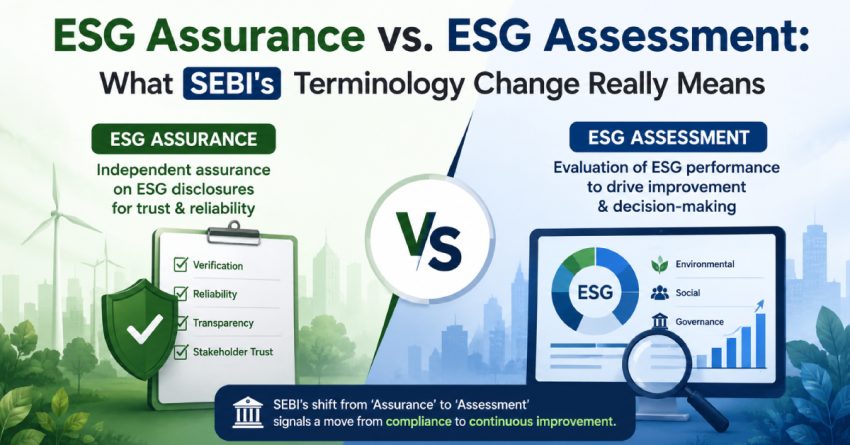
With the increasing importance of Environmental, Social and Governance (ESG) in business strategies, companies are becoming more aware of the expectations from the regulatory bodies. The recent development in the sustainability scene in India includes the shift in language by SEBI from “ESG Assessment” to “ESG Assurance.” This small shift in the language denotes the increased importance on the credibility and reliability of sustainability reporting.
Understanding this terminology change is essential for companies preparing for BRSR reporting, as it reflects evolving regulatory expectations around the credibility and reliability of ESG disclosures.
Evolution of ESG Reporting in India
India’s sustainability reporting model has seen a significant transformation in the recent years. Firms are no longer expected to report on their ESG activities; there is now an additional requirement to ensure that such reports are verifiable and measurable.
This reflects international expectations where sustainable data is required instead of mere claims from the investors’ and customer’s standpoint.
Importance of ESG Information
Quality information regarding companies’ environmental activities, social responsibility and sustainable business management allows for proper assessment of the companies’ sustainability and future performance. As sustainability is becoming an important investment criterion, the importance of quality information has increased along with that.
ESG Assessment: The Earlier Approach
What was ESG Assessment?
ESG Assessment involved measuring how an organization was performing sustainably using pre-established indicators or benchmarks. ESG assessment evaluated the firm based on environmental, social, and governance indicators.
Some of the outcomes included areas where the organization was strong and areas where the organization needed to improve its ESG maturity. Even though important, the objective was mainly to review practices and not to verify all data provided.
The Main Purpose of ESG Assessment
The purpose of ESG Assessment was to conduct an evaluation that would help firms improve their sustainability performance.
ESG Assurance: The New Focus
What Is ESG Assurance?
Whereas traditional ESG assessment is limited to evaluating the sustainability initiatives of a business, ESG assurance involves independent verification of the accuracy and completeness of the ESG reports. Therefore, an organization that goes through ESG assurance proves that it is able to support its claims with facts and follow the relevant reporting guidelines.
Such an approach helps companies improve their internal control environment and documentation practices.
The Scope of an ESG Assurance Review
Typically, an ESG assurance review will examine data collection and documentation procedures, governance procedures, reporting process, and conformity to sustainability standards.
Why SEBI’s Terminology Change Matters
Increased Accountability
The change from “Assessment” to “Assurance” indicates an increased level of accountability on the part of businesses, which will be required to keep better track of their data and have the sustainability statements verified by evidence.
Enhanced Investor Confidence
With investors using ESG reporting to guide their decision-making, assurance serves to boost the credibility of sustainability reports and alleviate worries regarding misleading and unsupported claims.
Effective Risk Management
With verified ESG data, businesses can detect reporting weaknesses, enhance governance, and take preemptive measures to manage the sustainability risks.
The Connection with BRSR Reporting
As the sustainability reporting of businesses improves, BRSR reporting is becoming increasingly important, especially when there is an adequate process of assurance behind it. Not only does correct reporting help meet regulatory standards but also shows a company’s dedication towards being transparent and practicing responsibly.
In such a case, businesses must make efforts towards ensuring an efficient system of data collection and internal governance in order to achieve effective BRSR Reporting.
Preparing for the Future of ESG Compliance
Developing Robust Internal Processes
Organizations need to develop internal mechanisms for collecting standardized ESG data, document the process properly, and review their reporting process on a regular basis.
Developing a Transparent Culture
ESG assurance is not just about fulfilling a compliance obligation; it is also a move toward becoming more transparent as an organization. Organizations adopting this strategy will find themselves well poised to build trust among stakeholders.
How CAC Can Support Your ESG Journey
Preparing for ESG assurance requires robust data management, effective internal controls, and alignment with applicable reporting requirements. CAC helps organisations strengthen their ESG reporting processes, improve data reliability, establish governance frameworks, and prepare for assurance engagements with greater confidence.
Conclusion
The move by SEBI from “ESG Assessment” to “ESG Assurance” is indicative of the commitment of SEBI to the improvement of the quality of sustainability reporting in India. Through the nomenclature shift, the need for assurance of information, good governance, and the need for factual reporting become clear. With evolving regulatory expectations, companies adopting an approach of assurance in their sustainability reporting would be better placed to achieve BRSR Reporting.
Frequently Asked Questions
Q: What is the difference between ESG assessment and ESG assurance?
An ESG assessment evaluates sustainability data, processes or performance using defined criteria. ESG assurance generally involves an independent engagement intended to enhance confidence in reported ESG information. The exact scope and level of verification depend on the applicable framework and engagement terms.
Q: How should a company prepare for ESG assessment or assurance?
The company should identify applicable indicators, assign responsibilities, standardise data collection, retain supporting documents, review calculation methods and conduct an internal readiness check before external verification begins.
Q: Can poor ESG data affect the verification process?
Yes. Incomplete records, inconsistent calculation methods, unclear ownership and unsupported claims can cause delays, additional queries and reporting weaknesses during assessment or assurance.
Q: Is ESG assessment or assurance a one-time exercise?
No. ESG data management should be an ongoing process. Regular monitoring allows companies to identify errors early, track performance consistently and remain prepared for every reporting cycle.
Q: How does CAC help improve the reliability of ESG data?
CAC can support businesses in defining data ownership, standardising reporting templates, documenting calculation methods, reviewing supporting records and establishing stronger internal controls around ESG information.
Also Read: How ESG and Technology Together Are Shaping Sustainable Businesses