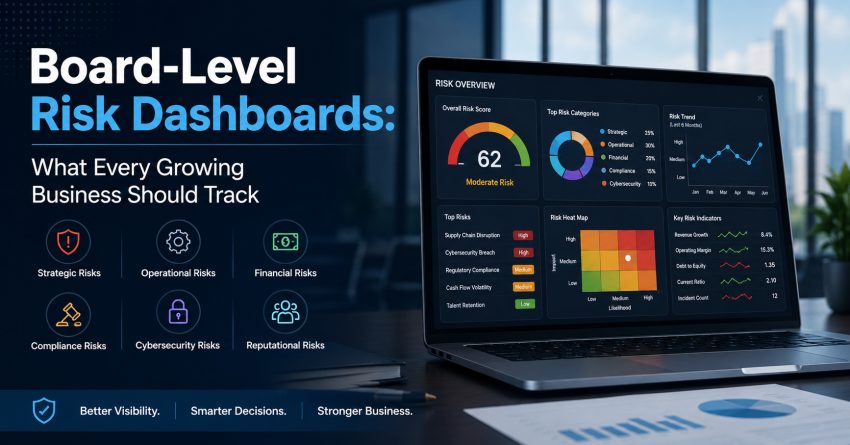
As businesses grow, the complexity and number of risks they face also increase. The operational team deals with day-to-day risks; however, the board requires some information about the risks the company faces at a much higher level to make its decisions. This is when the use of risk dashboards proves to be relevant.
With proper design, a dashboard allows the board to track performance, identify risks and improve governance through the use of risk metrics. Together with enterprise risk management, dashboards allow the board to make proactive decisions rather than react to problems.
Why Board-Level Risk Dashboards Matter
The directors have the responsibility of ensuring sustainability within the organization. The directors should receive short, concise, and actionable information.
Strategic Supervision
There is an effective way in which the leaders will be able to see the impact of the risks on the strategic goals through the dashboard.
Decision-making
By having up-to-date or real-time dashboards, it becomes easy to react to changes in business environment and market dynamics.
The Key Metrics That Every Growing Business Must Monitor
A well-designed dashboard must include measurable metrics aligned with business objectives.
Financial Risk Metrics
Cash Flows and Liquidity
Keeping track of cash reserves, working capital, and liquidity ratios assists in identifying possible financial risks in advance.
Customer Dependency
Businesses can analyze their dependencies on certain clients, sectors, or regions in order to be aware of the possible disruption risks.
Operational Risk Metrics
Operations Performance
Monitoring operational interruptions, production delays, and service interruptions is essential for identifying process deficiencies.
Supply Chain Reliability
Suppliers’ reliability, availability of inventory, and logistics performance are some of the important risk indicators for competitive businesses.
Compliance and Legal Risks
Regulatory Changes
It is vital for the boards to be aware of changing legal and regulatory environments that could affect operations or reporting processes.
Internal Controls Efficacy
Audit findings, policies compliance, and progress in implementing corrective actions are the metrics of effective governance.
Cyber Security & Technology Risk
Due to digital transformation, technology risks have been elevated up to the board level.
Security Incident Monitoring
Threat Discovery
Logging of attempted cyberattacks, phishing attacks, and system vulnerabilities will help strengthen the security approach.
System Availability
Downtime, recovery possibilities, and system performance are necessary for business continuity.
Reputation and ESG Risk Factors
The reputation of an organization can change swiftly because of any operational mistakes or stakeholder issues.
Client & Stakeholder Confidence
Client complaints, employee participation, brand sentiment, and stakeholder opinion can give a good understanding of reputational performance.
ESG Performance
Most investors and regulatory authorities want organizations to be governed responsibly and sustainably. Thus, adding ESG metrics to dashboards can be useful.
Building an Effective Risk Dashboard
Not all measures require board oversight. The dashboard needs to be focused and relevant.
Ensure the Dashboard Is Relevant and Useful
Apply visual signals, trends analysis, and thresholds in order to enable the directors to pinpoint any areas in need of improvement.
Regularly Evaluate and Revise Dashboard
The business environment changes all the time. A company needs to evaluate its dashboard periodically and ensure the metrics match new goals and challenges. The integration of a dashboard into the overall enterprise risk management framework will bring relevant data to the board.
Conclusion
Dashboard systems provide businesses with useful business intelligence. By measuring various types of business risks such as financial, operational, compliance, cyber security, and reputation, developing organizations are able to increase their governance and build their resiliency. With the help of an effective enterprise risk management framework, the dashboard systems enable boards to make good decisions and prepare for future issues.
Partner with CAC to create an enterprise risk management structure that ensures full transparency for your leadership on key business risks. Our professionals will assist you in developing proper risk dashboards and enhancing governance for better decision making.
Frequently Asked Questions
What is a board-level risk dashboard?
A board-level risk dashboard is a concise reporting tool that gives directors a clear view of the organisation’s most important risks. It typically highlights financial, operational, compliance, cyber security, reputational, and ESG-related indicators to support informed governance decisions.
Why does a growing business need a risk dashboard?
As a business grows, risks become more complex and harder to monitor through routine reports. A risk dashboard helps leadership identify warning signs early, understand their possible impact, and take action before issues affect business performance or reputation.
What are key risk indicators in a dashboard?
Key risk indicators, or KRIs, are measurable signals that show whether a risk is increasing or reducing. Examples include rising customer complaints, delayed collections, frequent system outages, policy violations, supplier delays, employee turnover, or unresolved audit findings.
How do ESG metrics fit into a risk dashboard?
Environmental, Social, and Governance metrics can help the board monitor sustainability commitments, governance practices, stakeholder expectations, employee-related risks, and regulatory developments. Including ESG indicators supports responsible and long-term decision-making.
Can CAC help create a board-level risk dashboard?
Yes. CAC can help businesses identify critical risk areas, define relevant KRIs, assess reporting gaps, and develop practical risk dashboards aligned with leadership and governance requirements.
Also Read: