Introduction
Each business entity irrespective of its size and sector requires a dependable mechanism for controlling the finances and mitigating any risks involved. Auditing serves a critical part in accomplishing all these requirements. But at times, many businesses find themselves torn apart over the issue of choosing between continuous audit and annual audit. Both have their own merits, but depending on the business environment, it is upon one to choose the best way forward.
Understanding Continuous Auditing
What Is Continuous Auditing?
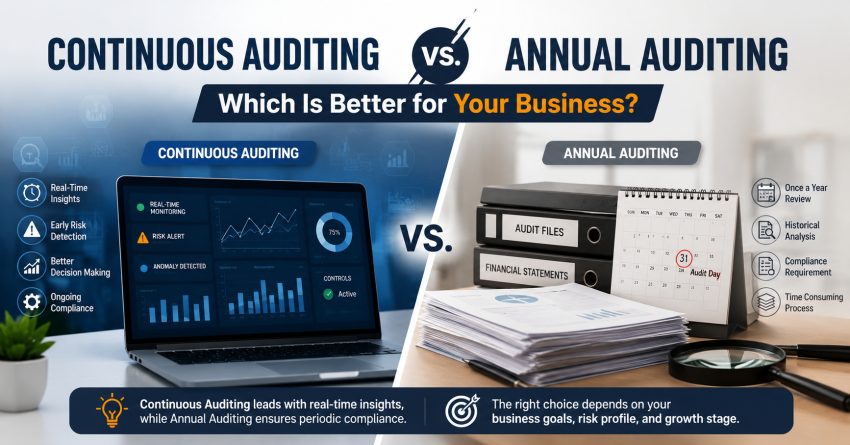
Continuous auditing refers to the ongoing review of financial transactions, operations, and internal controls throughout the year. Unlike traditional auditing, continuous auditing involves the review of data either in real time or during predetermined time frames as opposed to waiting for the end of the financial year.
Main Advantages
- Early detection of errors.
- Operational effectiveness.
- Good decision making.
- Reduced risk of fraudulent activity.
Most companies in fast-moving industries favor continuous auditing due to its flexibility.
Annual Auditing Defined
What Is Annual Auditing?
The process of annual auditing takes place once each year. It involves an evaluation of the financial reports, internal control systems, and adherence to the relevant legal requirements.
Key Advantages
- It offers a complete analysis of financial performance for the year.
- It satisfies the required legalities.
- It promotes investor and lender confidence.
- It offers suggestions for improvement.
Annual audits continue to be very important in businesses requiring formal financial reporting.
Continuous Auditing vs. Annual Auditing
Frequency of Review
Continuous Auditing
Financial transactions are monitored on a regular basis to help companies address any arising problems.
Annual Auditing
A yearly review of the financial information is done to analyze the business operations retrospectively.
Risk Management
Continuous Auditing
Continuous assessment allows for the detection of possible risks before they turn into serious problems that the company can address in a timely manner.
Annual Auditing
Even though the annual audit process identifies the areas of weakness, it might be too late to act upon the findings since the fiscal year has come to an end.
Costs and Resources
Continuous Auditing
This method might require more work from auditors and technologies but can pay off in terms of fraud prevention and risk management.
Annual Auditing
Annual auditing generally requires fewer ongoing resources than continuous auditing, although costs vary depending on the scope and complexity of the audit.
Which Option Is Better for Your Business?
Selecting the Best Option
The best auditing process will depend on some considerations, which include the following:
Size of the Business
Big companies having various departments and many transactions can use continuous auditing processes.
Industry Rules and Regulations
Industries that are highly regulated such as banks, hospitals, and manufacturing industries may need continuous auditing to be in compliance.
Risks Involved
The level of risks involved in your business can determine whether you should seek continuous auditing from internal audit firms.
Can Businesses Combine Both Approaches?
Hybrid Approach
It is common for companies to have a hybrid auditing approach where they conduct continuous auditing for essential operations throughout the year and perform annual audits for legal purposes and financial evaluation of the entire year.
Advantages of Such Approach
Such an approach helps in risk management while ensuring compliance with regulations and enables decision-making by management using current and year-end financial data.
Conclusion
It is not possible to make blanket statements while deciding between continuous and annual auditing since continuous auditing allows for proactive monitoring and early detection of risks whereas annual auditing gives a complete overview that helps in meeting regulatory requirements. Organizations need to consider their own needs and requirements while selecting any of these two methods and it is always recommended to engage professional internal audit services in this regard.
Strengthen your financial controls and stay ahead of business risks with CAC’s expert internal audit services tailored to your organization’s unique needs.
Frequently Asked Questions
Q: What is the difference between continuous auditing and annual auditing?
Continuous auditing reviews transactions, controls, and risks throughout the year, often at regular intervals or through technology-enabled monitoring. Annual auditing is a formal review conducted once a year to assess financial statements, compliance, and overall financial performance.
Q: Is continuous auditing better than annual auditing?
Neither approach is universally better. Continuous auditing is useful for early risk detection and ongoing control monitoring, while annual auditing supports year-end reporting, compliance, and stakeholder confidence. Many businesses benefit from using both.
Q: Which businesses need continuous auditing the most?
Businesses with high transaction volumes, multiple locations, complex operations, or strict regulatory obligations may benefit the most. This includes sectors such as banking, healthcare, manufacturing, retail, e-commerce, and financial services.
Q: How can CAC help businesses implement continuous auditing?
CAC helps businesses develop risk-based continuous auditing frameworks, review key controls, assess compliance gaps, and introduce practical monitoring processes for timely issue identification.
Q: What is a hybrid auditing approach?
A hybrid approach combines continuous monitoring of important controls and transactions during the year with a comprehensive annual audit. It helps management respond to risks quickly while meeting year-end reporting and compliance needs.
Also Read: How Internal Audit Strengthens Third-Party Risk Management