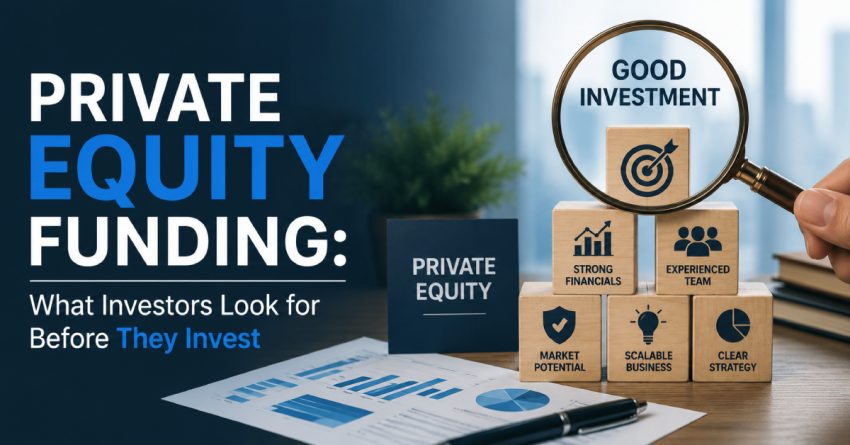
Expansion and the development of new products may necessitate substantial amounts of finance in private companies. While traditional financing options such as loans can support business growth, many high-growth companies prefer private equity or venture capital funding to accelerate expansion, strengthen operations, and access strategic expertise. This is when private equity and venture capital become invaluable. The money is only part of the value offered by such types of financing; the other parts include the advice and connections.
The investors do not simply make decisions based on the promise alone; rather, they perform evaluations to determine whether the company will be able to yield profit in the long run. It is essential to find out what the investors assess before they decide to invest.
Understanding the Investment Mindset
Reasons Why Investors Conduct Thorough Assessments
All investments come with some degree of risk. Investors seek to minimize risk by thoroughly analyzing all aspects of the firm before investing in them. The idea is to find firms that are growing sustainably, are efficient, and have a good competitive advantage.
Investors tend to look at more than just the present performance of the firm.
Key Factors Investors Consider
A Solid and Scalable Business Model
The first thing that investors look at is the business model. It will help them to see how the company earns money, if the model scales well, and how flexible it is in changing circumstances.
Companies that have recurrent income, customer demands, and smooth business operations usually appeal more to investors.
Experienced Leadership Team
Leadership Fuels Business Success
The quality of an experienced management team is often just as vital as the concept behind the business. Investors require founders and leaders who have relevant experience, leadership qualities, and execution abilities.
Market Opportunities
Market Size and Growth Potential
The investors look closely at the market in which the business works. They evaluate the growth of the industry and its size as well as whether the demand for the products will stay high in the future.
Those companies that are involved in the expansion of markets by offering something new attract attention.
An experienced leadership team instills trust that the firm will be able to overcome challenges and take advantage of growth opportunities.
Financial Performance and Stability
Good Financial Statements
Having good financial statements shows that there are clarity and good financial management within a company. Investors look at sales performance, profitability, liquidity, debt structure, and efficiency before investing.
Companies having well-organized financial statements lower the amount of risk and due diligence work.
Strategy for Realistic Growth
Expansion Strategies That Are Sustainable
Whereas setting high expectations is enticing, investors like enterprises have realistic plans that can be accomplished. They analyze the growth strategy, milestones, and the amount of effort needed to reach their future goals.
Enterprises looking for private equity and venture capital should make realistic forecasts based on dependable market research.
Competitive Advantage Matters
Creating Distinction in the Market Place
There needs to be a clear reason as to why consumers buy from the firm rather than other firms offering similar products and services. Investors look for things that distinguish a company like proprietary technology or unique branding.
Having a competitive advantage leads to sustainable profits.
Governance and Risk Management
Good Corporate Practices
Other areas that investors look at are corporate governance, legal considerations, and risk management strategies. Companies that operate with transparency, good business ethics, and strong internal controls tend to be considered low-risk investments.
Good governance proves that the company is ready for growth and sound financial management.
Conclusion
Securing financing is not just about coming up with a good business plan; it is about being prepared to showcase good leadership, sound financial, business potential, competitive advantages, strong governance practices, and scalability. Businesses that prepare well in advance and develop realistic business growth strategies have much higher chances of obtaining financing.
In the face of increasingly stiff competition for financing, having knowledge about what private equity and venture capital require will help create strong businesses and successful investor relations.
Frequently Asked Question
Q: What is private equity funding?
Private equity funding is capital invested in a private business in exchange for an ownership stake. Investors generally support companies with strong growth potential, scalable operations, and a clear path to value creation.
Q: What financial information is needed for private equity due diligence?
Businesses should be prepared with accurate financial statements, revenue trends, profit margins, cash-flow details, debt information, forecasts, tax records, and working-capital data.
Q: How can CAC support businesses preparing for private equity funding?
CAC can help businesses evaluate financial readiness, strengthen governance and internal controls, refine growth plans, support due diligence preparation, and develop a structured approach to investor discussions.
Q: Can CAC help companies understand their funding readiness before approaching investors?
Yes. CAC can assist businesses in identifying financial, operational, strategic, and compliance areas that may need attention before starting discussions with private equity or venture capital investors.
Q: Why is market size important to private equity investors?
Market size helps investors understand the company’s future growth opportunity. Businesses operating in growing markets with sustained customer demand are often better positioned to attract investment.
Also Read: The ESG Surge in Private Equity and Venture Capital: Invest Smart, Negotiate Smarter