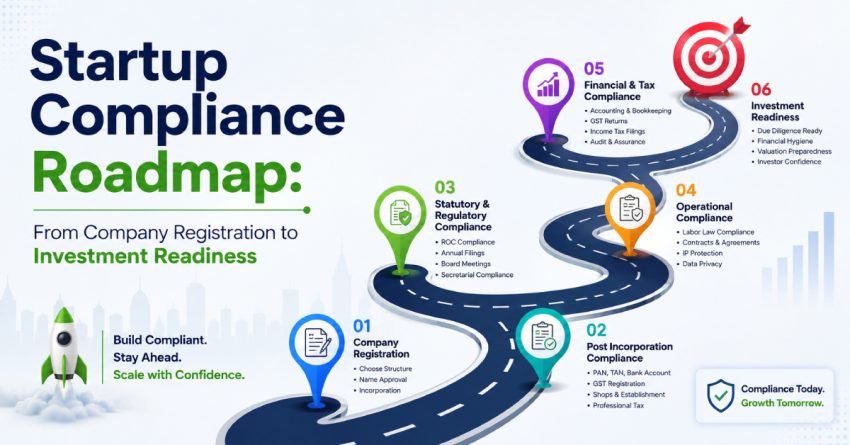
Starting a new venture is an interesting process; however, its ultimate success is based on something more than having a great idea. Every company needs to create a solid legal and financial base for itself to be legitimate, not to have any problems with law enforcement, and attract investments. A well-defined compliance roadmap helps entrepreneurs establish a strong legal and financial foundation, meet regulatory requirements, and prepare their businesses for sustainable growth and future investment opportunities.
Step 1: Build a Strong Legal Foundation
Selecting the Correct Business Entity
The first step towards setting up a successful startup is the selection of a suitable business entity. There are many forms of business entities available to entrepreneurs in India such as the Private Limited Company, the Limited Liability Partnership (LLP), or One Person Company (OPC). The choice depends upon the objectives of the firm, its ownership, and financing strategy. Investors are usually keen on investing in businesses having corporate structures.
Completing the Incorporation of the Startup
The process of startups registration in India comprises securing necessary approvals, incorporating the firm and ensuring the availability of various identification numbers required for tax purposes and conducting business.
Step 2: Obtain Essential Registrations and Licenses
Registrations for Taxes and Regulators
Startups must get their compulsory registrations done, which include GST registration, if necessary. Companies must also get themselves registered for PAN, TAN, and any other specific license required to run their business.
Compliance with Industry Regulations
Industries have their own set of regulations that need to be followed by businesses that operate in such industries. If your company belongs to any particular industry, it is essential that you know what kind of certifications are necessary for you to start your business.
Step 3: Maintain Financial Compliance
Appropriate Accounting Practices
Effective accounting is essential for being compliant. Every transaction must be documented so that the startup can prepare financial statements, pay the correct amount of taxes, and be transparent during auditing.
Filing Income Tax Returns and GST Returns
Income tax returns and GST returns need to be filed within the prescribed deadline to avoid penalties. This will improve the financial standing of the firm.
Step 4: Protect Intellectual Property
Securing Business Assets
Creative innovations, logos, programs, product designs, and trademark names are all considered to be business assets. Trademark, copyright, or patent registration ensures that such intellectual property is protected and gives startups a competitive edge.
Building Investor Confidence
Businesses which have secured their intellectual property rights tend to attract investors since they minimize the legal risks associated with running a business.
Step 5: Prepare for Investment Readiness
Corporate Documentation Preparation
When approaching investors, startups should have their statutory books, shareholder agreement, resolutions, accounts, and compliance documents well prepared. It makes diligence easier and portrays proper management of the business.
Scalable Compliance Structure Development
When businesses require funding, they need to put in place corporate governance structures, reporting systems, and compliance checks within the organization. Registration of startups in India is just one of the many steps taken towards compliance.
Final Checklist Prior To Raising Investment
Confirm That All the Requirements for Compliance Have Been Met
Investors look at much more than innovation or market potential in their decision-making. They examine whether the business follows its obligations, exercises financial discipline and has put in place proper governance structure. Proper startups registration in India, keeping proper accounts, protection of intellectual property rights and statutory requirements greatly enhance the investment-readiness of the startup.
How CAC Supports Startups
Navigating startup compliance can be complex, especially as regulatory requirements evolve. CAC helps startups with company registration, statutory compliance, tax registrations, accounting, corporate governance, and investment readiness. Our advisory services enable entrepreneurs to build compliant, scalable businesses that are well-prepared for investor due diligence and long-term growth.
Conclusion
The journey from company registration to investment readiness requires more than a strong business idea—it demands consistent compliance, sound financial management, and effective corporate governance. By following a structured compliance roadmap, startups can reduce regulatory risks, strengthen investor confidence, and build a solid foundation for long-term growth. With the right advisory support, businesses can confidently navigate each stage of their startup journey and prepare for future funding opportunities
FAQs
Q: What is a startup compliance roadmap?
A startup compliance roadmap is a structured plan covering incorporation, registrations, licences, accounting, taxation, intellectual property, employment obligations, corporate governance and investment-related documentation.
Q: Can CAC help a startup become investment-ready?
CAC can support investment readiness by reviewing financial records, statutory documents, ownership information, internal controls and corporate-governance processes before the startup approaches investors.
Q: What are the most common startup compliance mistakes?
Common mistakes include selecting an unsuitable entity, missing filings, mixing personal and business expenses, failing to document decisions, issuing shares incorrectly, ignoring IP ownership and approaching investors with incomplete records.
Q: Do startups need a founders’ agreement?
A founders’ agreement is strongly advisable for startups with multiple founders. It can define roles, ownership, decision-making, intellectual-property rights, vesting, confidentiality and the process to follow if a founder leaves.
Q: What is an investment-ready startup?
An investment-ready startup has a viable business model, clear ownership structure, accurate accounts, organized statutory records, protected intellectual property and a realistic growth plan that can withstand investor due diligence.
Also Read: How Incubators and Accelerators Empower Startup Growth