Introduction
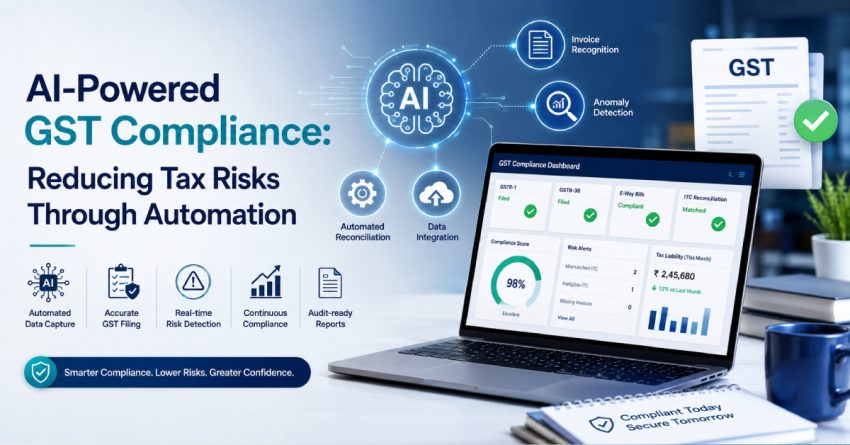
Businesses are now operating in a world characterized by changing tax laws. The manual management of Goods and Services Tax (GST) is time-consuming and error-prone in the case of large organizations that have many transactions. AI technology is revolutionizing the way businesses manage GST compliance by identifying data inconsistencies, reducing manual effort, and saving valuable time and resources. This will enable firms to minimize any risk associated with taxes, and it makes the GST audit process more efficient.
Why Traditional GST Compliance Faces Challenges
Manual Processes Increase the Risk of Errors
Traditional GST processes involve spreadsheets and manual data input. Any miscalculations in terms of invoices, taxation calculation, or filing of the returns may lead to fines or failure to comply.
Problems May Involve:
- Incorrect GST classification
- Mismatching of invoices
- Error of data input
- Late return submission
- Having problems with updates of regulation requirements
The above problems indicate that there is a need for advanced methods of GST compliance.
The Role of AI in GST Compliance
Automated Process for Enhanced Efficiency
The use of artificial intelligence enables automation of various compliance procedures while continually assessing financial data. This helps in detecting problems at once rather than waiting for the time of filing as in the case with the conventional methods.
Capabilities Offered by AI
- Invoice validation through automation
- Purchase and sales ledger synchronization
- Tax assessment automatically
- Identification of duplicate invoices
- Compliance notification automatically
- Tax anomalies prediction
This significantly improves the efficiency and accuracy of the GST audit process.
How AI Reduces Tax Risks
Detection of Compliance Risk Factors Early
The most notable aspect of AI is that it detects irregularities in transaction patterns before they pose any compliance risks.
Minimizing Risks through Automation
- Finds invoice discrepancies immediately
- Picks up wrong GST rates
- Detects the absence of input tax credits
- Vendor compliance monitoring
- Suspicious transactions detection
This prevents firms from facing notices and penalties.
Continuous Monitoring Instead of Periodic Reviews
In the traditional method of compliance, checks were conducted only periodically at monthly or yearly intervals. On the other hand, continuous monitoring is the feature of AI-based system.
Benefits for Businesses
Increased Efficiency in Operations
Automating routine processes enables the finance department to engage in effective financial planning rather than engaging in manual verifications.
Major Benefits for the Business
- Quick processing of GST returns
- Achieving accurate reports
- Diminishing costs involved in operations
- Consistent data
- Good compliance
- Real-time decision making
This ensures good financial governance and makes life easier for accounting departments.
AI and Data-Driven Decision Making
Going Beyond Compliance
In addition to automating tax compliance, modern AI systems provide useful intelligence based on analysis of patterns of transactions, suppliers, and tax trends. Such information may be used by organizations to enhance their procurement operations, manage cash flows, and control finance functions.
With the application of advanced analytics, each GST audit provides a chance to streamline business processes and not just comply with regulations.
Conclusion
With the help of AI, GST compliance is revolutionizing the way of future tax management. It not only makes the process quicker, more precise, and less risky, but with the use of automation, continuous monitoring, and predictive analysis, it helps organizations in reducing compliance errors along with increased operational efficiencies. With constantly changing tax laws, incorporating AI-driven tax compliance solutions helps businesses prepare for evolving regulations and minimize potential tax risks.
Frequently Asked Question
Q: What is AI-powered GST compliance?
AI-powered GST compliance uses artificial intelligence and automation to manage GST calculations, validate invoices, monitor transactions, detect errors, and simplify tax filing while ensuring compliance with GST regulations.
Q: What are the benefits of AI-powered GST compliance solutions?
AI-powered GST compliance solutions offer several benefits, including:
- Faster GST return filing
- Improved tax accuracy
- Reduced manual errors
- Real-time compliance monitoring
- Lower operational costs
- Better financial governance
Q: How does continuous monitoring improve GST compliance?
Continuous monitoring allows AI systems to track financial transactions in real time, identify compliance risks immediately, and help businesses take corrective action before filing GST returns.
Q: Why is AI-powered GST compliance becoming essential for businesses?
As GST regulations continue to evolve, AI-powered compliance solutions help businesses stay compliant, reduce tax risks, improve operational efficiency, and manage tax obligations with greater speed, accuracy, and confidence.
Q: How does AI reduce GST-related tax risks?
AI detects invoice mismatches, incorrect GST rates, duplicate invoices, missing input tax credits, and suspicious transactions before they become compliance issues, helping businesses avoid penalties and notices.
Also Read: Why Data Accuracy is Critical in GST Audits