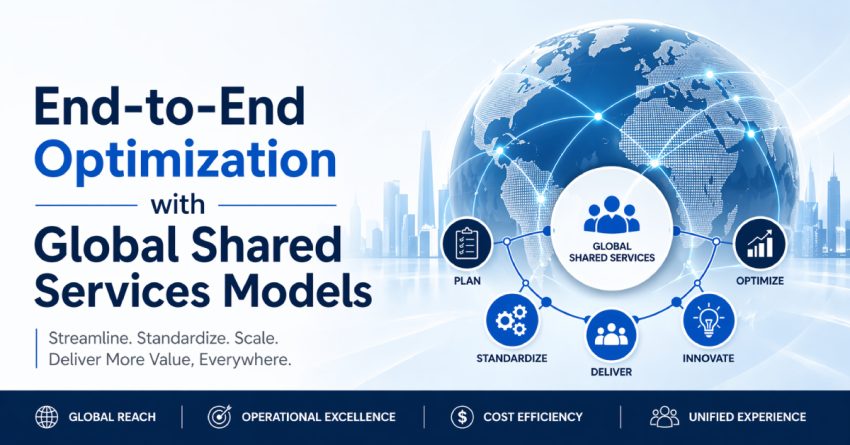
Global Shared Services (GSS) models have become an effective strategic building block of companies that require achieving operational excellence, cost effectiveness and uniform service delivery to its clients and regional markets. It is a necessity to have stream-lined, standardized and end-to-end optimized processes increase as the enterprises grow in size and complexity. End-to-end optimization using Global Shared Services Models is the way that the business will shift its operations form siloed to coherent, and unified systems of operation that provide a tangible benefit to the entire business.
Understanding End-to-End Optimization in GSS
End-to-end optimization is termed as the total change in a business process- that is its initiation to the end- with functions, system and geographies. Organizations redesign workflow to eliminate redundancy, manual dependencies, improve transparency and provide consistency over the isolated activities rather than improvements.
This optimization is more effective in the framework of Global Shared Services Models. GSS incorporates various business processes like finance, HR, IT, procurement, and customer support into a centralized model and organizations are able to operate together and under a common standard with smooth coordination.
Why End-to-End Optimization Matters
Eliminates Fragmented Processes
Lots of companies are troubled with disconnected workflows within the departments and territories. End-to-end optimization enables the standardization of processes, interconnectivity and synchronization of processes within the whole framework of service delivery.
Enhances Efficiency and Reduces Cost
By removing duplication, automating repetitive tasks, and improving data flow, businesses achieve significant cost savings and faster turnaround times. Global Shared Services enable economies of scale that amplify these benefits.
Improves Data Accuracy and Visibility
The singular system enables the teams to monitor performance metrics, identify inefficiencies at an earlier stage, and make decisions. End to end optimization helps in real time reporting and also in maintaining data quality in all functions.
Strengthens Customer and Employee Experience
Efficient processes imply more speed, less mistakes, and consistency. It can be the inner teams or the outer customer, but all people have easier interactions.
Key Components of End-to-End Optimization in GSS
Standardization of Processes
The basis of GSS is standardization of workflows in different regions and departments. It allows consistency in the service quality and reduces variations in the process.
Automation and Digitalization
Robotic process automation (RPA), AI and cloud solutions are some of the technologies that have a significant contribution to end-to-end optimization. Automation improves speed, eases manual labor, and liberates the teams to engage in strategy.
Centralized Governance
Effective governance will make sure that policies, adherence, risk management, and service-level agreements (SLAs) are uniform across the enterprise.
Continuous Improvement Culture
The process of end to end optimization is not a single undertaking. GSS models encourage the idea of continuous improvement that is reinforced by data analytics and periodic performance evaluations.
How GSS Enables True End-to-End Optimization
Global Shared Services Models inherently support end-to-end optimization through:
- Unified service delivery frameworks that reduce duplication
- Integrated systems for seamless data flow
- Cross-functional collaboration that breaks traditional silos
- Centralized performance monitoring to identify gaps quickly
- Scalable infrastructure to support global operations
Through GSS, organizations are able to make sure that processes between procurement and payment, between hire and retire or between order and cash are carried out with efficiency without delays and inconsistencies.
Conclusion
End-to-end optimization using Global Shared Services Models is a disruptive strategy that propels operational excellence, agility, and long-term value deployment. With organizations becoming increasingly complex, the integration of an optimized GSS framework is a way to build a lean, integrated, and future-oriented organization. The efficiency, innovation, and high-quality service delivery help companies with the holistic approach to gain a competitive advantage.
Also Read: Discussing the Top Trends Reshaping Global Business Services