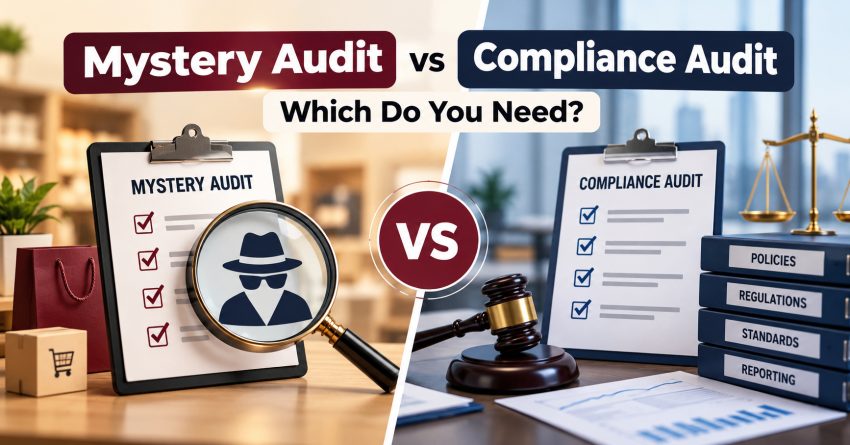
Retailers need to understand both whether their stores follow operational standards and whether customers receive a consistent shopping experience. A compliance audit evaluates adherence to established policies, procedures and operational requirements, while a mystery audit assesses the customer experience through an anonymous shopper. Understanding the difference between mystery audits and compliance audits helps retailers choose the right approach for their business objectives.
Use a checklist to ensure you comprehend the purpose of each audit
The primary difference is that each audit is intended to measure a different aspect. A compliance audit will be based on policies, procedures and operational requirements. It could review such topics as documentation, billing procedures, stock management, employee compliance with safety regulations, etc.
A mystery audit, on the other hand, assesses the actual experience of customers by employing a mystery shopper who engages with the store but never gives their name out. When employees don’t know that they are being audited, Mystery audit in retail can help them to understand if they are adhering to the service standards or not.
What a Compliance Audit Checks?
Typically, compliance audits are conducted based on a set of requirements. Auditors can go into retail outlets and look to see that employees are using the organisation’s procedures.
Typical areas addressed are:
- Record opening and closing procedures
- Cash-handling and billing controls
- Making and keeping stock records and handling of stock
- Display and merchandising standards
- The safety and security measures in place
- Employee adherence to company policies
Results can be used to identify areas of need for management to address or for further training.
What can come from a Mystery Audit?
Mystery audits pick up on the customer journey much more. The evaluator acts as a normal customer, making observations to predefined criteria.
In retail, Mystery audit can look at:
- How quickly customers are attended to
- Employees’ knowledge of products/services
- Staff behaviour and communication
- Cleanliness and presentation
- Efficiency and accuracy of the billing and payment process
- How staff members interact with customers
This can show variations between the service a business expects and the service that the customers actually receive.
When to consider a Compliance Audit?
A compliance audit is more suitable if the main risk is that the operation is inconsistent with the internal policies. It can be very helpful for companies that have several branches and want to have uniform processes in each.
For instance, if a store has implemented different cash handling processes, a compliance audit could be used to assess if the stores are adhering to the new processes.
When is a Mystery Audit more Useful?
In retail, mystery audit is a helpful tool for auditing if customer experience is a key business focus. It can aid management to know how employees interact with customers in real life situations.
It can help a company to evaluate:
- Service quality across multiple outlets
- Employee behaviour and communication
- Product knowledge
- Customer handling
- Store presentation
Use BOTH to get a more complete view
These audits don’t need to be done in succession. They can give complementary information in many situations. A compliance audit is a way to determine if employees are compliant with the documented procedures, and a mystery audit is a way to determine if the documented procedures actually result in satisfactory customer experience.
A retailer might discover that the required billing process is being followed in compliance check but does not have a clear understanding of product presentation with customers. Both can be used to give a wider perspective of operational performance.
Select a business objective and use it as a basis for the selection
The right audit is dependent on the business’s desires to know. A compliance audit might be more appropriate for identifying gaps in processes, policies and controls. However, if the point of focus is on customer experience and employee interaction, then mystery audit for retail could yield more meaningful information.
When retailers have more than one store, a combination of both strategies may yield greater insight into current operational areas of improvement, enhance consistency and enhance customer-facing performance. These results can then be used to deliver targeted training, enhance processes and agree performance standards.
Managing multiple retail outlets requires a clear understanding of both operational compliance and customer experience. CAC’s retail audit services help businesses identify process deviations, evaluate store-level performance, strengthen accountability and improve service consistency across locations.
Contact CAC to discuss a retail audit approach suited to your business needs.
FAQs
Q: How can mystery audits help retailers improve customer experience?
Mystery audits help retailers evaluate staff behaviour, product knowledge, service quality, customer interactions and the overall shopping experience. The findings can help identify service gaps and guide targeted employee training.
Q: What does a compliance audit check in a retail store?
A retail compliance audit examines billing procedures, stock management, store operations, employee adherence to policies, merchandising standards, and safety measures.
Q: How can CAC support retail businesses through mystery and compliance audits?
CAC helps organisations identify operational deviations, evaluate customer-facing practices, strengthen accountability, and use audit findings to guide training and process improvements.