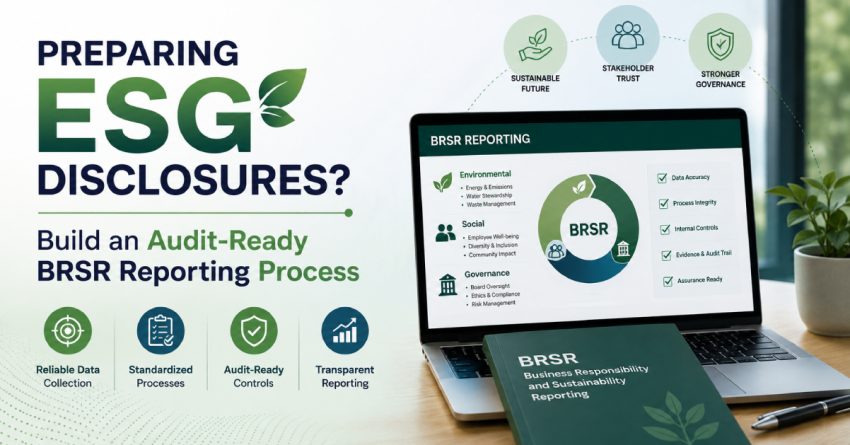
Environmental, Social, and Governance (ESG) reporting has gained importance in the field of corporate reporting in India. In a world where companies are being measured based on sustainability, ethics, people management, and governance, it is not sufficient for companies to just have good ESG disclosures. Companies require an effective and evidence-based reporting process.
An effective BRSR reporting process will enable organizations to compile ESG data systematically.
Why an Audit-Ready ESG Process Matters
Beyond Just Collecting Information
An ESG process encompasses information from various departments such as finance, human resources, operations, procurement, compliance, and sustainability units. The lack of structure and defined responsibility in the manual process of collecting information could result in inconsistency, lack of evidence and delays.
An audit-ready process entails well-defined responsibility and documentation from the get-go.
Evidence Builds Trust
The ideal ESG statement must have credible evidence behind it. From energy usage to employee actions, waste management to governance policies, organizations should be able to show where the information comes from and how it was obtained.
Key Steps to Build an Audit-Ready BRSR Process
Identify Ownership of ESG Metrics
Identify Owners
The first step involves identifying who is responsible for each ESG metric to ensure consistency and review of the data prior to its submission.
ESG coordinator or the reporting team within an organization can address conflicts between departments.
Create Standard Templates
Reduce Inconsistencies in Reporting
Each department might use different templates and ways of defining metrics and calculating values. Standard templates will help to minimize inconsistencies in these processes.
Organizations need to clarify units of measurement, time periods when data was recorded, methods of calculation, and relevant documents for each particular metric.
Establish Traceability of Information
Establish Connection Between Metrics and Source Documents
It is necessary to ensure audit-ready reporting by establishing connections between the data reported and source documents. They could include utilities bills, payroll, policies, and vendor, environmental, and register information from the organization.
Establishing Review and Validation Controls
Before Consolidation
Information has to be validated before its use in the consolidated report. Variances, exclusions, calculations errors, and differences from the prior period can all be analyzed. Managerial review could be another layer of control.
Strengthening the Reporting Workflow
Leverage Technologies Wisely
The use of ESG reporting technology can assist companies in gathering data, ownership tracking, documentation of findings, and monitoring the process of reporting. Automated processes can also increase transparency regarding pending reports and reviewing phases.
Maintain Consistency of Methods
It is important to remember that consistency matters when assessing ESG performance for various time periods. All changes in the methods of calculations need to be clearly documented and communicated.
Preparation for Assurance and Stakeholder Scrutiny
Perform an Internal Readiness Check
In the preparation for the release of reports, companies may conduct an internal check that will allow the identification of gaps in data, unsubstantiated claims, mistakes in calculations and processes. As a result, such a well-controlled BRSR reporting mechanism will be a continuous process.
Conclusion
The development of an auditable ESG disclosure process requires collaboration, standardization, documentation, and effective internal controls. Through assigning ownership, ensuring evidence availability, verifying data, and constantly enhancing reporting processes, companies can make ESG disclosures more valid and efficient.
Overall, efficient BRSR reporting is not only about satisfying disclosure requirements but about developing a trustworthy information base.
Looking to make your ESG disclosures more structured, reliable, and audit-ready?
CAC’s BRSR reporting services can help strengthen your reporting processes, improve data readiness, and build a more robust ESG disclosure framework.
Frequently Asked Question
Q: What is BRSR and why is ESG reporting becoming essential in India?
Business Responsibility and Sustainability Reporting (BRSR) is the mandatory ESG disclosure framework designed to standardize corporate sustainability reporting in India. ESG reporting is essential because investors, regulators, and stakeholders increasingly measure companies on their environmental impact, ethical practices, human capital management, and corporate governance rather than financial performance alone.
Q: What is BRSR and why is it important for ESG reporting in India?
Business Responsibility and Sustainability Reporting (BRSR) is an ESG disclosure framework in India. It helps eligible companies report standardized information on environmental, social, and governance performance.
Q: What does an audit-ready BRSR reporting process mean?
An audit-ready BRSR process ensures ESG data is properly collected, documented, reviewed, and traceable to supporting evidence. It includes clear metric ownership, standardized templates, and appropriate review controls.
Q: How can CAC help with BRSR reporting?
CAC can help business’s structure BRSR data collection, establish reporting controls, improve documentation, conduct readiness checks, and develop a more reliable and audit-ready ESG reporting process.
Also Read: How BRSR Reporting Builds Brand Trust and Market Credibility