Introduction
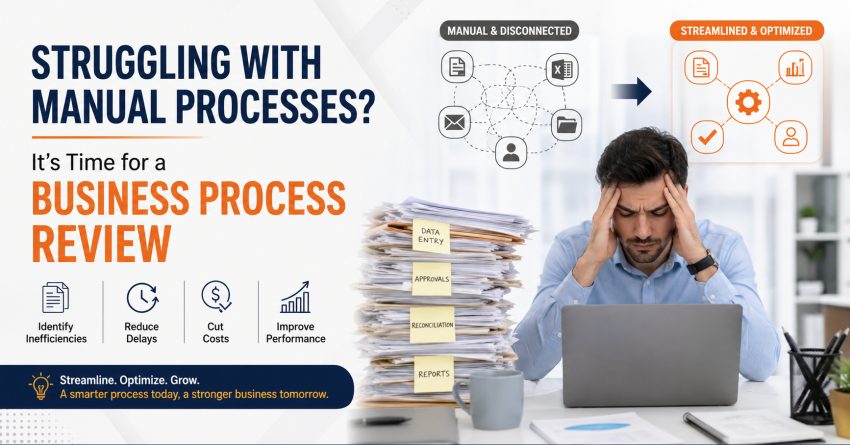
There are many companies that continue to use manual means to undertake their work, from filling out paperwork to getting approval and updating spreadsheets. Even though such activities might seem to be easy to handle initially, as the company grows, they can become the cause of lags and mistakes in work, which will affect the productivity of the business. If your team is spending more time fixing mistakes than adding value, it could be the right time for you to consider a business process review.
Understanding the Cost of Manual Processes
Common Challenges Businesses Face
Manual operations often create bottlenecks that affect every department. Employees may duplicate work, lose important information, or spend excessive time on repetitive tasks. These challenges reduce efficiency and make it difficult to respond quickly to customer needs.
Hidden Impact on Growth
The real cost of manual processes goes beyond wasted time. They can affect employee morale, customer satisfaction, and decision-making. Without standardized workflows, businesses struggle to scale operations while maintaining quality and consistency.
Signs That Indicate It’s Time for Change
Consistent Mistakes and Late Deliveries
Frequent Mistakes
If your business constantly faces data-entry errors, missed deadlines, or inconsistencies, your current workflows may need improvement. All these signs indicate that it needs to be analyzed and possibly improved.
Slow Decision-Making
The process of making decisions becomes inefficient when it takes too much time for approvals and employees need to wait for information from other departments.
Lack of Information about Workflows
Businesses that use manual tracking of their processes don’t have access to up-to-date information about their operations.
Advantages of Business Process Review
Inefficiency Identification
With business process review, it becomes easier for companies to identify inefficiencies that exist within the processes and know where time is wasted, duplications happen, or actions are not needed.
Foster Cooperation
If there are well-defined workflows, then it will be easier for workers to know what is expected of them and thus communicate better and complete tasks faster.
Preparation for Automation
Through a business process review, firms can also prepare themselves for the use of digital solutions as they will optimize the workflows first before using technology.
Creating a More Efficient Future
Focus on Continuous Improvement
Evaluate Performance Consistently
The business environment is always changing; hence, consistent evaluations should be conducted to take advantage of the changes that might come along.
Promote Employee Feedback
Employees carrying out day-to-day activities possess vital information on areas of improvement. They may provide management with ideas they never thought of before.
Conclusion
Although manual operations might work for now, a growing organization requires an efficient and scalable approach to keep up with the competition. Any lags, redundancy, or poor communication should serve as a signal for change. The right approach to a business process review will enable companies to optimize operations, increase efficiency, and build processes that lead to success.
Ready to eliminate manual bottlenecks? CAC’s Business Process Review service helps identify process gaps, streamline workflows, reduce inefficiencies, and build a roadmap for automation and growth.
Frequently Asked Questions
Q: What is a business process review?
A business process review is a structured assessment of how work is completed across an organisation. It identifies delays, repetitive tasks, errors, unclear responsibilities, and opportunities to improve efficiency.
Q: What is the difference between process review and process automation?
A process review analyses how workflow currently functions and identifies what should improve. Process automation uses technology to perform selected tasks more efficiently. Reviewing the process first helps avoid automating inefficient workflows.
Q: Why should businesses choose CAC for process improvement support?
CAC combines operational assessment, risk awareness, control review, and business-focused recommendations to help organizations improve processes in a practical and measurable way.
Q: What outcomes should businesses expect after a process review?
Expected outcomes can include simplified workflows, stronger accountability, faster turnaround time, fewer errors, clearer documentation, better reporting, and a practical roadmap for improvement or automation.
Q: Can a business process review help reduce operating costs?
Yes. By removing unnecessary steps, reducing rework, improving resource allocation, and identifying tasks suitable for automation, a process review can help control avoidable operational costs.
Also Read: Digital Twins in Business Process Reengineering: Are They Worth the Investment?