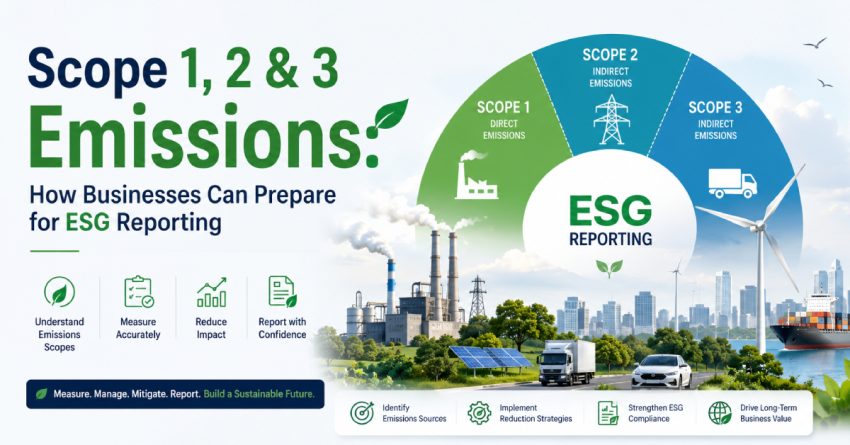
Environmental, Social, and Governance (ESG) reporting has become a vital component of sustainability initiatives for organizations from all sectors. Nowadays, investors, regulators, consumers, and business partners alike require more information about companies’ environmental impact in more transparent form. Scope 1 2 3 emissions are among the most important aspects of ESG reporting, as they help businesses measure greenhouse gas (GHG) emissions and identify opportunities to reduce their environmental impact.
Preparing for ESG reporting involves more than gathering data. It requires businesses to identify emission sources, establish reliable measurement methods, and implement practical emissions-reduction strategies.
Understanding Emission Categories
What are Scope 1 Emissions?
Scope 1 emissions pertain to direct greenhouse gas emissions that come from sources owned or controlled by the organization itself. Examples include direct emissions from vehicles, manufacturing processes, generators, boilers, and industrial operations. Since these emissions happen in the organizations process itself, businesses can control these emissions as much as possible through clean technology and energy-efficient processes.
What are Scope 2 Emissions?
Scope 2 emissions are indirect emissions resulting from the acquisition of electricity, steam, heating, and cooling used by business. While they are emitted by the facilities of the energy producer, they are counted under the emissions of the organization itself. Companies can minimize Scope 2 emissions by using renewable energy, improving energy efficiency, and better management of facilities.
What are Scope 3 Emissions?
Scope 3 emissions include all other indirect emissions in the value chain of the organization. It includes emissions related to purchased goods, transportation, employee commuting, business travel, waste disposal, product distribution, and customer usage of the products. The scope of emissions of this type is usually the hardest one to measure.
Why Accurate Emissions Reporting Matters
Meeting ESG Requirements
Correct emissions reporting provides support to companies in their ESG reporting efforts, illustrating their dedication to environmental performance. Scope 1 2 3 emissions information helps companies report in a way that meets the needs of their investors, regulators, and clients looking for sustainable operations.
Finding Improvement Areas
A correct emissions inventory allows finding areas that have the most significant impact on the environment. Such approach helps companies make better decisions regarding energy management, procurement, logistics, etc.
Steps Businesses Can Take to Prepare
Establish an Effective Data Gathering System
Pinpoint Every Source of Greenhouse Gas Emissions
To begin the process, one must identify all of the sources of greenhouse gases. It covers everything from fuel use to electricity consumption, transportation, supplier activities, and waste production.
Leverage Technological Tools for Sustainability
Today’s sustainable technology enables efficient gathering of data, monitoring of emissions at several facilities, and the preparation of reports in standard formats.
Engaging with Internal and External Stakeholders
An effective ESG reporting process involves working together with the financial, operational, procurement, sustainability departments, and the supply chain. The suppliers should be encouraged to share accurate emission data, especially for Scope 3 reporting.
Developing a Long-Term Emissions Reduction Strategy
Set Realistic Reduction Goals
Organizations need to set realistic reduction goals that are in accordance with the existing levels of their emissions. Such goals must be in alignment with the organization’s business targets and contribute toward compliance and good practices.
Monitor Performance Continuously
ESG reporting is an ongoing process and not a single event. Regular monitoring and audit of performance will allow businesses to track their progress toward their ESG reporting goals.
Conclusion
With the rise of sustainability reporting becoming more important now than ever before, it is necessary to take up a systematic approach towards managing their greenhouse gas emissions. It can be achieved by understanding what scope 1 2 3 emissions are and taking steps to maintain efficient data management and value chain collaboration. Not only will it improve ESG reporting, but it will give businesses the opportunity to find areas where they can become more efficient and environmentally friendly.
Businesses that establish accurate emissions reporting systems today will be better prepared to meet evolving ESG expectations and regulatory requirements. CAC supports organisations with ESG reporting, emissions assessment, and sustainability advisory services to help build practical and future-ready ESG strategies.
Frequently Asked Questions
Q: What are some common examples of Scope 1 emissions?
Scope 1 emissions may come from company-owned vehicles, manufacturing facilities, boilers, generators, furnaces and industrial processes. Since these sources are directly controlled by the business, organisations generally have greater ability to reduce them.
Q: What activities are included in Scope 3 emissions?
Scope 3 emissions may include purchased goods, supplier activities, employee commuting, business travel, waste disposal, outsourced transportation, product distribution and the use or disposal of products sold by the company.
Q: What data is needed to calculate business emissions?
Businesses may require fuel records, electricity bills, production data, travel details, transportation records, waste information, procurement data and supplier disclosures. The exact data depends on the organization’s operations and reporting boundaries.
Q: Can CAC help companies develop an emissions-reduction strategy?
Yes. CAC helps organizations assess their emissions profile, identify priority emission sources, establish practical reduction targets, strengthen ESG reporting processes, and develop sustainability strategies aligned with business objectives and applicable reporting requirements.
Q: Can technology improve emissions tracking?
Yes. Technology can centralize information from different locations, automate calculations, monitor performance, identify data gaps and produce standardized reports. However, automated results should still be reviewed for accuracy and completeness.
Also Read: AI, ESG, and Compliance: The Future of Corporate Governance