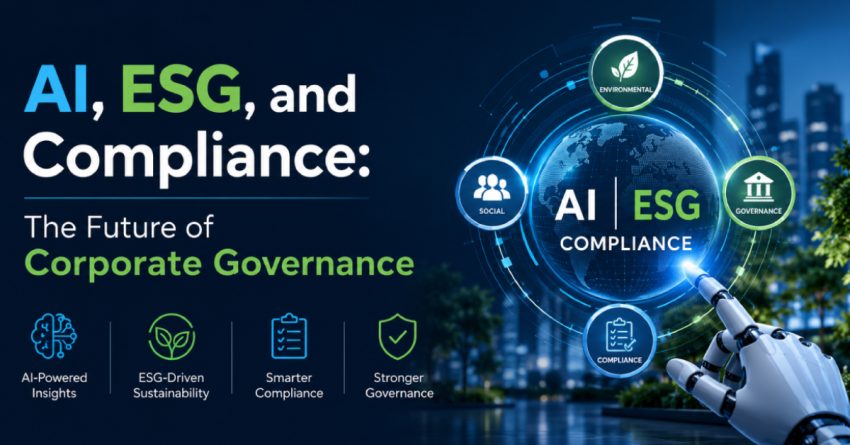
There is an emerging shift in corporate governance as companies adopt technological changes and sustainability initiatives. Companies are not assessed on the basis of financial measures anymore; there is increasing emphasis on transparency, ethics, and environmental and social responsibility. Artificial Intelligence (AI), Environmental, Social, and Governance (ESG), and compliance are coming together to provide better decision-making for companies amid a changing regulatory environment.
Partnering with an experienced ESG consulting company in India can help businesses integrate AI, ESG, and compliance into a robust corporate governance framework while meeting evolving regulatory and sustainability requirements.
Understanding the Link Between AI, ESG, and Compliance
How AI Is Changing Corporate Governance
The technology of Artificial Intelligence helps organizations to analyze huge amounts of data at a rapid speed.
Main advantages of using AI for governance include the following.
- Real-time monitoring of compliance
- Detection of risks automatically
- Accurate reporting
- Speeded-up internal audit procedures
- Better strategic decision-making based on data
These advantages help leadership teams concentrate on planning and innovations while complying with the regulation.
The Growing Importance of ESG in Business
Why ESG Matters Today
Increasingly, investors, consumers, and authorities expect enterprises to operate responsibly. ESG programs allow organizations to lessen their negative influence on the environment, enhance their work practices, and build up corporate integrity.
Three Main Components of ESG
Environmental
- Carbon emission reduction
- Waste management
- Responsible usage of resources
Social
- Well-being of employees
- Diversity and inclusion
- Community relations
Governance
- Ethical conduct
- Transparency in reporting
- Conformity to legislation
An experienced ESG consulting company in India helps create effective ESG policies that conform both to national legislation and international standards of sustainability.
AI Enhancing ESG Compliance
Better Data Collection
AI-based systems gather and analyze data from various business operations, making ESG reporting more precise and efficient. Automation ensures no errors and uniformity in reporting.
Risk Prediction
Machine learning algorithms can identify potential compliance risks at an early stage.
AI Uses for ESG
- Automatic ESG reporting
- Carbon footprint calculations
- Supplier risks
- Fraud detection
- Policy compliance checks
These uses allow businesses to take appropriate decisions and stay accountable.
Strengthening Compliance Through Technology
From Reactionary to Proactive Governance
Traditional compliance tools tend to address problems after they happen. On the other hand, AI-driven compliance software constantly monitors business processes and gives warnings about any possible non-compliance.
Advantages of Automatic Compliance
- Lower risks of regulatory breaches
- Constant monitoring of company’s policies
- Enhanced audit-readiness
- Faster reaction to incidents
- Better document management
By leveraging artificial intelligence within the framework of compliance, companies can build a stronger governance model.
Challenges Businesses Should Address
Striking the Right Balance Between Innovation and Responsibility
Despite the many benefits that come with AI, there are certain challenges that need to be taken care of:
- Data privacy
- Transparency of algorithms
- Security threats
- Change in regulations
- Ethical use of AI
Good governance ensures that the use of AI is ethical and responsible.
The Future of Corporate Governance
A Data-Driven and Sustainable Approach
The concept of corporate governance is progressing from being mere regulatory to sustainable corporate governance. The adoption of AI into ESG efforts by corporations helps them understand the risks involved, improves stakeholder confidence, and leads to increased efficiencies in their operations.
With the help of ESG consulting companies in India that have vast experience in the matter, corporations will be able to build governance frameworks that incorporate technology, compliance, and sustainability.
How CAC Supports Businesses
Successfully integrating AI, ESG, and compliance requires a structured approach supported by industry expertise. CAC helps businesses develop governance frameworks, strengthen compliance processes, improve ESG reporting, and manage evolving regulatory requirements. Our advisory services enable organizations to build transparent, resilient, and future-ready governance practices.
Conclusion
The convergence of AI, ESG, and compliance is redefining corporate governance by enabling organizations to improve decision-making, strengthen risk management, and enhance transparency. As regulatory expectations continue to evolve, businesses must adopt governance frameworks that combine technology, sustainability, and compliance.
With the right advisory partner, organizations can build governance practices that support long-term growth while meeting stakeholder and regulatory expectations. CAC helps businesses achieve these objectives through comprehensive ESG consulting, compliance advisory, and governance solutions tailored to their unique needs.
Looking to strengthen your ESG strategy or corporate governance framework? Contact CAC today to discuss tailored ESG, compliance, and governance solutions that support sustainable business growth and long-term business resilience.
Frequently Asked Questions
Q: How are ESG and corporate governance connected?
ESG and corporate governance are closely connected because governance determines how a company manages environmental responsibilities, employee welfare, ethical practices, risk, compliance, and transparent reporting.
Q: What are the three main components of ESG?
The three main components of ESG are:
- Environmental: Emissions, waste, energy, and resource usage
- Social: Employee welfare, diversity, safety, and community relations
- Governance: Ethics, transparency, leadership, compliance, and accountability
Q: What are the common challenges in ESG reporting?
Common challenges include inconsistent data, unclear reporting standards, limited internal expertise, difficulty tracking supplier information, changing regulations, and the absence of reliable systems for collecting and verifying ESG data.
Q: How can CAC help businesses develop an ESG strategy?
CAC helps businesses assess their current ESG practices, identify material sustainability issues, define measurable goals, develop suitable policies, implement governance frameworks, and create an ESG roadmap aligned with business objectives and applicable regulatory and reporting requirements.
Q: What is proactive compliance management?
Proactive compliance management involves continuously monitoring risks and addressing potential issues before a violation occurs. It is different from reactive compliance, where action is taken only after a problem has already been identified.
Also Read: How ESG and Technology Together Are Shaping Sustainable Businesses