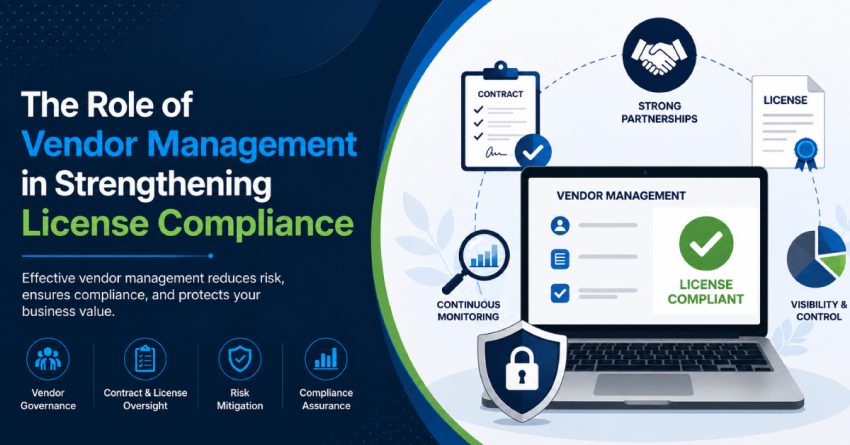
In today’s technology-driven business environment, organizations rely heavily on third-party vendors for software, tools, and digital services. While these partnerships enable efficiency and scalability, they also introduce compliance responsibilities that cannot be overlooked. This is where vendor management plays a critical role in ensuring effective License Compliance Management across the organization.
Understanding Vendor Management in Compliance
Vendor management is the process of choosing, supervising and sustaining relationships with outside vendors. With regard to software and digital assets, it serves to provide clarity of all licensing agreements and implement them correctly. In the absence of a formal vendor management process, companies can lose sight of the terms of the licensing and become prone to non-compliance.
Vendor management assists organizations to remain in line with contractual requirements, minimizing chances of fines or legal issues. This security is vital in ensuring strong License Compliance Management practices.
Ensuring Transparency in Licensing Agreements
Ensuring transparency in licensing agreements is one of the most important tasks of vendor management. Vendors usually come up with complicated contracts having different rights to use, renewal terms and limits. The wrong understanding of these terms may lead to overuse or underuse of licenses.
Active control over the relations with the vendors allows organizations to clear terms, conclude more advantageous agreements, and verify the proper use of licenses. This preemptive strategy enhances License Compliance Management by reducing the levels of ambiguity and making sure that all stakeholders are operating at the same level.
Monitoring Usage and Avoiding Over-Licensing
Vendor software usage monitoring is another important element of vendor management. Poor visibility or fear of non-compliance also makes businesses purchase more licenses than they need. This causes unwarranted expenses and inefficiency.
Organizations can optimize license usage for real needs through frequent communication with vendors and using monitoring tools. Vendor management allows companies to manage their portfolio of licensing optimally but without compromising. Consequently, License Compliance Management is not only a legal protection measure but also a cost-controlling measure.
Managing Audits and Risk Mitigation
Audits are often carried out by software vendors to determine whether licensing agreements are adhered to. These audits may interfere with operations and put businesses at risk of financial fines without adequate preparation. Vendor management assists companies to be audit-ready through proper records and documentation.
Governance can be achieved by working together with the vendors and performing internal audits to help businesses identify and present compliance gaps before they get out of control. This proactive approach can greatly improve License Compliance Management and minimize the overall exposure of risks.
Strengthening Long-Term Vendor Relationships
Good vendor relationships transcend compliance and build trust and cooperation. Open communication with vendors enables the organization to receive more favorable support, receive updates in time, and have more flexible terms. This collaboration may be particularly advantageous in situations of expansion of operations or the implementation of new technologies.
An effective vendor ecosystem means that compliance needs are kept up to date with business expansion. Vendor management in this context is a strategic facilitator for sustainable License Compliance Management.
Conclusion
A pillar of good compliance in modern organizations is vendor management. It directly helps with excellent practices of License Compliance Management by ensuring transparency and maximizing license use, as well as being ready to audit. Companies investing in organized vendor management not only minimize the risks of compliance but also improve the efficiency and cost-effectiveness of their operations.
Also Read: What Is License Compliance Management? A Guide for Modern Businesses