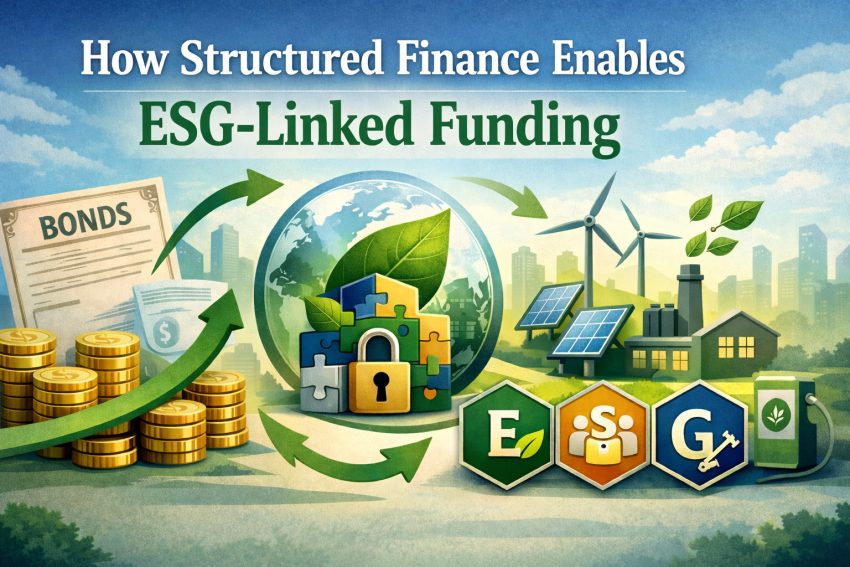
ESG objectives have become a core business strategy. Investors, regulators, and consumers want companies to be responsible and demonstrate their evident advance toward sustainability. Constructing clean energy systems, enhancing workplace conditions, or achieving environmental goals, however, can cost a lot of money. Structured finance management comes in significantly here. It assists companies to develop financial solutions through which the companies tie capital raising to ESG performance.
With the assistance of such tools as green securitization, sustainability-related instruments, and impact-oriented structures, businesses can obtain financing that will not cause excessive economic pressure and will contribute to their long-term responsibility priorities.
Why ESG-Linked Funding Is Growing
Many organizations aim to cut carbon emissions, enhance social efforts and embrace better governance practices. However, long-term sustainability projects are not always financed traditionally since seen by investors less payback time. A different option is ESG financing. It provides companies with flexibility in terms or reduced costs of borrowing money as a reward to achieve sustainability objectives.
Organized management of financing will make sure that these funding models are done in a secure, open, and objective way.
Green Securitization: Turning Sustainable Assets into Funding
One of the most significant tools to be aided by structured finance management is green securitization. Simply put, it enables companies to combine their green assets, renewable energy investments, electric vehicle loans or energy-efficient buildings and turn them into securities, which can then be invested.
Here’s how it helps:
- Companies can open up capital on assets they possess.
- The investors will have access to sustainable and clean projects.
On the one hand, the company gets finances at favorable rates since the assets underlying it are green.
As an illustration, a solar energy firm can combine the receivables of the various solar installations and issue securities supported by the foreseeable cash flows of the solar installations. This provides the company with new liquidity to have more solar capacity without accruing substantial debt.
Sustainability-Linked Instruments for Better Performance
Whereas the green securitization is hinged on the nature of the underlying asset, sustainability-linked instruments hinge on the behavior and performance of the company. These are sustainability-linked bonds and sustainability-linked loans. In such models the cost of capital is pegged on the capacity of the company to achieve certain set ESG targets.
These targets may include:
- Lowering carbon emissions
- Reducing waste
- Improving diversity
- Strengthening governance
- Use of renewable sources of energy.
In case the company achieves the objectives of the agreement, the interest rates or terms of repayment become better. In case of failure, it could cost more. These instruments are to be fair, transparent and measurable through managed finance.
Impact Funding: Direct Support for Sustainability Goals
Impact funding is concerned with quantifiable social or environmental performance. Rather than focusing on financial returns only, investors will fund those projects that will change society. These can be cheap houses, clean water programs, garbage-collection facilities or rural development.
The management of structured finance assists in the development of transparent structures of impact funding through:
- Establishing performance targets.
- Establishing reporting standards.
- Designing performance-based repayment plans.
- Ensuring accountability
As an illustration, impact-driven finance can be given to a firm that is building low-income living quarters, with the money being repaid only after some community good is provided. This makes the financial as well as social objectives remain on track.
Bridging the Gap Between Investors and Sustainable Projects
The issue of the unmet needs by investors seeking sustainable opportunities and companies being in need of funds and having no structured offers is one of the largest challenges in financing ESG. Managing structured finance serves as the intermediary. It assists in transforming sustainability objectives into investment structures that are sound financially.
This includes:
- Assessing risk levels
- Establishing investor friendly models.
- laying out terms of repayment.
- Performing a due diligence on the ESG metrics.
- Assuring reporting transparency.
This means that the financial risks are well defined and controlled, hence allowing more investors to support ESG projects.
Strengthening Long-Term ESG Commitments
Funding models that are linked to ESG are not only concerned with raising money. They compel businesses to have long-term sustainable practices. The management of the structured finance will keep the funding models to be in line with the performance, governance, and responsibility.
By investing in green structures and investing in companies with pledged targets of sustainability, companies create a culture of improvement in the company. This helps safeguard their reputation, entice conscientious investors and enhance stability in the businesses.
Also Read: Structured Finance Management: A Smarter Way for Businesses to Raise Capital