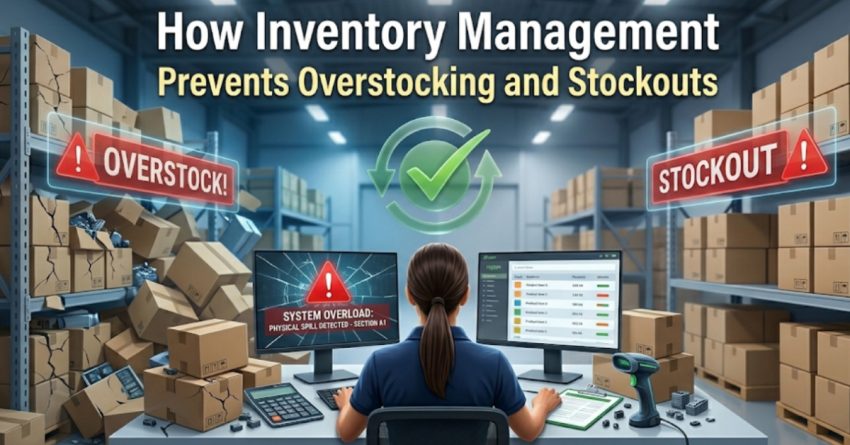
The issue of efficient stock management is one of the largest problems that businesses must deal with nowadays. Excess inventory will incur costs that are unwarranted and insufficient will cause loss of sales and dissatisfied buyers. The role of inventory management is here. The appropriate balance of businesses is achieved through a well-considered strategy that will facilitate the operation of businesses and contribute to improved profitability.
Understanding Overstocking and Stockouts
Making too many purchases in terms of selling these goods to the business is known as overstocking. This frees up capital, raises storage expenses and can even result in wastage particularly of perishable items.
Stockouts on the other hand arise when products are not available when the customers require them. This may cost the company in terms of lost sales, the loss of customer confidence and the loss of the brand image.
Inventory management can prevent both these scenarios and ensure that the company never has the wrong inventory at any given time.
Proper Demand Forecasting
Demand forecasting is one of the most important methods of inventory management that help avoid overstocking and stockout. With the help of past sales records and the market trends, companies can be able to predict the amount of stock they require in future.
This also assists in ranking the quantity of the correct number of products and eliminates the possibility of overstocking or insufficiency. A business can also plan better when it has better planning of its purchases.
Inventory Tracking in Real Time
Manual tracking of stock may cause errors and misunderstanding. The modern systems give real time information on the stock quantities, and this assists the business in knowing the available quantities at any given point.
Real time inventory management will help businesses to easily identify items with low stock and re-order them before they deplete. Meanwhile, they do not have to make needless orders of the products that already have the appropriate number.
Better Order Planning
Orders should be planned to achieve inventory balance. Businesses can be more organized, instead of making a bulk order when they are not aware of the demand.
Inventory management allows the companies to establish the reorder points and minimum stock level. This is to make sure new inventory is ordered at the time of need to prevent overstocking and even a stockout.
Better Supplier coordination
The suppliers are significant in keeping stocks. Delays in delivery may cause stockouts and early or large-scale deliveries may cause overstocking.
Good inventory management assists companies in aligning themselves better with suppliers. Planning the orders ahead and responding to the communication will allow the business to guarantee deliveries on time and prevent the warehouse from holding excess stocks.
Minimizing Waste and Cost of storage
Unused inventory does not only occupy space but also makes the cost of storage expensive. In other instances, the products can be so old or ruined before sale.
Having good stock management provides the ability to have the optimal level of stock and this will mean that the businesses will not have to store extra stock and waste will be minimized. This brings about a greater control of cost and efficiency.
Improving Customer Satisfaction
Customers demand that products to be at their disposal when they require them. Loss of trust and frustration may be caused due to frequent stockouts.
Through efficient time management of inventory, a company is able to save on its inventory and guarantee that its orders are met on time and that products are available whenever needed. This enhances customer satisfaction and fosters the desire to do more business.
Conclusion
It is necessary to have the right balance between supply and demand in any business. Both overstocking and stockouts may be detrimental to operations and profitability when improperly handled.
Through effective inventory control, companies can anticipate demand, monitor inventory on a real-time basis, and make efficient order planning. This does not only save on costs but also makes the experience of customers smooth and reliable which helps in long-term growth.
Also Read: The Cost-Saving Power of Inventory Management Companies