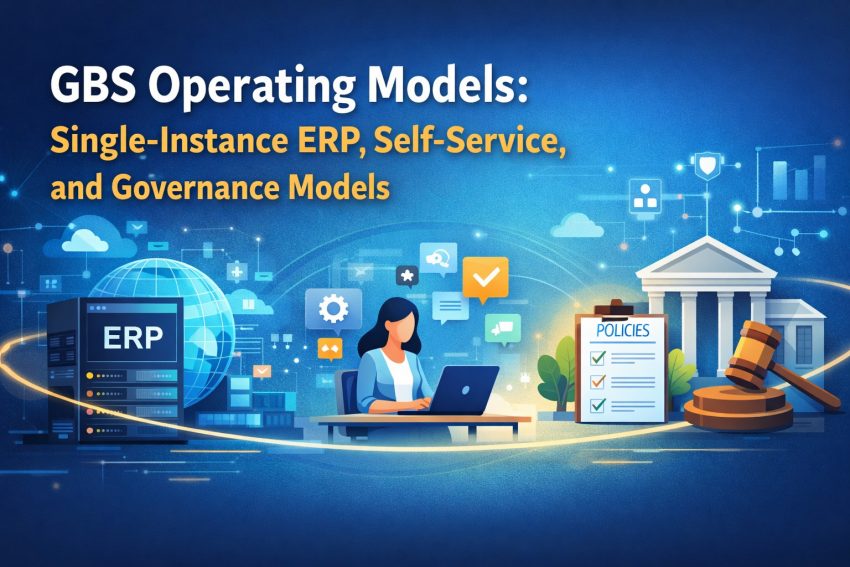
Global Business Services (GBS) has emerged as an advanced operating strategy that centralizes business functions across finance, HR, procurement, IT, supply chain, and more. As enterprises expand globally, they require scalable frameworks that enable efficiency, technology integration, and consistent service delivery. To achieve these goals, many organizations implement structured GBS operating models. Among the most impactful are the Single-Instance ERP model, Self-Service model, and Governance model. Each of these contributes uniquely to operational excellence, business continuity, and digital transformation.
Single-Instance ERP: Unifying Data and Processes
Single-Instance ERP model merges business applications to form a single platform which serves as a platform to several regions and departments. This model brings together data, processes and workflows in a single version of the truth instead of operating with fragmented systems. In the case of global companies, this minimizes data silos and eliminates duplication of technology investments. A Single-Instance ERP increases the level of visibility of business operations, including real-time analytics and process standardization.
Since everyone uses the same system, all users are subjected to similar interfaces, reporting systems and compliance systems. This is especially helpful to industries that have rigid audit and regulatory standards. The standard process also hastens the onboarding process, minimizes manual errors, and enhances teamwork between teams based in various geographies. Finally, the Single-Instance ERP model creates a resolute digital foundation of scalable GBS processes.
Self-Service Models for Autonomous Operations
The Self-Service model enables employees, managers, partners and customers to access services on their own using portals, mobile applications, and AI based support. This allows activities such as payroll queries, vendor invoice tracking, travel refunds, procurement requests and human resource documentation to be achieved without the assistance of support personnel in a GBS ecosystem. The major constituent of this model is automation, chatbots, and knowledge bases.
The Self-Service model lowers operational costs, removes bottlenecks and speeds up transactions by removing human intervention. More to the point, it allows employees to work on strategic initiatives as opposed to repetitive queries. The Self-Service model also provides usage data that assists organizations to enhance service delivery on a continuous basis. This model is the foundation of future-ready GBS frameworks.
Governance Models: Driving Accountability and Standards
A Governance model outlines the decision-making process, performance management and compliance of a GBS. It lays out positions, duties, chain of escalation, key performance indicators and service level agreements (SLAs) to be accountable. Another way in which governance ensures transparency is by establishing alignment of goals between business stakeholders, service providers and global shared service teams.
Good governance avoids uncontrolled variation, assures process quality and protects data. It also favors transformational projects like automation, outsourcing plans, and investments in technology. By having a well-established governance set-up, organizations are able to increase their GBS capacities without fear as they feel assured that risk management and operational standards have not been compromised.
Conclusion
Single-Instance ERP, Self-Service, and Governance Models of GBS operating models will create a strong basis of efficient, scalable, and digitally powered business services. On the one hand, ERPs help to integrate information & operations, on the other, Self-Service increases autonomy of operations, and Governance maintains required discipline & responsibility. This combination allows businesses to streamline international businesses, save money, and generate innovation – making GBS one of the strategic growth drivers in the contemporary competitive business environment.
Also Read: How Shared Services Can Drive ESG: Operationalizing Sustainability in GCCs/GBS