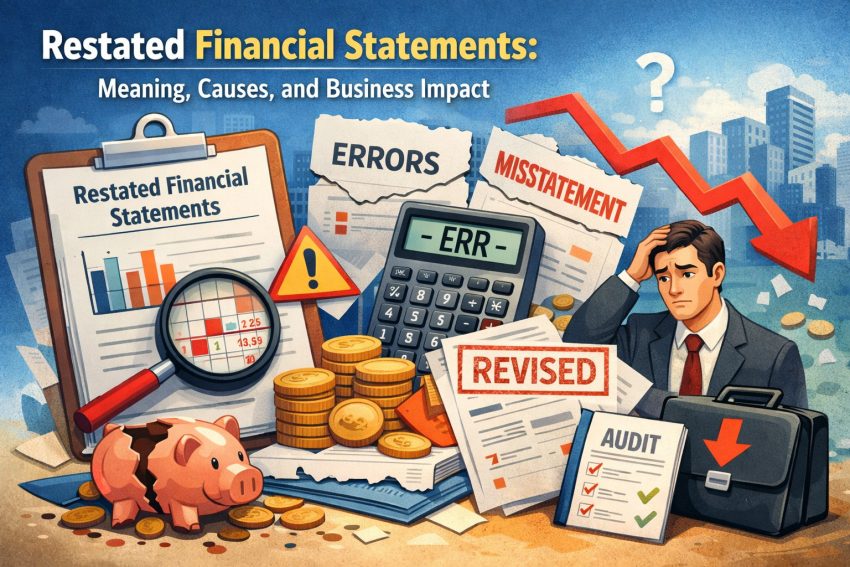
In the modern controlled and transparency-focused business world, the right financial reporting is important to making decisions and confidence among stakeholders. Nevertheless, in some cases, the already issued financial statements are no longer true representations of the financial position of a company. When this happens, companies are obliged to declare restated financial statements. This is also referred to as financial statement restatement, and this process is crucial in re-correcting the material errors and making sure that the accounting standards are adhered to.
Meaning of Restated Financial Statements
Restated financial reports are financial reports that are issued as replacements of previously issued statements because of some inaccuracies or failure to comply with proper accounting principles. Financial statement restatement is an undertaking following misstatement of material errors that may create misleading information to the financial information users and is prone to mislead users who may include investors, lenders, regulators, or the management. These mistakes can either be as a result of inappropriate accounting treatment and misclassification, failure to disclose or misuse of accounting standards.
In contrast to regular changes or estimates, restated financial statements show that past-period financial reports were material, and need to be fixed retroactively. To maintain transparency, companies usually reveal the type of mistake, the timeframes involved and the amounts involved in the restatement.
Causes of Financial Statement Restatement
There are several reasons why companies may need to issue restated financial statements. One of the most common causes is incorrect revenue recognition, especially in complex contracts or long-term projects. Errors in recognizing revenue at the wrong time or in the wrong amount can significantly distort financial performance.
The other common reason is the misuse of accounting standards, including the inappropriate treatment of leases, financial instruments or employee benefits. Financial statement restatement can also be triggered by changes in regulatory interpretations or even lack of updating the accounting policies in accordance with new standards.
Less prevalent, but still a severe cause of restated financial statements, is fraud or deliberate misrepresentation. Weaknesses in internal control, absence of a segregation of duties or weak supervision may enable errors or manipulation to be unnoticed. Also, restatement can be because of mistakes in consolidation, intercompany transactions, tax calculation or asset valuation.
Business Impact of Restated Financial Statements
Effects of restated financial statements for a business can be great. Reputation wise, restatements can cast doubt on management, internal controls and financial governance. Investors and analysts can re-appraise valuations of companies which would cause volatility in shares prices or loss of investor confidence.
A financial restatement operationally requires a lot of time and resources. Management, finance department, auditors, and advisors need to liaise to find out the mistakes, recalculate the numbers, and come up with updated disclosures. The process may derail strategic efforts and normal day-to-day operations.
There can also be regulatory and legal consequences of restated financial statements. Inquisitors can begin investigations, and lenders can review the performance of covenants. In extreme situations, business entities can suffer fines, slow IPO execution or difficulty in accessing funds.
Importance of Transparency and Prevention
Though restatement of financial statements may be difficult to make, prompt and clear disclosure can be used to maintain stakeholder confidence. It is acceptable that companies which actively respond to mistakes and build internal controls show accountability and adherence to proper reporting. The risk of financial statement restatement can be also minimized with the help of strong accounting policies, audits, and professional advisory services.
Conclusion
Financial statement restatement or restated financial statements are the corrective measures that guarantee financial accuracy and adherence. In as much as they can have short term effects on credibility and operations, they eventually promote transparency and long-term sustainability of operations in business once dealt with in a responsible manner.