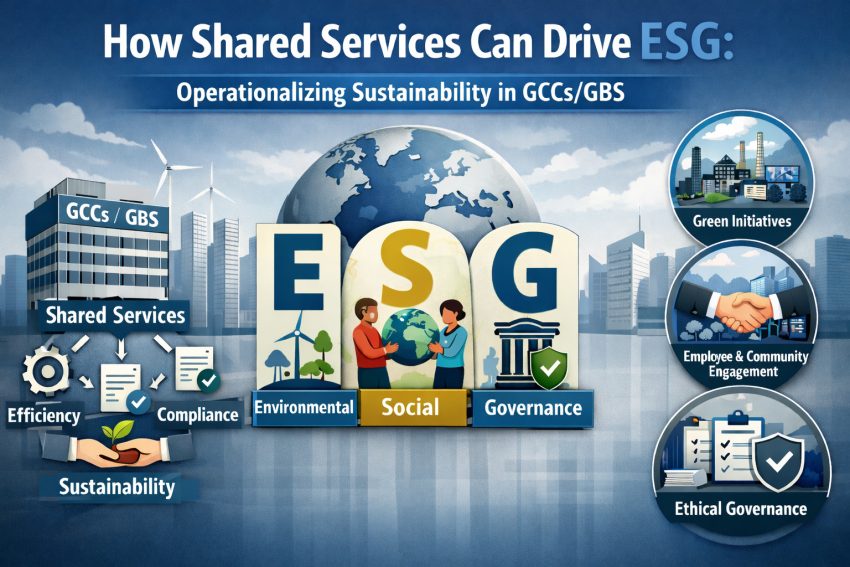
In recent years, Environmental, Social, and Governance (ESG) priorities have moved from being optional add-ons to essential components of corporate strategy. Companies around the world are reevaluating their activities to be in line with sustainability ethics, transparency and accountable governance. Global Capability Centers (GCCs) and Global Business Services (GBS) have become effective enablers in this transformation journey. They have cross-functional competence, digital capabilities, and process excellence that can put ESG strategies into practice.
The Strategic Role of GCCs and GBS in ESG Integration
Conventionally, the GCCs and GBS units were developed to provide cost efficiencies, standardization and centralization of operations. Their position, however, has changed considerably. Today, they are hubs of innovation, analytics and digital transformation, essential to integrate ESG objectives into business activities.
These centers already handle enterprise-wide processes like finance, procurement, human resources and technology; hence they are best placed in gathering data, tracking performance and applying sustainability metrics to the global operations. Their design enables them to spearhead ESG implementation in a measurable manner and on a scale.
Environmental Responsibility through Shared Services
Sustainability of the environment is initiated through awareness and quantifiable efforts. GCCs and GBS can spearhead this change by establishing sustainability measures as part of regular reporting and operational systems.
As an example, these centers can monitor and determine information regarding energy consumption, waste production and carbon emissions within a few business units. They can use a combination of sophisticated analytics and AI to find ways of minimizing their energy usage, optimizing their logistics and aiding the practices of the circular economy.
Another strength of shared services is digitization that helps towards environmental goals. The shift towards paper-based working processes to digital operations eliminates the consumption of resources and contributes to efficiency. Besides, since numerous GCCs and GBS units switch to green offices, the use of renewable energy, or the remote working framework establish an example of eco-friendly practices.
Social Impact through Workforce and Community Engagement
“S” in ESG concentrates on individuals, employees, clients, and societies. GBS and GCCs are the cores in promoting social responsibility in organizations.
They can support diversity, equity, and inclusion (DEI) internally, particularly by making sure they hire people and provide them with career opportunities. At the same time, because of the large and very diverse workforce these centers employ, they can introduce very focused programs on upskilling, employee wellbeing and leadership development.
On the outside, shared service units have an opportunity to positively influence society by choosing their vendors and interacting with communities. GBS organizations can expand the social footprint of their parent company by selecting suppliers who behave in an ethical manner towards labor and contribute to activities of local community. The value linking social value and business success is supported by the fact that many major companies have already developed systematic volunteering initiatives and CSR projects at the core of which their GCCs are operating.
Governance and Transparency: The Backbone of ESG
The “G” in ESG is Governance, which deals with ethical activities, compliance, and accountability. GCCs and GBS can adequately incorporate governance in their working processes by integrating data-based controls, standard procedures, and risk management systems.
Compliance reporting can be centralized and audit procedures streamlined using shared services to ensure that business operations are transparent. ESG scorecards and automated dashboards allow the management to monitor the achievements against the targets in real-time. In addition, the centrality of GCCs means that there is uniformity in application and documentation of policies in geographies, thereby minimizing the risks of non-compliance.
Leveraging Technology to Scale ESG Impact
Technology is central to the operations of GBS and GCCs, and it is no exception to the success of ESG. ESG can be transformed into quantifiable strategy through automation, data analytics and AI to make it a qualitative story.
Indicatively, predictive analytics are used to predict carbon footprints, and robotic process automation (RPA) can enhance quality of data to be used in ESG reporting. The sustainability data of various regions can be consolidated through cloud-based tools since they show a single picture of performance. These digital enablers not only simplify the process of ESG compliance but also turn sustainability into a business-as-usual activity.
Building the ESG-Ready GCCs of the Future
Since the ESG expectations are on the rise, the future GCCs or GBS will become a sustainability command center, A center that monitors, measures and controls ESG performance on the enterprise scale. This change will require a clear road map that will contain:
- Alignment in leadership: Integrating ESG objectives in the shared service mission.
- Sustainability reporting and analytics: Upskilling teams.
- Data maturity: Introducing strong ESG data governance.
- Partnerships: Cooperation with sustainability specialists and partners in technology.
Conclusion
The process of sustainable business practices is a growing trend that can no longer be reversed and GCCs and GBS organizations are a pivotal factor in ensuring that the process is feasible and quantifiable. Technology, culture, and operations of these centers allow operating ESG through their processes to go beyond support functions and become strategic enablers of corporate responsibility. This way they assist the businesses to not only fulfill the compliance and investor’s expectations but also generate long term value to society and the planet.
Also Read: Multi-Hub Global Shared Service Models: Advantages, Challenges & Best Practices