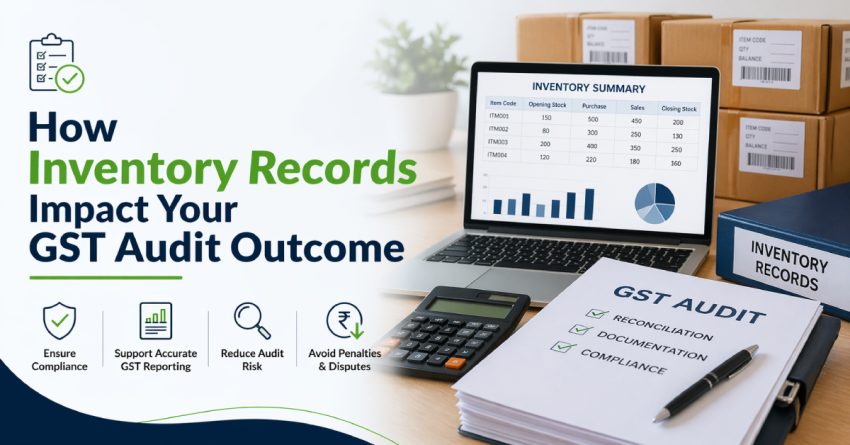
Inventory is a vital aspect of day-to-day operations of any business that deals with goods. Nonetheless, most business owners fail to see the close connection between inventory records and compliance. When a GST audit is conducted, such records are critical in evaluating whether your business’ financial records are true and reliable.
Simply put, inventory records are not merely the business of keeping track of stock, but they do have a direct impact on the calculation and verification of your tax liability. We would like you to learn about the ways they impact your GST audit result and why it is important to keep them in good condition.
Inventory Records: Why are they important in a GST Audit?
A GST audit is done to verify that the information presented in the returns as represented in the business transactions. Given that goods are purchased, stored and sold, inventory or goods acts as a mediator between purchasing and selling.
When your inventory books are correct, then auditors may easily:
- Verify purchase invoices
- Match sales data
- Check input tax credit claims
Conversely, bad inventory management may cause confusion and cast doubts on a GST audit.
Connection between Inventory and Input Tax Credit
Input tax credit (ITC) is one of the major areas to be examined as part of a GST audit. Companies assert ITC when they buy goods, which ought to be recorded in inventory.
When there is a discrepancy such as claiming ITC on the goods not on stock it can result in:
- Disallowed tax credits
- Additional tax liability
- Penalties
Keeping up with the inventory will help make sure that each purchase is supported and can prove your arguments in the GST audit.
Stock Discrepancies Can Raise Red Flags
One of the most frequent problems identified during a GST audit is the discrepancy of stocks. These occur when:
- Physical stock is not equal to recorded stock.
- Goods are unaccounted or missing.
- Unnecessary inventory exists without records.
These differences can indicate mistakes and even potential non-conformance. Auditors might raise questions as to whether:
- Underreported sales have been reported.
- Purchase records are not recorded correctly.
That is why it is necessary to conduct stock checks and updates on a regular basis to prevent complications.
Impact on Sales Reporting
Through inventory records you also help to validate your sales information. The flow of goods out of inventory should be shown as sales.
Provided that inventory records are not correctly updated:
- Sales can show less than the actual.
- The amount of tax liability can be understated.
This discrepancy may result in review of your returns during a GST audit and imposition of penalties. It is important to have proper tracking so that your sales and stock movement are on track.
Significance of Good Documentation
Keeping:
- Purchase invoices
- Stock registers
- Delivery challans
- Goods return records
These are some of the documents that support your data when audited by GST. Even true transactions can be hard to demonstrate without them.
Documented records enable auditors to rapidly check the records and thus, the process becomes easier and faster.
What Businesses can do to be prepared?
Simple habits that businesses should embrace in order to have a smooth GST audit include:
- Record stock updates on a regular basis.
- Carry out regular stock inspection.
- Simple accounting or inventory program.
- Compare purchase and sales with stock.
Complexity must take a back seat to consistency. Even the simplest systems can perform well provided they are well maintained.
Conclusion
Inventory records are not merely operational records, but they are also a vital aspect of compliance. The records used during a GST audit will assist in determining the validity of purchases, sales and tax claims.
Inventory management makes audits easy and hassle free. However, incomplete and mismatched records can cause delays, penalties and unwarranted complications.
Having clean, up-to-date and well-documented inventory records is not only a way to improve business but also to achieve a successful and fruitful GST audit result.