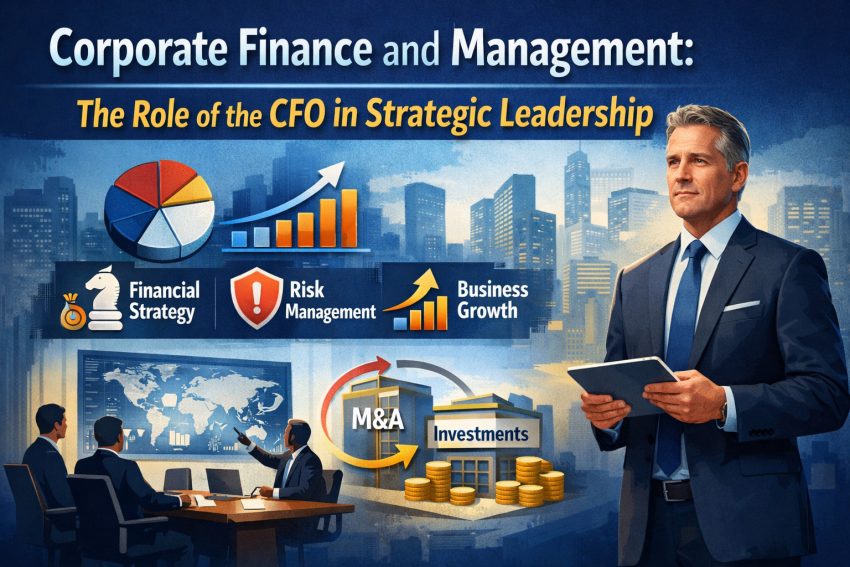
In the current competitive business environment, good financial practice is not enough to make a company grow. They require an eye, guideline, and excellent leadership to ensure that every decision is made. It is here that the Chief Financial Officer (CFO) is very influential. The CFO of the modern world is much more than the person who manages accounts and financial reports; he/she is a strategic leader who shapes the future, culture, and development of the organization. Corporate finance and management are greatly boosted by their leadership that keeps the businesses financially sound and on their way to their destinations with confidence.
From Number Keeper to Strategic Leader
In the past, CFOs were perceived as primary financial controllers working on accuracy, compliance, and budgeting. Their role has today increased. They are energetic decision-makers, business associates to the CEOs, and a major participant in the boardroom debates. Their wisdom allows leaders to know the impact of any plan, investment or risk on profitability and sustainability. Corporate finance and management have interwoven to be seamlessly integrated with the guidance of companies drawing the liaison of financial objectives and the vision of a business.
Driving Business Growth with Financial Strategy
Another aspect of strategic leadership, which is a significant role of a CFO is the planning of business expansion. They are not only analyzing previous figures but predicting the future. CFOs evaluate the markets, investment opportunities and expansion possibilities. They assist in making decisions about diversification, acquisition of a business or modernization. They bring business goals to match financial planning, which helps in advancing corporate finance and management towards long-term and constant growth instead of temporary performances.
Strengthening Risk Management and Financial Stability
No business is without threats of risk- there are risks like uncertainty in the market, shifts in regulations, economic recessions and operational impediments. The CFO is important in recognizing these risks at an early stage and establishing robust financial barriers. They establish sound financial policies, ensure liquidity and come up with contingency plans. This is a strict practice such that corporate finance and management do not go haywire even where external conditions cannot be predicted.
Leading Digital and Financial Transformation
Innovation is also an advocate of modern CFOs. As business processes are digitalized, automated, and data-driven to leverage digital tools, data analytics, and AI, the CFO must make sure that financial functions are up to date. They favor the use of technology to enhance the accuracy of finances, the speed of reporting and the efficiency of decisions. They combine financial technology and business processes to introduce smarter insights and make corporate finance and management smarter and more agile.
Building Transparency, Trust, and Governance
Financial integrity is very key to investor trust and business reputation. The CFO maintains good governance structures, transparency and ethical conduct. They ensure that all the financial decisions are made in compliance terms and according to honesty. These assistance organisations gain credibility within the stakeholders, clients, investors, and regulators, and consolidate faith in the corporate finance and management practices.
Empowering Teams and Shaping Business Culture
Leadership is not just about making decisions but also about individuals. An effective CFO will develop competent finance departments, foster growth of knowledge, and instill a spirit of responsibility. Their leadership approach determines the way departments work together, the way decisions are made and how the organization becomes financially conscious. Employees can add towards organizational success when they can realise financial impact and thus corporate finance and management are collaborative and people driven.
Conclusion
The contemporary CFO must be outside of spread sheets and balance sheets. They are expansion strategists, risk managers, technological opportunities, moral custodians and cultural shapers. Their strategic leadership makes them all in terms of financial soundness, sustainability and long- term objectives of decisions made by the organization. The CFO is the heart of corporate finance and corporate management, as it leads organizations to remain strong, competitive and future proof by driving their financial strength and business direction.
Also Read: Corporate Finance and Financial Management Essentials for Leaders