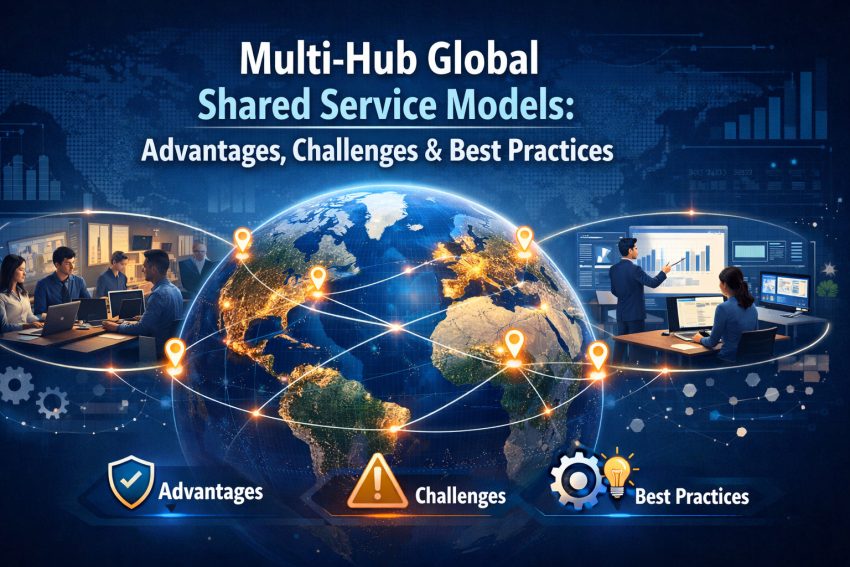
Shared service models are becoming popular with global organizations to make their operations smoother, less expensive and efficient. But as the business expands and diversifies in the markets, the conventional one-hub shared service model may not be effective in supporting the needs of an international business. Here, multi-hub global shared services model enters into the picture – a model that is meant to provide agility, resilience and local relevance without losing global consistency.
What Is a Multi-Hub Global Shared Service Model?
Multi-hub model is opening several strategically positioned shared service centers in regions like Asia-Pacific, Europe and the Americas with each region having a regional hub of certain business functions. These hubs have a single governance structure that is spread out to take operations nearer to regional markets as well as the customers.
Compared to one centralized hub, the multi-hub approach provides both globalization and regionalization, enabling organizations to provide high-quality services and eliminate operational risks associated with a geographical, regulatory, or time-zone based location.
Advantages of the Multi-Hub Model
1. Business Continuity and Risk Diversification
Resilience is one of the most powerful strengths of a multi-hub arrangement. Having operations in different locations allows organizations to continue business even in case of any disruption, either natural disaster, political upheaval or global crisis. Should any of the hubs experience a problem, other hubs are able to intervene to minimize the amount of service downtime.
2. 24×7 Operational Coverage
Multi-hub models are those which allow organizations to work round the clock through different time zones. Business organizations can offer 24/7 support and quicker response to global clients. This, Follow the Sun model, enhances responsiveness and customer satisfaction greatly.
3. Availability of Multicultural Human Resources
When shared service hubs are in multiple geographies, it enables businesses to access regional expertise. An illustration would be – a hub in India can be technology and analytics-driven, whereas one in Eastern Europe can deal with finance or compliances. This variety improves innovation and makes sure that the appropriate capabilities are available where required.
4. Cultural and Regulatory Consistency
Regulatory environment and cultural norms vary in different regions. A regional hub model will keep the operations within the limits of local laws besides being more aligned to the cultural and business practices. This enhances cooperation and stakeholder participation in every geography.
Challenges in Implementing a Multi-Hub Model
1. Complication of Governance and Co-ordination
There are governance challenges in operating hubs in multiple geographies. It may be a complex task to make sure that all hubs follow standardized policies, service levels, and reporting structures & be flexible.
2. Data Integration and Technology
Several hubs imply several data systems, technologies, and communication tools. A well-built IT infrastructure and high level of cybersecurity are needed to integrate these systems and achieve a fluid flow of data, high level of security and consistency of analytics across hubs.
3. Cost Considerations
Multi-hub models bring in resilience and flexibility. That said, it may involve higher initial setup and costs of operation. A trade-off of this nature that is closer to regional proximity on one hand, and cost-effective on the other, requires careful financial planning.
4. Changing Direction: Talent and Change Management
It may be difficult to bring different teams from different regions to work on the same vision. Organizations must put money into leadership development, cross-cultural training and integrated communication plans to maintain consistency in performance.
Best Practices for a Successful Multi-Hub Model
1. Secure a Transparent Governance System
Establishing a global governance model with specific roles and responsibilities of each hub is need of the hour. Making sure that there is consistency in KPIs, service standards and escalation procedures is required.
2. Centers of Excellence (CoEs) definition
Each hub may have certain functions or areas of expertise in which it is strong. An illustration would be a hub in Manila may deal with customer care whereas one in Poland may deal in finance. This prevents redundancy and enhances domain excellence.
3. Install Unified Technology Platforms
Digital workflow management, data analytics, and collaboration in every hub must be standardized. Cloud-based systems can be made transparent and safe in terms of data and communication between hubs.
4. Develop a Community of Culture and Teamwork
The hubs must operate under one organizational culture though difference in geographical locations exists. Teamwork can be strengthened by frequent virtual town halls, trans-hub ventures and worldwide leadership courses.
5. Incessant Process Improvement
Promote local process improvements and global best practices as each hub identifies and applies it locally and shares it globally. Hubs should have a feedback loop, which guarantees constant improvement of efficiency and innovation.
Conclusion
The multi-hub worldwide shared services model is the next step in the development of GBS and GCCs set up through global governance and local agility. Through this model, organizations can develop resilience, create efficiency and competitiveness in dynamic business environment.
The achievement is, however, conditional on a well-defined strategy, solid governance and appropriate technological foundation. When used properly, multi-hub model can turn shared services from a Back-office Operation to a Strategic Global Partner – one that has power to provide business continuity, innovativeness, and long-term growth.
Also Read: Developing Next-Gen Skills in Shared Services: AI, Cloud & Cybersecurity