


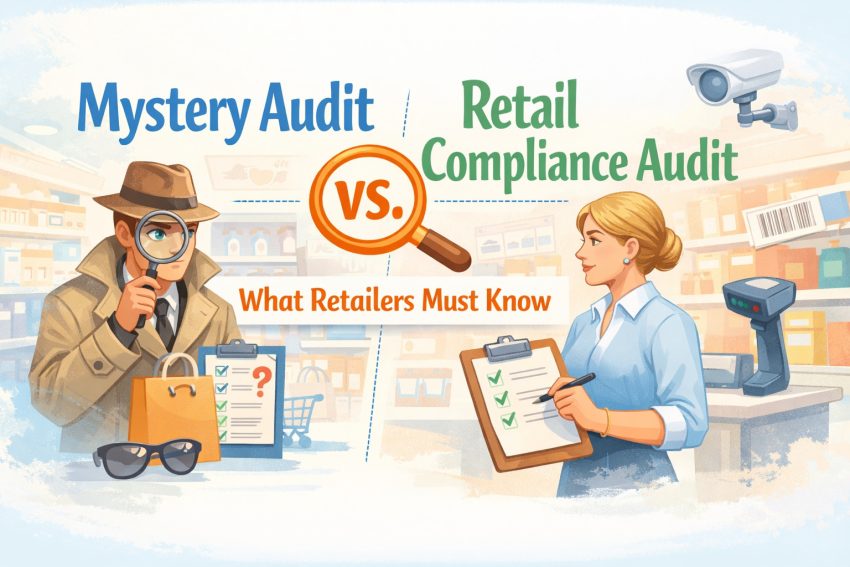
In today’s highly competitive retail environment, maintaining consistent standards across stores is essential for brand reputation, legal compliance, and customer satisfaction. To achieve this, retailers commonly rely on two important evaluation tools: retail compliance audits and mystery audits. While both aim to improve store performance, they serve very different purposes. Understanding the differences between the two helps retailers choose the right approach for their business needs.
What Is a Retail Compliance Audit?
A retail compliance audit is an official and systematic test that aims at confirming whether a store is adhering to set policies, procedures as well as regulatory standards. It is concerned with the accuracy of operations, lawfulness, and compliance with internal policies.
In a retail compliance auditor’s auditors examine documentation, store layout, safety measures, inventory records and adherence to labor laws, hygiene levels, pricing regulations and brand policies. These audits are normally planned and done with elaborate checklists. The aim is to find holes, risks, and non-conformity that may attract penalties, financial loss or even damage in reputation.
Chain stores and franchises are also very interested in retail compliance audits in which standardization of locations is of the essence. They also assist the management in making sure that all the outlets are functioning in the same standard.
What Is a Mystery Audit?
A mystery audit, often called a mystery shopping audit, evaluates the customer experience by observing store operations from a shopper’s perspective. In this method, trained individuals visit stores posing as regular customers and assess real-time service quality.
The areas of concern by mystery audits include employee conduct, product knowledge, service turnaround, upselling, store hygiene and general shopping experience. Because the presence of the store employees will not be aware of the audit, their spontaneous behavior will be recorded, which will be an important resource in terms of investigating the daily routine.
In comparison to compliance audits, mystery audits are more subjective and experience based. They are most instrumental in knowing how the customers perceive the brand at ground level.
Key Differences Between Retail Compliance Audit and Mystery Audit
The greatest disparity is the purpose. A retail compliance audit is designed to make sure that it adheres to the rules, and a mystery audit is dedicated to the interaction with customers and quality of service.
The other distinction of significance is methodology. The compliance audits in the retail industries are clear, routine and checklist oriented. The mystery audits are unannounced, anonymous and observational.
Regarding the areas of focus, the retail compliance audits are conducted on legal, operational, and procedural levels including safety standards, accuracy of billing, and inventory management. Mystery audits are used to assess soft aspects such as employee attitude, greetings criteria, and service efficiency.
The outcome also varies. The compliance audit of retail generates detailed reports on the non-compliance, risks and corrective measures. Mystery audits create experience-based knowledge and performance ratings concerning customer service.
Which Audit Should Retailers Choose?
The decision would be based on business goals. Retail compliance audits are important to retailers who are at risk of minimizing risk, legal requirements, and discipline within their operations. Mystery audits on the other hand are more beneficial to those who seek to enhance customer satisfaction and frontline performance.
Most of the successful retailers recommend combining the two audits. Compliance audits are made to make sure that the foundation is solid, whereas mystery audits help to balance the customer experience.
Also Read: Mystery Audit in Retail: What It Is and Why It Matters