
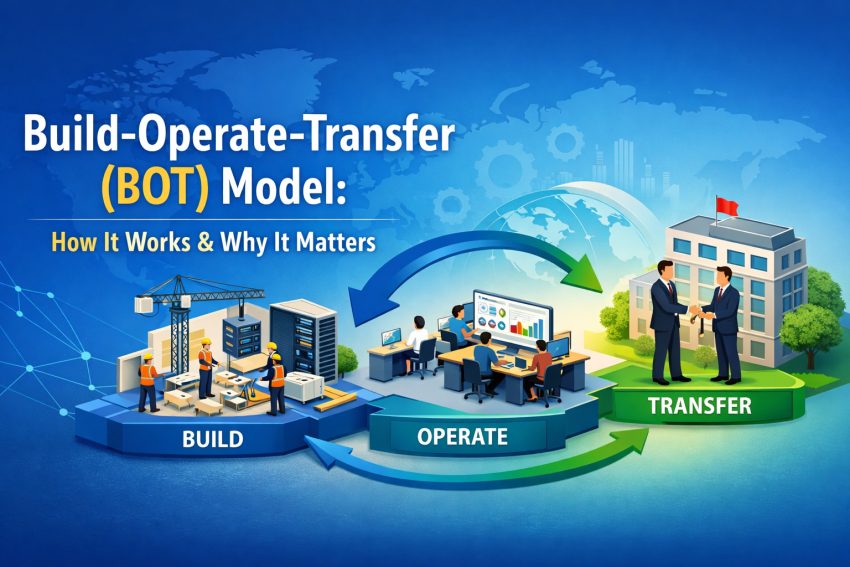
The Build-Operate-Transfer (BOT) model is a widely used project financing and implementation framework, especially in large-scale infrastructure development. Governments across the world adopt this model to encourage private sector participation in public infrastructure while reducing financial and operational burdens. Understanding the BOT model is essential for policymakers, investors, infrastructure developers, and students of finance and public administration.
Meaning of the Build-Operate-Transfer Model
Build-Operate-Transfer model is a type of public-private partnership (PPP) in which a concession is awarded to a private party to construct, operate, and ultimately transfer an infrastructure project to the government. With this structure, the privately hired party funds and builds the project which they then run during a concession period to recoup their investment and make profits and finally transfer the asset to the public authority at the expiry of the term.
The highways, bridges, airports, power production plants, the water supply, as well as the urban infrastructure projects are usually treated with BOT projects.
Structure of the BOT Model
The BOT model follows a well-defined structure involving multiple stages and stakeholders:
Project Award and Concession Agreement
Project identification and awarding to a private developer is done in a transparent bidding process by the government. A concession agreement defines the scope of a project, the project term, share of revenues, the mechanisms of sharing risks and conditions of transfer.
Financing and Construction Phase
The non-governmental organization gets funds by combination of equity, bank loans, and, in some cases, government subsidy. It also designs and builds a project within the stipulated schedules and quality parameters.
Operation and Maintenance Phase
After the project is finished, the daily work, maintenance and delivery of services is handled by a private operator. Depending on the nature of an undertaking, the revenue is generated either through user fees, toll, tariffs, or government annuity payments.
Transfer Phase
The government receives back the assets at the expiry of the concession period in a specified condition normally free of charge. The public authority receives complete ownership and control.
Importance of the Build-Operate-Transfer Model
The Build-Operate-Transfer model plays a crucial role in modern infrastructure development for several reasons:
Encourages Private Investment
BOT enables the governments to use private capital to fund projects that require a lot of capital, but it would not require the state to incur the cost in the short run hence there would be less strain on the budget.
Efficient Project Execution
The benefits of having private players are the availability of technical know-how, innovation, and efficiency, which at times result in the project being completed faster and better operational performance.
Risk Sharing
Construction, financing and operations risks are passed to the private sector whilst governments retain policy and regulatory control.
Improved Public Services
As revenue is usually attached to performance and usage, the motivation of the private operators is to keep the level of service and efficiency of the operations up to the mark.
Long-Term Asset Creation
The governments receive a fully operational infrastructural asset without having to incur the initial financial cost.
Conclusion
Build-Operate-Transfer model has become a strong instrument of filling the infrastructure gaps especially in developing economies. The BOT model would facilitate sustainable growth of infrastructure, better delivery of services and ensure efficient utilization of resources through integrating public supervision and efficient operation of the private sector. With ever-increasing infrastructure needs, the BOT framework will be a major economic growth and benefit factor to the population.