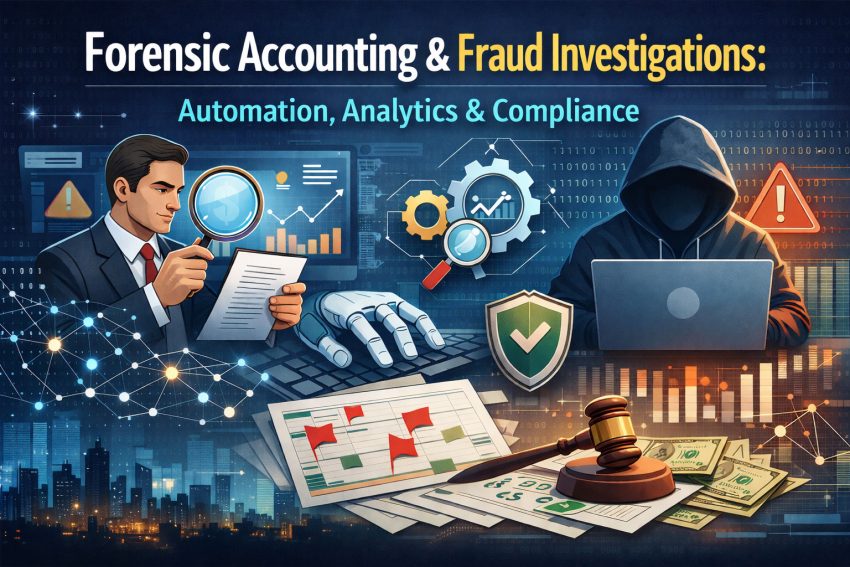
In today’s fast-paced and data-driven business environment, financial fraud has become more complex and harder to detect. Traditional investigation methods are no longer sufficient to uncover sophisticated schemes involving digital transactions, layered accounts, and cross-border operations. This has led to a significant transformation in forensic accounting and fraud investigations, where technology, analytics, and regulatory developments play a crucial role.
Automation Transforming Forensic Accounting Practices
Due to automation, forensic accounting and fraud investigations have become a game-changer. Financial records take a lot of time to be analyzed manually and are vulnerable to human error particularly when it involves a significant amount of information. The automated tools currently enable forensic accountants to scan through millions of transactions at a time to detect anomalies and raise a red flag over suspicious pattern.
Financial data extraction, organization, and reconciliation are the most common uses of robotic Process Automation (RPA), which can be used to extract and organize financial data and reconcile it with different sources (bank statements, ERP systems, invoices, etc.). This enables the investigators to work on the analysis and interpretation instead of the repetitive work. Consistency, audit trails and swift turnaround times also bring about fairness, which is important in cases involving frauds, which is also enforced by automation.
Predictive Analytics Enhancing Fraud Detection
Predictive analytics is changing the nature of the way forensic accounting and fraud investigations are carried out. Organizations can respond to possible risks instead of responding to them once fraud has taken place because they are able to track past data and behavioral patterns. The complex algorithms are used to investigate the patterns of transactions, the activity of vendors, employee activities, and fiscal ratios and determine the possibility of fraud.
Machine learning models continuously improve as they process more data, making fraud detection smarter and more accurate over time. Forensic accountants use predictive analytics to identify high-risk transactions, unusual spending behaviors, and inconsistencies that may otherwise go unnoticed. This proactive approach helps businesses minimize losses and strengthen internal controls before fraud escalates.
Role of Evolving Regulatory Frameworks
The regulatory systems in the world are growing tougher and more open, which has a direct impact on the area of forensic accounting and fraud-mongering. The governments and regulators are now requesting higher financial reporting, compliance, reporting standards and so on. Corporate governance, anti-money laundering and financial reporting regulations in India have made organizations accountable to a great extent.
New frameworks that are in the process of evolving compel companies to keep elaborate financial records and institute more formidable internal controls. Forensic accounting is essential in compliance terms to these regulations and the organizations in terms of regulatory inspection and investigation. Penalties and reputational damage as well as legal consequences may follow failure to do so, and forensic readiness has become a business requirement.
Integration of Technology and Compliance
The process of automation, predictive analytics, and regulatory compliance has moved forensic accounting and fraud investigation up to the level of strategic function. Companies are also making investments in converged forensic tools, which are data analytics based on regulatory monitoring tools. Such systems identify fraud and make sure that the standards and laws change to follow the new standards.
In the contemporary world, forensic accountants must have a combination of financial skills, technology, and regulation knowledge. This interdisciplinary strategy helps them to maneuver complex fraud cases and also coordinate investigations with legal and compliance demands.
Also Read: Forensic Accounting and Fraud Investigations: The Basics Explained