In the evolving world of corporate funding, businesses require more than traditional loans to support expansion, manage risk, and finance large-scale projects. This is where structured finance management plays a transformative role. Unlike conventional methods that rely purely on collateral or credit scores, structured finance uses tailored, complex instruments to help companies raise capital efficiently while minimizing financial exposure. As global market dynamics shifts, structured finance has become a crucial tool for organizations aiming to diversify their funding sources and strengthen financial stability.
What Is Structured Finance Management?
Structured finance is a specialized area of financial management that designs customized funding solutions for companies with unique requirements. Instead of relying on plain debt financing, structured finance utilizes complex models, asset pools, and risk allocation mechanisms to create alternative financing options. Products such as securitization, collateralized debt obligations (CDOs), asset-backed securities (ABS), and structured leasing fall under this framework.
Management of structured finance entails planning, implementation and monitoring of such instruments to ensure that businesses acquire much-needed liquidity as well as streamlining financial risks.
How Structured Finance Helps Businesses Raise Capital
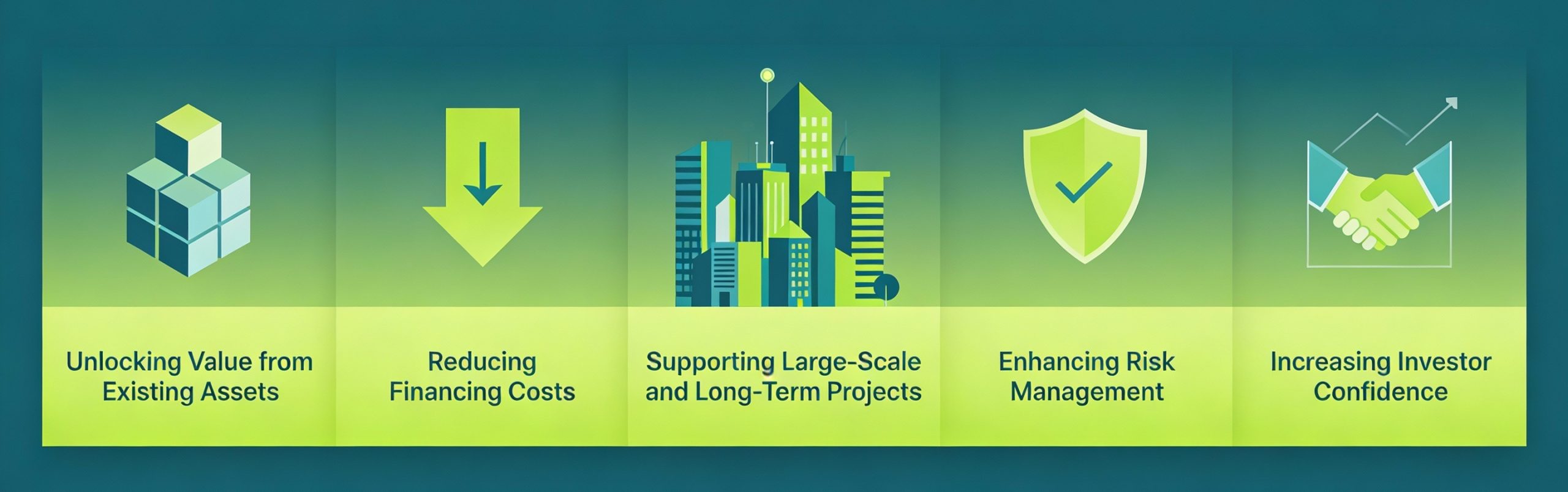
Unlocking Value from Existing Assets
Many companies sit on valuable assets—such as mortgages, invoices, equipment, and receivables—that are often underutilized. Structured finance allows these assets to be converted into tradable financial instruments. For instance, receivables securitization helps businesses convert invoices into instant cash. This method generates liquidity without taking traditional loans, reducing dependency on banks.
Reducing Financing Costs
The interest rates charged to traditional loans are quite high compared to businesses that have unpredictable streams of income or have capacities that are large. Financed Structured finance is the best method of minimizing the cost of funds raised by spreading the risk among various investors. With credit enhancements, guarantees, and asset pools, companies are able to acquire loans at a reduced interest rate.
Supporting Large-Scale and Long-Term Projects
Other megaprojects in infrastructure, energy, or telecommunication have long-term need of finance that the traditional lenders might be reluctant to advance because of riskiness. Structured finance allocates risk through different instruments and hence the business can find it easy to attract investment and get funding to their multi-year projects without overburdening the balance sheets.
Enhancing Risk Management
Structured finance is designed to distribute the risk to the willing investors who are likely to bear them and cover the generating business. Indicatively, firms can insure themselves against any possible losses through tranching (division of securities into varying levels of riskiness). This makes the funding smarter, safer and more scalable.
Increasing Investor Confidence
Structured finance increases transparency and credibility by employing well-controlled instruments supported by real assets or streams of income. These instruments are more appealing to investors because of the apparent distribution of risks and high standards of governance. Consequently, firms have the ability to draw in varied sources of investment and raise capital with ease.
In Conclusion
Structured finance management provides a powerful instrumentation of companies to liberate the concealed asset worth, reduce risks and obtain capital in a smarter way than ever before. It also gives organizations the strength to invest in expansion, implement extensive projects, and be assured of going through turbulent markets. Structured finance is not an option at the age of capital efficiency, but a tactical requirement on the business growth of the present-day age.
Also Read: Investment Banking: Powering the Financial Ecosystem